
Editorial
Writing
Research-backed stories and practical guidance on AI adoption, tools, costs, and the work of putting them into production.
The deck says everyone. Census says 18%. The denominator is the story.
McKinsey finds nearly nine in ten survey respondents report AI use somewhere in their organizations. Census finds 18% of U.S. firms use AI in a business function. Both can be honest. They are not counting the same population.
Gary Stanton · September 5, 2026

The Productivity Gap Is Real: What Happens When Your Competitor Adopts AI First
By April 2026, the gap between companies that deployed AI six months ago and those just starting is already permanent. Here's why catching up later doesn't work, and what to do Monday morning.
Dana Whitfield · April 9, 2026

Five AI Patterns Your Teams Are Already Running — Here's What Changes Monday
Your finance team just built an AI agent without telling you. This isn't a pilot anymore — it's how work happens now. Here are the five operational patterns reshaping production, and what you actually need to do.
Dana Whitfield · March 17, 2026

The Three-Layer ROI Framework: Why Most AI Projects Fail Before They're Measured
Companies measuring AI ROI the wrong way kill good projects and overfund bad ones. Here's how operators at scale separate signal from noise.
Dana Whitfield · March 15, 2026
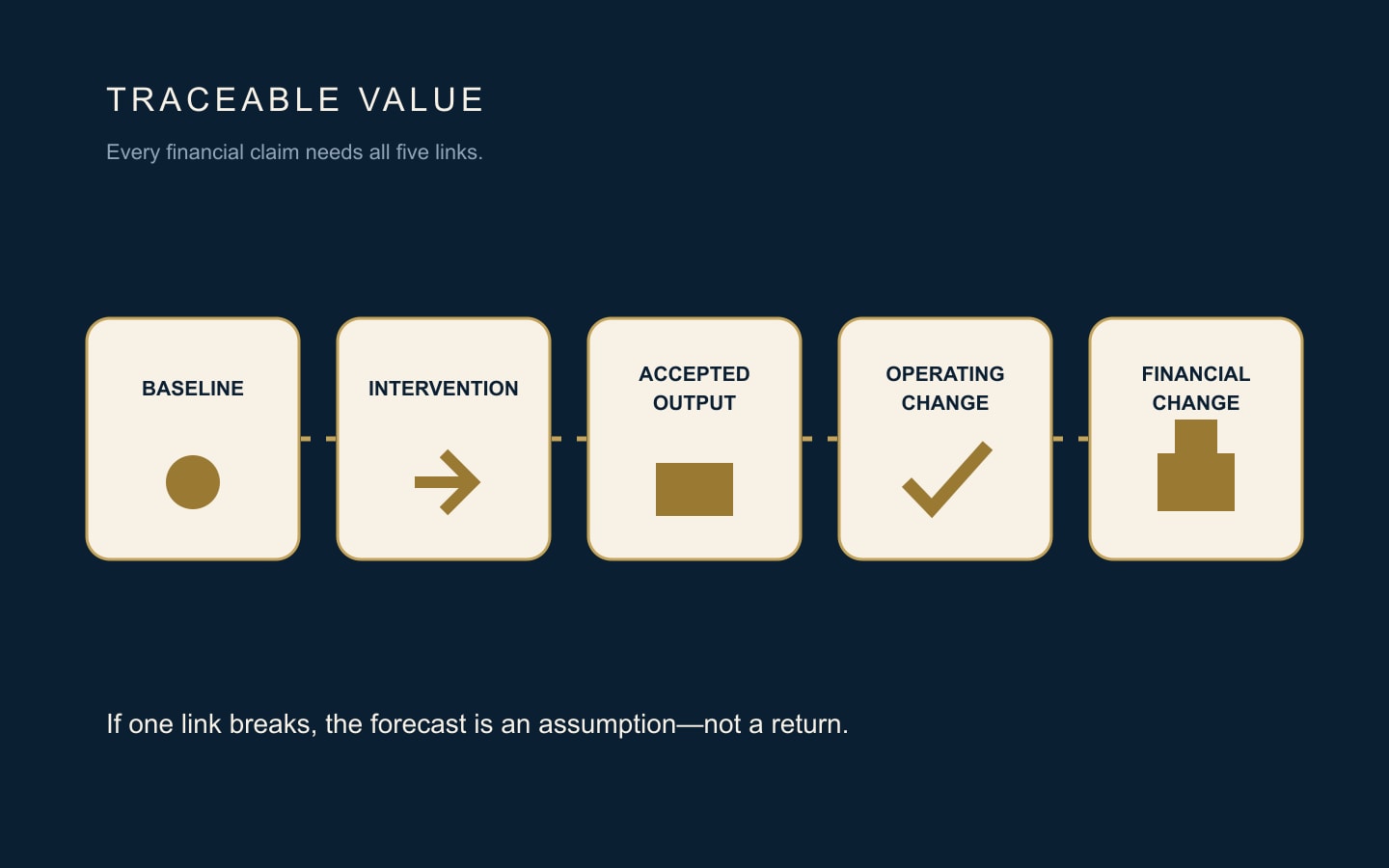
How to Build an AI Business Case Your CFO Can Audit
A defensible AI business case starts with one constrained workflow, a measured baseline, and claims finance can trace. Use this model to price capacity, quality, risk, and the cost of review.
Dana Whitfield · March 3, 2026
Your Forecast Is a Fiction — Here's How to Rebuild It Before Thursday
Most sales managers know their forecast is wrong but fix it by interrogating reps harder. The real fix is a three-layer system that replaces gut feel with behavioral signals, starting with the data rot underneath.
Dana Whitfield · March 3, 2026
The One-Tool Rule: How to Add AI to a Founder-Led Business Without Losing Your Week
Most founders try six AI tools, stick with none, and lose a month. The One-Tool Rule forces a different sequence: find your worst time leak, fix it with one tool, then expand only after the habit holds.
Dana Whitfield · March 3, 2026
AI for CFOs: Automating the Finance Work That Used to Eat Your Week
CFOs are quietly using AI to automate variance analysis, board reporting, and forecasting. Here's exactly what they're using and how.
Dana Whitfield · March 3, 2026
Your Marketing Org Chart Is Lying to You — Here's the Operating Model That Replaces It
Most CMOs are bolting AI tools onto a broken operating model. The ones pulling ahead have rebuilt how decisions, content, and budget allocation actually flow through their teams.
Dana Whitfield · March 3, 2026
Sequencing AI Investments by What Hurts Your Customers First
Illustrative scenario: a 200-SKU brand spends its quarterly AI budget on personalization before fixing a visible support bottleneck. The Bleed-First Framework sequences investment by measured operational damage rather than the strongest vendor pitch.
Dana Whitfield · March 3, 2026
The Intake Problem That Rewires How Small Firms Think About AI
Most small law firms approach AI as a tool question — which product, which feature, which price. The ones pulling ahead treat it as a capacity question, and the difference reshapes the entire practice.
Dana Whitfield · March 3, 2026
The Healthcare AI Decision Rubric Your CFO Actually Needs
Most health systems evaluate AI the same way they evaluate EHR upgrades — committee meetings, vendor demos, and hope. A sharper filter exists: the Three-Gate Rubric separates the 90-day wins from the five-year money pits.
Dana Whitfield · March 3, 2026
The Solo Advisor Capacity Problem AI Actually Solves
A solo RIA in Scottsdale went from drowning at 90 clients to comfortably managing 130 — not by hiring, but by restructuring her week around a three-phase AI workflow. Here's the framework she used and the specific tools that made it work.
Dana Whitfield · March 3, 2026
Notion AI vs Obsidian: Name Your Bottleneck, Then Pick Your Tool
Most teams agonize over Notion vs Obsidian as if it's a feature shootout. The real decision is simpler: figure out whether your bottleneck is organizational or cognitive, then commit for 90 days.
Pete Callahan · March 3, 2026
The CRM AI You're Paying For vs. the CRM AI Your Reps Actually Open
A 25-person sales team ditched Salesforce Einstein for HubSpot AI — not because the tech was worse, but because nobody had ever configured it. Here's the framework that would have saved them six months.
Pete Callahan · March 3, 2026
The AI Assistant You're Paying For Is Probably the Wrong One
A five-task stress test reveals which model earns a paid seat for your work
Pete Callahan · March 3, 2026
Copilot Handles the Boilerplate. Cursor Handles the Architecture. Here's the Decision Matrix.
After running both AI coding assistants on production work for six months, our team landed on a two-tool workflow nobody planned for — and a decision framework that maps to exactly three variables.
Pete Callahan · March 3, 2026
The 70% Draft Problem: How to Make Claude Do the Thinking You Keep Postponing
Most teams treat Claude like a search engine with manners. A simple diagnostic framework reveals whether your AI prompts are generating real first drafts or just polished filler you'll rewrite anyway.
Pete Callahan · March 3, 2026
The Draft-Then-Judge Stack: Why Two Cheap Tools Beat One Expensive AI Writer
Separating drafting from judgment is the core idea: use one tool to produce, another rubric-driven pass to challenge it, and a human editor to make the final call.
Pete Callahan · March 3, 2026
Your Team Already Has ChatGPT Logins. Here's Why Nobody's Using Them.
Most teams signed up for ChatGPT months ago. Seats are paid, logins are active, and usage dashboards show near-zero adoption. The fix isn't more training—it's giving people a repeatable prompt structure and one workflow to prove it works.
Pete Callahan · March 3, 2026

How AI Is Collapsing Sales Cycles: What's Actually Happening in 2026
A mid-market SaaS company closes deals 3–4 calls earlier using AI conversation analysis. This isn't productivity theater. It's a structural shift in how sales organizations work. Here's what's changing, and what you need to do about it.
Jules Marchetti · November 15, 2025

Zapier vs Make: The Decision Your Ops Team Will Make Three Times
Feature checklists are identical. Mental models aren't. Here's why picking the wrong platform costs you more in iteration friction than it saves in setup time.
Jules Marchetti · November 8, 2025

The RevOps Playbook: Stop Building AI Systems Nobody Uses
Illustrative scenario: a SaaS company spends six months building a lead-scoring model that sales representatives ignore. The point is the adoption failure, not a claimed customer engagement.
Dara Keating · November 1, 2025

GitHub Copilot After 6 Months: The Productivity Trap
One fintech team's code velocity jumped 34% after deploying Copilot. Then their security audit found 47 credential-handling violations. The real problem wasn't the tool—it was optimizing for the wrong metric.
Jules Marchetti · October 25, 2025