
How AI Is Collapsing Sales Cycles: What's Actually Happening in 2026
A mid-market SaaS company closes deals 3–4 calls earlier using AI conversation analysis. This isn't productivity theater. It's a structural shift in how sales organizations work. Here's what's changing, and what you need to do about it.
Published November 15, 2025· Updated Sep 16, 2026

A mid-market SaaS company with 40 sales reps implemented an AI conversation analyzer six months ago. No one got fired. No quotas doubled overnight. But when the VP of Sales ran the numbers, she noticed something odd: her reps were closing deals 3–4 calls earlier than before. The discovery conversations that used to sprawl across weeks had compressed. Reps were asking different questions—sharper ones, arriving later in the conversation. The AI wasn't replacing judgment. It was removing the tax on bad judgment. The wasted time. The missed signals. The meetings that should never have happened.
This pattern is now repeating across B2B sales organizations. Not as sudden productivity gain. But as a series of small reorientations that compound. Over the past 18 months, more AI has been woven into the sales function than in the previous decade combined. The shift isn't about working harder or faster. It's about walking into conversations with information that didn't exist before.
For revenue leaders, the signal-to-noise ratio is brutal. Every vendor claims their tool makes reps 30% more productive. Most of this is marketing. But underneath the noise, a concrete structural change is reshaping what separates a good sales organization from a great one. And it's not what most people think.
The Hidden Problem: You're Still Playing the Old Game
Most sales organizations still operate on a 2010s assumption: reps are information-gathering machines. Their job is to understand the customer's business, competitive landscape, budget constraints, stakeholder map. This was always hard work. Reps spent weeks in discovery, building knowledge through conversations and institutional memory. The best reps were researchers.
What's changing isn't that reps need less knowledge. It's that the knowledge now exists before the conversation starts. AI tools ingest every signal about a prospect—financials, recent hires, technology stack, earnings calls, job postings, website changes, funding, news—and surface what matters. The rep no longer discovers the customer's world. The rep walks in already understanding it.
This inverts the traditional sales skill hierarchy. The reps struggling aren't necessarily bad at relationships or negotiation. They're struggling because they're playing a game that no longer exists—the game where gathering information was the primary job. Most organizations haven't reorganized around this fact.
The Reframe: Sales Is Splitting Into Two Distinct Phases
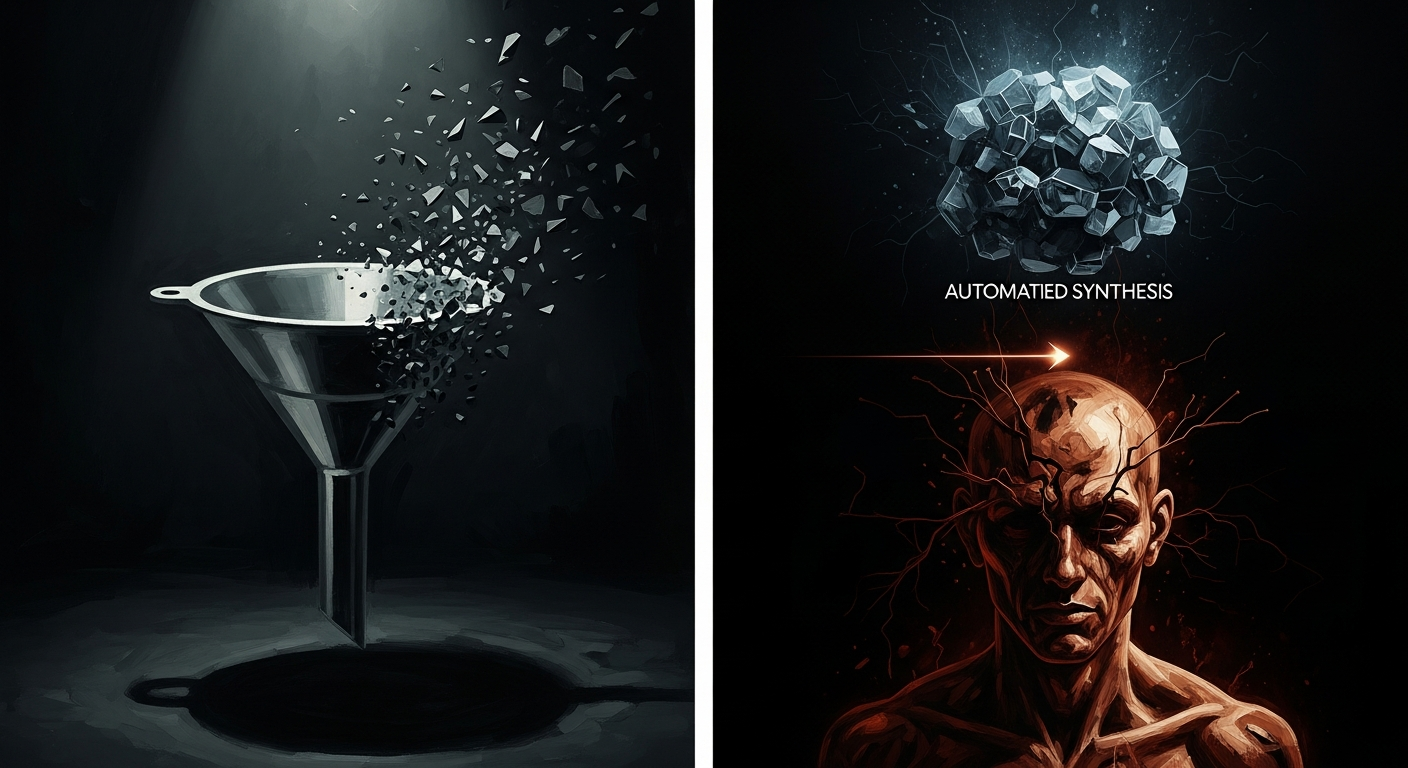
Sales in 2026 is no longer a single motion. It's two.
Phase one—prospect identification and insight synthesis—is becoming almost entirely automated. AI tools are now comprehensive and cheap enough that the traditional discovery call is becoming redundant. By the time a rep talks to a prospect, the prospect's problem, budget window, competitive situation, and stakeholder map are already mapped. Reps (or in some cases, automated workflows) do this work before human engagement begins.
The automation layer a founder can see
Branching scenarios. You still own the graph.
We may earn a commission · editorial verdicts remain independent
Phase two—execution—is where human sales skill now lives. Moving from insight to action: building consensus, negotiating terms, handling objections, closing. This always required humans. Now it's the only phase that does.
Teams winning right now have internalized this split and rebuilt their entire motion around it. They're not asking how to make discovery faster. They're asking how to compress it entirely and allocate their best reps exclusively to execution. This is the inversion most organizations haven't made yet.
What's Actually Changing: Four Concrete Shifts
1. Pre-Call Intelligence Is Now Table Stakes
A year ago, having pre-call research was a competitive advantage. Now it's baseline. Companies using Apollo, Clearbit, Gong's Forecast, or Salesloft start every conversation with synthesized intelligence: the prospect's role, recent company moves, trigger events, likely stakeholders, competitor landscape.
A rep at a B2B software company now starts a call knowing not just that the prospect's company hired a new CTO, but what the CTO's previous company was, what infrastructure decisions they made there, and what inherited problems they're likely managing. This isn't inference. This is pattern matching at scale, happening in seconds instead of hours.
What matters operationally: if your team doesn't have this yet, it's the first thing to implement. Not because it's flashy. Because it's the foundation for everything else.
2. Conversation Intelligence Is Moving Into the Call Itself

A year ago, tools like Gong and Chorus were post-call coaching. You'd record, analyze, find where the rep missed the budget question, then debrief. Valuable. Not transformative.
Now these tools are flowing into the call itself. Real-time prompts appear in the rep's UI: "Prospect mentioned ROI three times. Ask about payback period." Or: "Competitor mentioned. Play back differentiation." Some tools offer live transcription with AI-generated suggestions flowing in during conversation. A rep glances at their screen and sees: "Objection pattern detected. Use angle B."
This is subtle and massive: the variance between your best reps and average reps is collapsing. The gap was always pattern recognition—knowing which questions matter, which moment to push. The AI handles pattern recognition. The human handles judgment. Your weak reps suddenly stop doing predictable things wrong.

3. Pipeline Forecast Became Predictive
For decades, pipeline forecast was lagging indicator built on rep gut, deal stage, and historical hunches. And it was wrong often.
Now the AI watches every conversation, email, and touchpoint and produces real-time close probability. Not gut. Not stage-based assumption. Algorithmic prediction based on conversation patterns, engagement velocity, and your historical outcomes.
A VP at an enterprise software company told us: "Our forecast used to be a political document. Now it's information. We know which deals actually close. Which means we allocate executive time where it matters." This sounds like a forecasting fix. It's actually a repriorization of the entire sales organization.
4. Deal Execution Is Becoming Async
For years, sales happened synchronously. Schedule a call, rep and prospect show up, negotiate. This created a bottleneck. A deal with four stakeholders meant four meetings, plus email delays, plus waiting for decision-makers.
AI is making deal execution async. Dynamic proposal tools now respond to prospect behavior in real time. A prospect views implementation timeline twice? The system flags that timeline is the sticking point. Next version adjusts. Reps can work multiple deals simultaneously without the meeting bottleneck collapsing them.
What to Do on Monday Morning
- Audit your sales motion for discovery tax. Map every rep's average sales cycle. Identify which calls are exploratory versus closing. You're looking for the calls that should be eliminated entirely. This is your compression target.
- Implement pre-call intelligence for all active deals today. Choose one tool (Apollo or Clearbit for basic work, or a broader platform like Gong's Forecast). Don't wait for perfect. Get reps access to synthesized prospect intel before every call. This is the foundation.
- Enable real-time conversation assistance on your next 10 deals. If you're using Gong, Chorus, or Squadcast, turn on real-time prompts. Let reps experience the difference between calling with pattern recognition and without. This should feel like suddenly having your best rep in the room.
- Run one forecast test. Take your next 20 deals and compare your rep's stage-based probability estimate to your AI tool's algorithmic prediction. Track which actually closes. The gap between rep instinct and AI prediction will be your signal for how much repriorization is possible.
- Redesign commission structure for execution-only. If you're automating discovery, you need to stop paying reps for discovery work. Shift compensation entirely to deal closure and expansion. This forces the organizational pivot to happen.
The Structural Advantage Isn't Speed. It's Elimination.
The sales organizations pulling away right now aren't the ones that made their reps 30% faster. They're the ones that eliminated entire phases of work and reallocated human judgment to the one place it actually matters: turning qualified opportunities into closed deals.
The game changed. Most organizations are still playing to win at the old game.
The automation layer a founder can see
Branching scenarios. You still own the graph.
We may earn a commission · editorial verdicts remain independent
Weekly Newsletter
AI Adoption Weekly
New research, field guides, training studies, and tool decisions for operators.
No spam. Unsubscribe anytime.
Related Comparisons
Calculator
AI seat cost calculator
List price × headcount. You enter the hours and the operating assumptions.