
Voice AI Can Now Work Across Apps. A Service Team Still Needs a Recovery Plan.
New live voice models and connected-app controls make longer service tasks feasible. The operator’s test is resolution, escalation, and a clean recovery when the spoken request goes wrong.
Published September 24, 2026

A customer calls about an address change on an order that is already moving. The voice assistant hears the request, looks up the shipment, and speaks naturally. Then it changes the wrong address. The customer calls back, and a human agent spends ten minutes repairing the record. The first call sounded excellent. The service outcome was worse. That gap is the test for the new generation of voice AI.
The recent capability shift
Google introduced Gemini 3.8 Live and Live Extended Thinking on September 15 for real-time dialogue and multistep tasks; its developer materials describe live models that can reason and act while maintaining a conversation. On September 23, OpenAI said ChatGPT Business users could use plugins and connected apps during Voice conversations, with existing workspace permissions and action restrictions still applying. These are different products and surfaces: Google offers models for builders, while OpenAI describes a workplace feature. Neither announcement is proof that an unsupervised contact-center deployment will resolve more customer issues.
The improvement is worth attention because it reduces the old gap between speech and work. A voice system can listen, ask a clarifying question, consult a permitted system, and continue the task. That is much more useful than transcribing a call into another queue. It also adds failure points: recognition, identity, permissions, tool state, business rules, and final confirmation.
Separate three service jobs
Information-only calls are the easiest first lane: hours, status, policy, and product facts from a maintained source. Assisted-agent calls keep a person on the line while AI retrieves or drafts. Action-taking calls change a record, issue a credit, schedule a visit, or cancel something. The third lane needs identity checks, explicit confirmation, transaction logging, and a clean rollback path. Do not score all three with one containment rate.
A useful pilot starts with a single action such as updating a delivery preference before cutoff. Define the cutoff, which orders are eligible, the system of record, and what the caller must confirm. If the system cannot verify identity or the order is already out for delivery, the correct outcome is a clear handoff—not a guessed success.
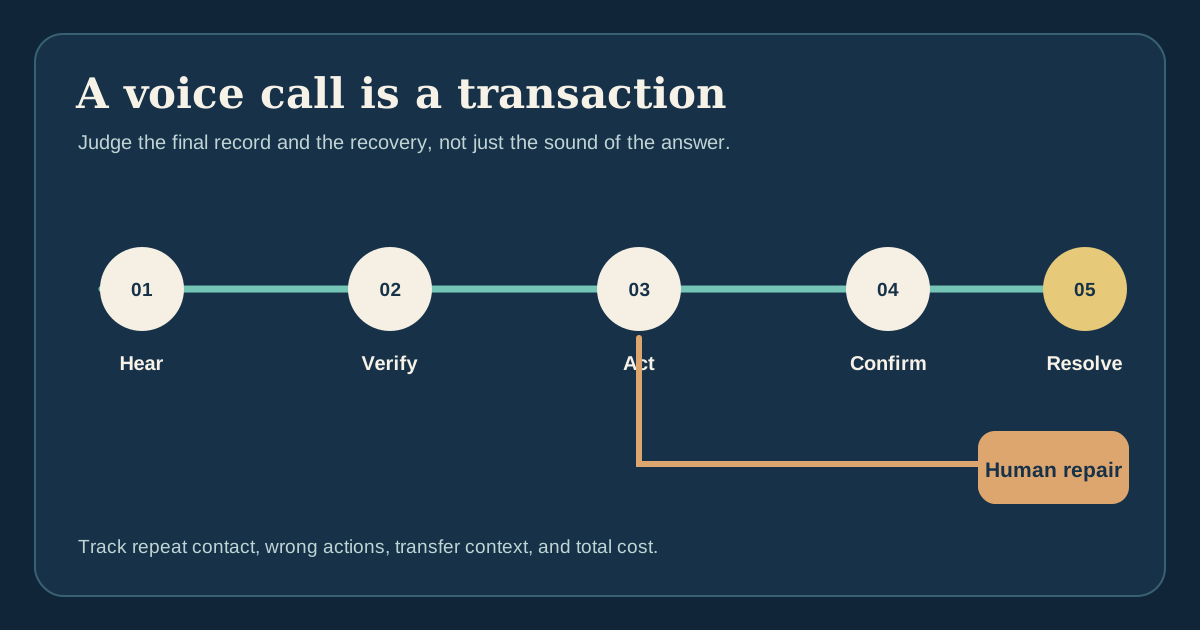
- Resolution: Did the requested outcome happen, and did the customer avoid repeat contact for a defined period?
- Accuracy: Was the right record changed with the correct details and customer confirmation?
- Escalation: Did the handoff include the issue, verified context, and attempted steps?
- Experience: Did callers understand that they were speaking with an AI system and how to reach a person?
- Economics: What was the combined cost of model time, telephony, tools, human rescue, and remedy?
Run a failure rehearsal before a live queue
Use fifty recorded or scripted requests that cover ordinary cases, interruptions, background noise, accents, two people speaking, outdated order data, and ambiguous consent. Include at least ten cases where the correct answer is “I cannot complete that action.” Have service leads grade the final record, not only the transcript. Check whether a human receiving an escalation can finish without asking the caller to start over.
Google reports strong speech and agent-task benchmark results for its new models. Those figures help decide which technology to trial. They do not include your call mix, authentication process, order system, remedy policy, or customer expectations. A natural voice can be actively misleading if it makes an unsupported promise sound settled.
The decision rule
Pilot one narrow queue for two to four weeks. Compare it with the same category handled by the current team, including repeat calls and work transferred to humans. Set a hard stop for unauthorized changes, material misinformation, or a broken escalation path. Track the tail of the distribution: the slowest and most difficult cases often create the cost and harm that an average handle-time chart hides.
The skeptical reading is simple: better conversation is not better service. The next signal to watch is verified resolution without repeat contact, at an acceptable total cost and with an escalation a person can actually work. If that moves, voice AI has become an operating improvement rather than a better-sounding front door.
Primary sources
- Google: Gemini 3.8 Live models — September 15 launch and benchmark context.
- Google: audio models for developers — Real-time dialogue and action capabilities.
- OpenAI: ChatGPT Business release notes — September 23 voice plugins and continuing workspace controls.
Put this to work
- Workflow evaluation training — Plan matched cases, quality checks, and escalation rules.
- AI ROI decision lab — Include repeat contacts and human review in the economics.
Weekly Newsletter
AI Adoption Weekly
New research, field guides, training studies, and tool decisions for operators.
No spam. Unsubscribe anytime.
Related Comparisons
Calculator
AI seat cost calculator
List price × headcount. You enter the hours and the operating assumptions.