
Six Months of Better AI Models: What Actually Changed for Business Teams
The spring-to-fall model releases improved computer use, professional work, and cost per task. The executive question is which workflow can now pass its acceptance test—not which benchmark won.
Published September 24, 2026

Imagine a leadership team that last tested an AI assistant in March. It drafted a respectable renewal brief, then misplaced a contract exception and needed twenty minutes of repair. The pilot stopped. Six months later, the vendor arrives with a chart showing a much stronger model. The right response is neither to reopen every rejected project nor to dismiss the chart. Retest the exact failed work. That is what the spring-to-fall improvement means for a business.
What changed between March and September
OpenAI introduced GPT-5.4 for professional work on March 5, GPT-5.5 on April 23, and GPT-6 Astra on September 3. Its release material describes improvements in multistep work, computer use, and professional artifacts such as documents and spreadsheets. Google introduced Gemini 3.8 Flash on September 2 at the same introductory price as 3.7 Flash, reporting gains in coding and multistep reasoning. Anthropic introduced Claude Opus 5.5 on September 22, reporting performance near its higher-tier Fable 5.1 on most work and about 40% lower typical workload cost than Opus 5. These are provider reports, not a single independent comparison.
Four changes matter operationally: models can carry more of a task across tools; they can produce more usable business artifacts; some capable options cost less per completed task; and voice or computer interaction broadens the work they can touch. The unit of purchase is moving from a clever answer to an accepted piece of work. That shift makes review, permissions, and recovery more important, not less.
The retest rule: revive a failed workflow, not a prompt demo
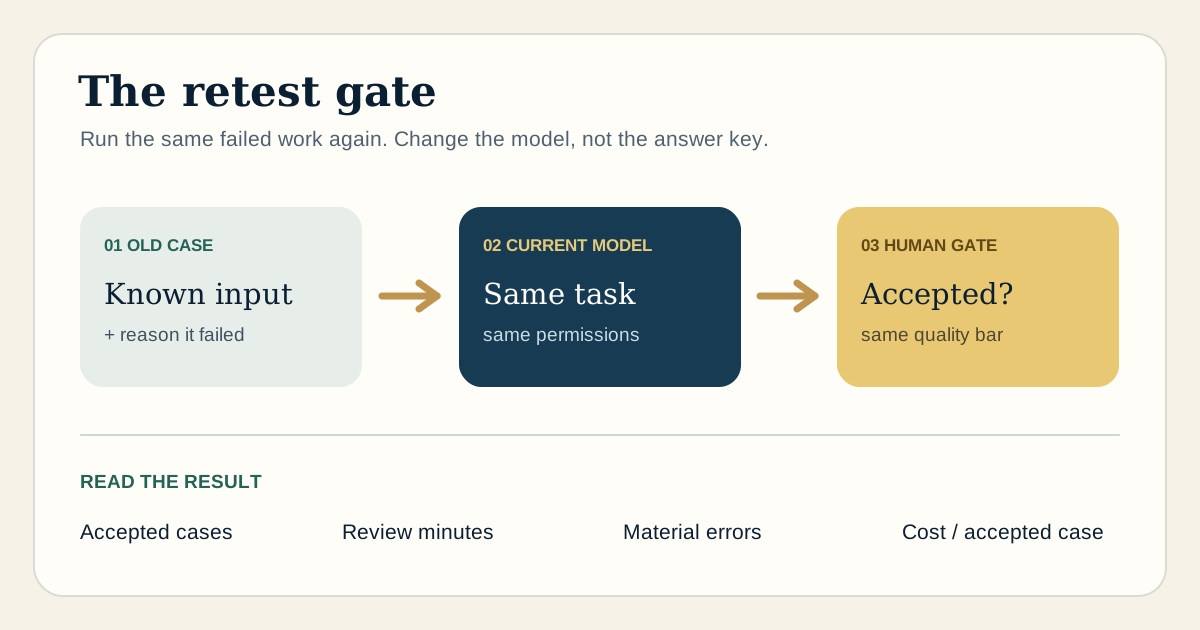
Find three tasks your team tried and rejected earlier this year. Keep the old input, the accepted answer, the reasons for failure, and the time it took a person to fix the result. Run the current candidate models on the same cases, with the same tool access and the same reviewer. A model that writes a prettier brief but still misses the contract exception has not changed the business decision.
A workable score is accepted outputs divided by total cases. Beside it, record median review minutes, material errors, elapsed time, cost per accepted output, and how often a person had to rescue a failed action. Record the same measures for the existing human process. This reveals whether the gain comes from better first-pass quality, faster repair, lower price, or simply a narrower test.
- Document work: ask for a source-grounded brief and check every material claim against the approved record.
- Customer service: count issues resolved without repeat contact or an avoidable transfer.
- Finance analysis: check source figures, formulas, assumptions, and whether the final decision changed.
- Software delivery: measure merged changes and incidents, not generated lines of code.
What the new benchmarks do—and do not—tell a buyer
Release benchmarks are useful for deciding what deserves a retest. They do not tell you your error rate after your policies, data permissions, integrations, and reviewers are involved. Providers also run different tools, effort settings, and safeguards. Anthropic itself says small benchmark margins have become a less reliable guide to real-world differences. Treat vendor tables as a shortlist, then evaluate each candidate on your accepted-output test.
The same distinction applies to cost. A lower token price can be overwhelmed by longer prompts, retries, additional tool calls, or expensive human review. Compare the full cost of a completed, approved case. If a stronger model halves the review time, it may justify a higher price. If it merely creates more drafts for an already overloaded approver, it may make the queue worse.
Where the business case gets stronger
The strongest candidates are jobs that previously failed for a specific model limitation: a complex document comparison, a multistep reconciliation, a software task requiring repository context, or a visual workflow that needed computer use. Jobs that failed because source data was missing, ownership was unclear, or no one could authorize the final action will still fail. Model progress does not repair a broken operating design.
Before adding seats, ask the workflow owner to name one accepted output, its current volume, and the person who signs it off. Run a two-week replay on historical cases. If the result passes quality, test it on a limited live population with a stop rule. Only then convert released time into a staffing, throughput, service, or revenue consequence. The site’s ROI decision lab can keep capacity separate from cash while you do the arithmetic.
The skeptical read
Models may improve faster than a company can change its controls. Access varies by plan and administrator setting; a benchmark model may not be the version available to your staff. Some new actions touch software and sensitive records, raising the cost of a wrong click. The September releases are a reason to reopen the evidence file, not to announce a return before the first accepted case.
Watch one number over the next quarter: the share of eligible work completed to the old quality standard, at a lower total cost or faster end-to-end time. If that number moves, the six-month model advance has reached your business. If only the demo moves, it has not.
Primary sources
- OpenAI: Introducing GPT-5.4 — March 5 release and professional-work claims.
- OpenAI: Introducing GPT-5.5 — April 23 release and task-completion claims.
- OpenAI: GPT-6 Astra — September 3 model, availability, and reported evaluations.
- Google: Gemini 3.8 Flash — September 2 release and introductory pricing.
- Anthropic: Claude Opus 5.5 — September 22 performance, cost, and benchmark caveats.
Put this to work
- AI ROI decision lab — Model accepted volume, review time, and full cost.
- Business-case worksheet — Turn the retest into a funding decision.
Weekly Newsletter
AI Adoption Weekly
New research, field guides, training studies, and tool decisions for operators.
No spam. Unsubscribe anytime.
Related Comparisons
Calculator
AI seat cost calculator
List price × headcount. You enter the hours and the operating assumptions.