
How to Use AI for a Quality of Earnings Review That Holds Up in a Deal
A practical system for using AI in M&A quality of earnings: source records, adjustment tests, cash conversion, industry examples, audience-specific outputs, and a worked EBITDA bridge.
Published October 6, 2026
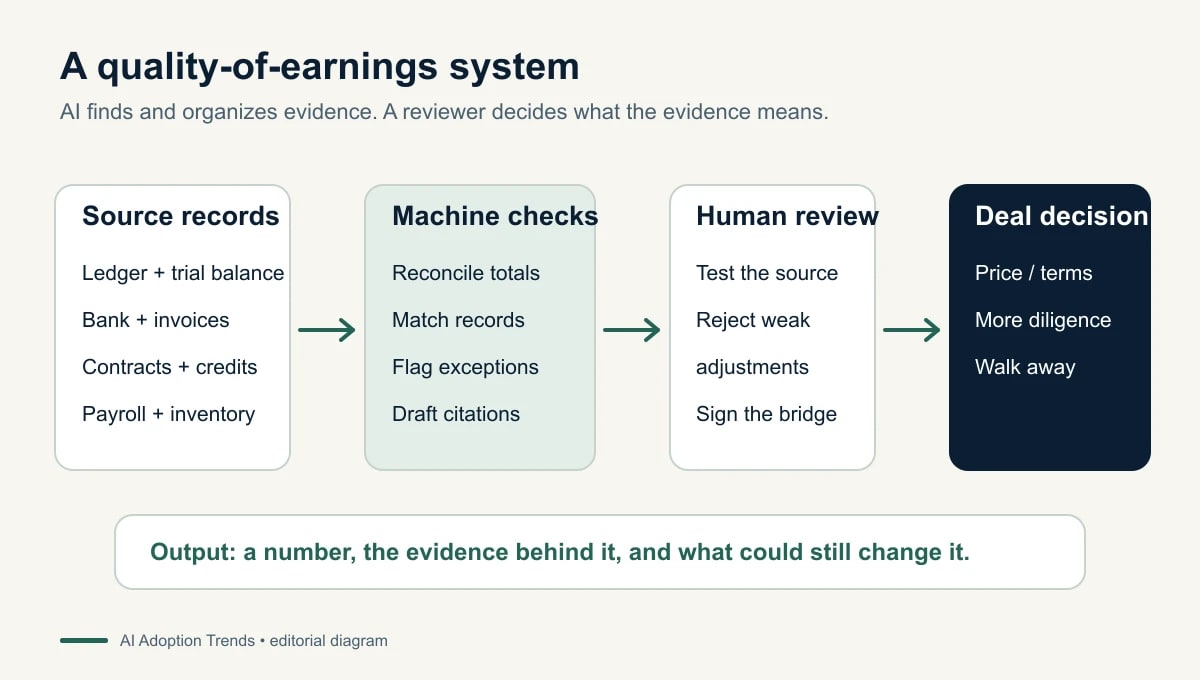
A buyer can be shown $3 million of earnings and still not know what it is buying. Revenue may have been booked before the work was done. A cost called “one-time” may come back every year. A profitable month may have produced no cash. A quality-of-earnings review asks which earnings are supported, repeatable, and likely to survive the ownership change. Artificial intelligence can make the review faster and wider, but only if it produces a trail from each conclusion back to the underlying record.
This guide is for a buyer deciding what to pay, a seller preparing for diligence, a lender sizing debt, and an operator inheriting the business. It gives each a different output. The examples are constructed, in US dollars, and use US generally accepted accounting principles (GAAP) as the default frame. Where an International Financial Reporting Standards (IFRS) source illustrates a general principle, the engagement team must apply the company’s actual accounting framework. Nothing here creates an audit opinion or replaces the transaction team’s independent work.
What a useful review has to explain
The useful output is not a single “normalized EBITDA” number. Earnings before interest, taxes, depreciation, and amortization (EBITDA) is a starting performance measure. The review should show how reported results tie to the books, why each proposed change belongs in or out, whether earnings turned into cash, how much working capital the business normally needs, and what could break the next year. The AICPA’s valuation guidance describes normalized earnings as removing nonrecurring, noneconomic, or other unusual items to make periods comparable. That description does not bless any particular add-back.
For a public company, the SEC’s non-GAAP guidance warns that excluding normal recurring cash operating costs, applying adjustments inconsistently, or removing losses while keeping similar gains can mislead investors. Private deal negotiations have different disclosure rules, but those are excellent challenges to put to a seller’s bridge. State the accounting correction separately from a deal normalization and separately from a forward forecast. Never quietly merge all three.
Start with a source map, then prove the totals
Ask for monthly trial balances and general-ledger detail for at least the trailing 12 months, preferably 24 to 36 months where seasonality or customer mix matters. Add bank statements, customer and vendor subledgers, invoices, credit memos, contracts and amendments, payroll, inventory or job-cost records, tax returns, and the management reporting package. Record the accounting basis, fiscal calendar, entity perimeter, currency, data owner, export date, and whether each file is complete. A missing subsidiary or a changed chart of accounts can make a polished AI summary meaningless.
The first machine task is deterministic: recompute sums, map accounts, compare trial balance to the general ledger and management accounts, tie beginning and ending balances, and report every unexplained difference. Preserve the original files and hashes. Let AI propose account mappings or explain unusual labels, but make code or spreadsheet formulas perform the arithmetic. The PCAOB’s audit-evidence standard requires auditors to assess the accuracy and completeness of company-produced information. A deal review is not an audit; the same evidence discipline is useful because a model cannot repair an incomplete export.
- Minimum gate: the monthly profit-and-loss statement ties to the trial balance, and the trial balance ties to the period-end balance sheet. List every reconciling item, its owner, amount, and resolution.
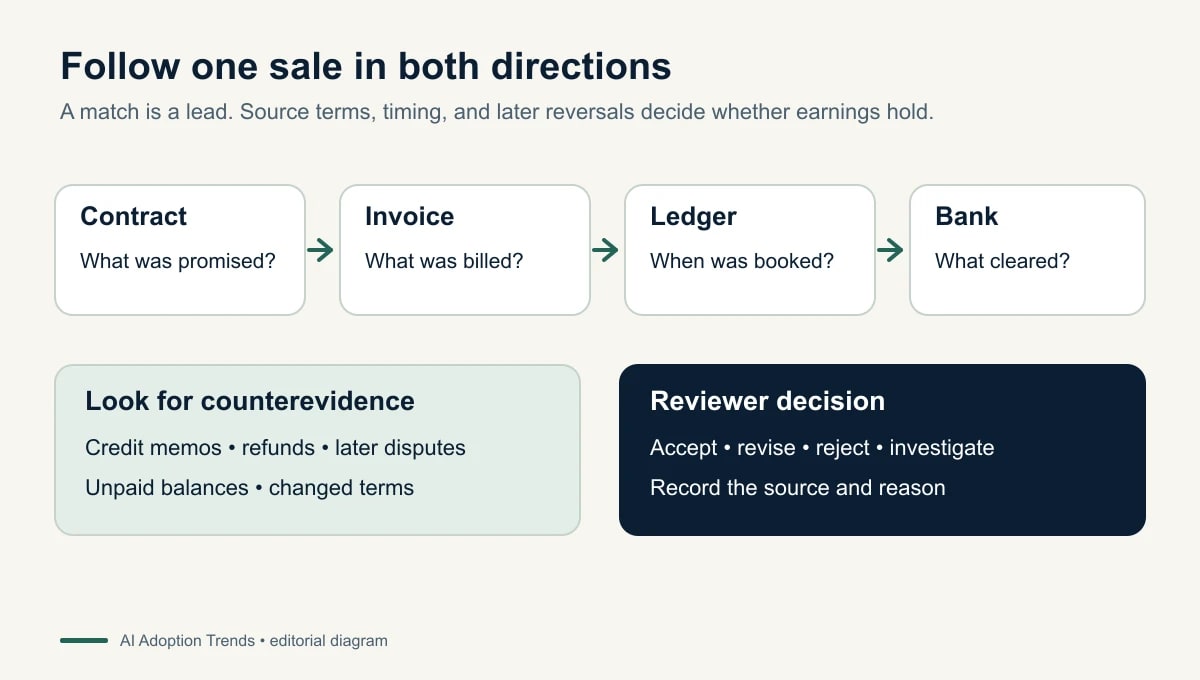
- Revenue gate: invoice, credit memo, contract, delivery or service record, general-ledger entry, and later collection can be joined by stable identifiers. Sample the largest and the oddest exceptions manually.
- Cash gate: bank balances and statements tie to the cash ledger; receipts and disbursements around period-end are assigned to the right entity and period.
- Change gate: save mapping rules and rerun them when a new file arrives. A silent manual remap destroys comparability.
Give AI narrow jobs with visible evidence
A strong workflow gives a language model documents to read and a constrained answer format: record ID, extracted term, source page or row, confidence flag, and reason for review. Good tasks include identifying renewal and cancellation clauses, grouping expense descriptions, finding duplicate invoices, drafting a list of period-end journal entries, comparing customer names across systems, and summarizing a reviewer’s resolved exceptions. It should not invent a “reasonable” EBITDA adjustment from a seller memo.
For each candidate adjustment, require five fields: original ledger amount, proposed signed change, supporting documents, whether the economic event recurs, and the reviewer’s decision. Add a link to counterevidence—such as a later credit memo or an invoice for the supposedly finished project. A model-generated explanation without a source is an unanswered question, not a finding. The PCAOB standard also notes that evidence from an independent knowledgeable source is generally more reliable than evidence only from the company, and that inconsistent evidence calls for more procedures. Use that as a design principle, not a claim that the AI work is an audit.
Put confidential deal data in an approved environment. Limit access by role, retain prompt and output logs only for the agreed period, and confirm whether a model provider may use submissions for training or other purposes. The FTC’s vendor-security guidance recommends specific contract terms, limited access, and verification of vendor controls; its AI confidentiality discussion describes the sensitivity of financial data sent to model services. Redaction helps but can remove the customer or contract identifiers needed to test the transaction, so design the secure workspace first.
A prompt that earns its place
Example instruction to an approved document model: “For each contract amendment, return contract ID, effective date, affected product or service, changed price, changed acceptance or cancellation terms, exact source page, and any conflict with the invoice or revenue schedule. Use UNKNOWN where the source is silent. Do not decide accounting treatment. Output JSON only.” A reviewer checks a sample against the originals and corrects the extraction rule before using it across the population. The point is to turn 400 documents into 40 reviewable exceptions, not to turn 400 documents into one confident paragraph.
Test revenue before debating add-backs
A reported sale is not automatically earned revenue. Under the FASB’s Topic 606 overview, recognition depends on the contract, distinct promises, transaction price, allocation, and satisfaction of the performance obligation. Variable consideration, modifications, and timing matter. AI can locate clauses and compare them with schedules, but a qualified reviewer decides how the company’s policy applies. The IFRS 15 overview gives the parallel five-step framework for IFRS reporters.
Run three cuts. First, a period-end cutoff: list invoices and manual revenue journals booked in the last and first weeks of each month or quarter, then compare service dates, shipping or acceptance evidence, credits, and cash received later. Second, a customer cohort: compare monthly billed, recognized, credited, collected, and outstanding amounts by customer and product. Third, concentration: identify the few customers, products, contracts, or projects responsible for the earnings increase. Do not assume an outlier is wrong; require its documents.
Example: a $240,000 annual software contract is billed on December 20 and service begins January 1. Billing creates a receivable and ordinarily a contract liability before service, while the service is recognized over the applicable period under the actual contract and policy. An AI system can flag the difference among signing, billing, cash, and service start. It cannot decide the recognition answer from an invoice date alone. This is an illustrative case, not a finding about a company.
Build an adjustment bridge that can be challenged
Take a constructed business with reported EBITDA of $3.00 million. The seller proposes $0.30 million of excess owner compensation after the cost of a replacement executive, and $0.20 million for a documented one-time legal settlement. The reviewer also removes a $0.10 million nonrecurring gain and finds $0.45 million of ongoing service cost that was not accrued. Supported adjusted EBITDA is $2.95 million: 3.00 + 0.30 + 0.20 − 0.10 − 0.45. A model should calculate this bridge, attach records to each line, and display unresolved items outside the total. The human team determines whether the owner replacement estimate is realistic and whether the settlement is truly isolated.
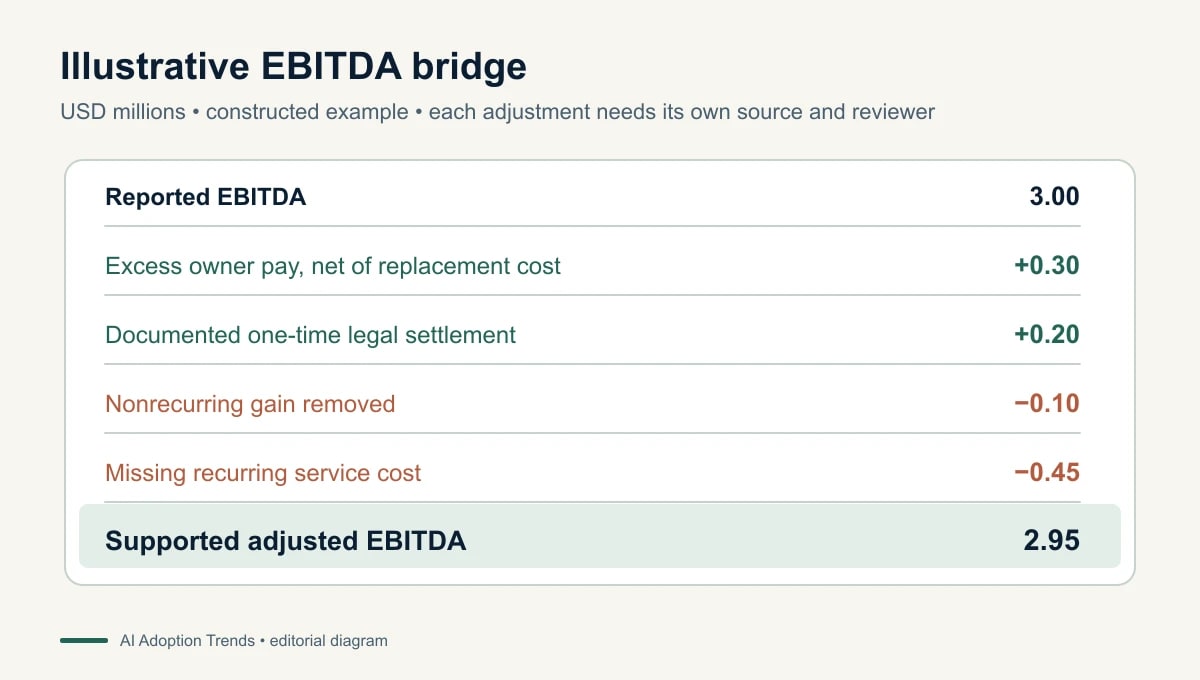
The sign matters. Removing a one-time expense raises a measure; removing a one-time gain lowers it. Under-accrued recurring cost lowers it. The SEC warns about asymmetric adjustments and recurring cash costs in public non-GAAP presentations. In a private deal, ask the same questions even when the parties are free to negotiate their own definition. If the seller calls annual recruiting fees, routine rework, or continuing cybersecurity spend “one-time,” show the past occurrences and expected future need before accepting the label.
At an illustrative six-times EBITDA multiple, the $0.55 million difference between a seller’s proposed $3.50 million and the supported $2.95 million would imply a $3.30 million difference in enterprise value, before debt, cash, working capital, taxes, and deal terms. This is sensitivity math, not a valuation conclusion. Do not multiply every possible add-back by a deal multiple before deciding whether it is supportable.
Then ask whether earnings became cash
Put the EBITDA bridge beside monthly operating cash flow, receivables aging, inventory or work in process, payables, deferred revenue, capital spending, and debt service. EBITDA excludes several cash demands. The IFRS cash-flow standard explicitly separates noncash items and changes in operating assets and liabilities when reconciling profit to operating cash flow. The exact statement classification follows the reporting framework, but the deal question is direct: what cash did the business actually need to produce those earnings?
In the same constructed example, suppose receivables rose $0.70 million, inventory rose $0.30 million, and payables fell $0.15 million, with no other reconciling items. That $1.15 million cash use takes $2.95 million of adjusted EBITDA to $1.80 million of operating cash flow in this simplified illustration. Equipment spending of $0.60 million leaves $1.20 million before financing distributions. Real statements have taxes, interest, noncash items, and other changes to reconcile; do not force them into this neat example. If a buyer must put cash back into inventory or staff after closing, the earnings multiple alone hides that demand.
A working-capital target—often called a “peg”—is a deal agreement about the level of operating current assets less operating current liabilities to be delivered at close. It is separate from earnings, though the same error can affect both. AI can produce monthly balances using the negotiated account definition and show seasonality; a deal team must decide the target, exclusions, and what happens to a shortfall. Track debt-like items separately so an unpaid tax, customer refund obligation, or seller expense does not quietly move between schedules. If the records cannot yet support that work, our finance AI buying-order guide starts with reconciliation before new forecasting tools.
Change the output for the person making the decision
Buyer: the transferable earnings packet
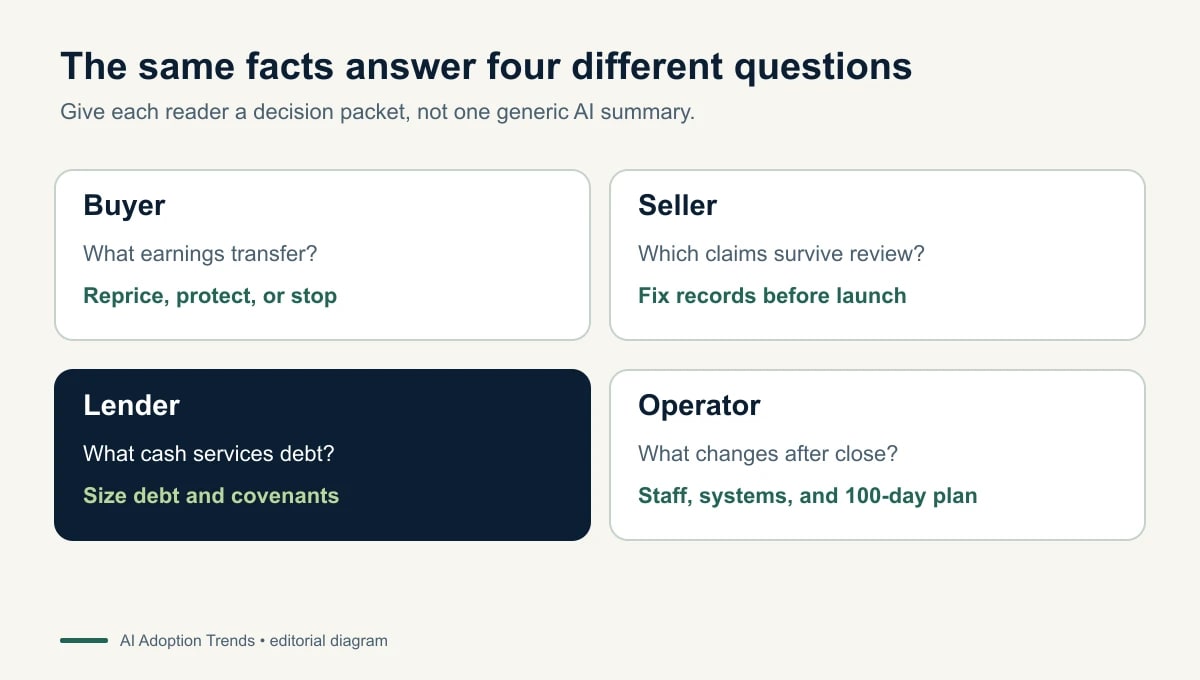
The buyer needs reported-to-adjusted earnings, downside cases, customer and supplier concentration, cash conversion, working-capital requirements, debt-like items, and a list of unanswered questions that could change price or terms. A useful AI output ranks exceptions by possible deal impact and evidence strength, not by how surprising the wording looks. The buyer should commission independent testing of the seller’s largest favorable adjustments and the last quarter’s revenue.
Seller: the challenge-ready data room
The seller needs a stable account mapping, an adjustment register with documents, consistent month-by-month schedules, an explanation of unusual swings, and known weaknesses disclosed before the buyer discovers them. AI can find missing support and conflicting contract dates early. It should not rewrite a story to make an unsupported add-back sound persuasive. If the records do not support an item, remove it or label it open.
Lender: capacity to repay in a bad month
The lender cares about actual cash available for interest and principal, a covenant definition, collateral values, concentration, seasonality, and what happens if the top customer pays late. Give it a downside bridge and debt-service schedule with explicit assumptions. Adjusted EBITDA alone cannot answer that question. AI can rerun the case for slower collections or lower margin; credit officers approve the assumptions and lending decision.
Operator: the first 100 days
The new operator needs the cost and revenue changes that will occur after closing: a founder’s replacement, customer transition obligations, systems that need repair, deferred maintenance, staff retention, and the owner of every open exception. A diligence finding should become a named action and budget. The operator may value a $50,000 recurring billing problem more than a $200,000 historical add-back because the first one will still be present on day 101.
Look back and forward with separate labels
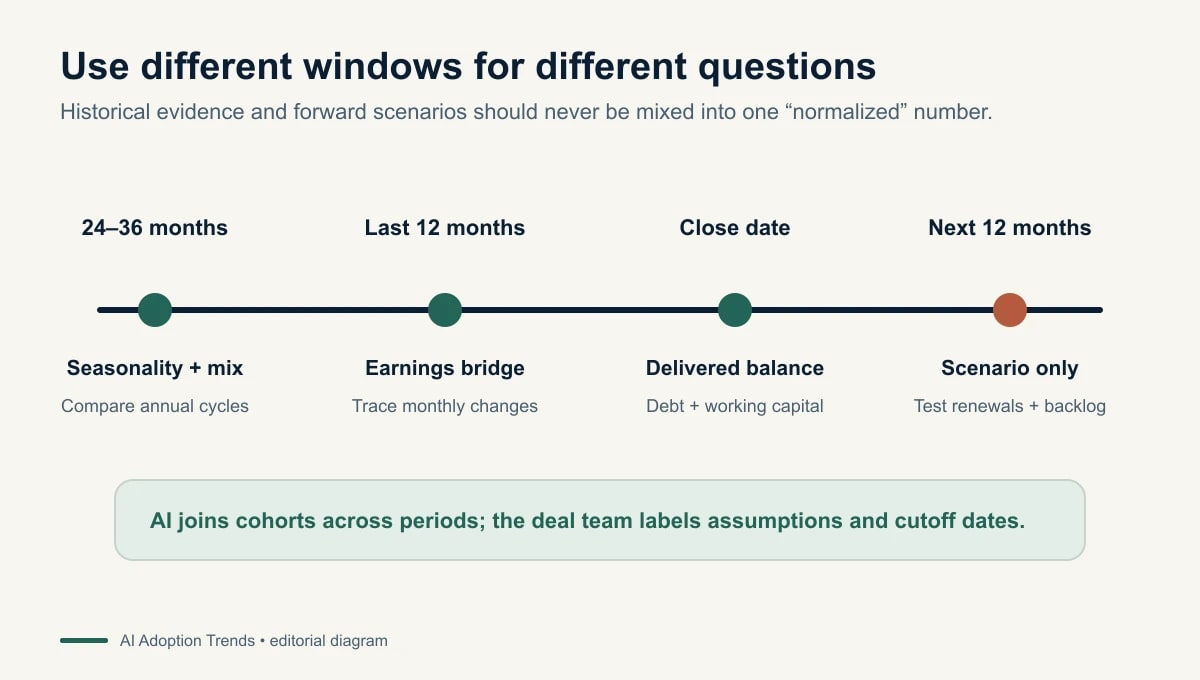
Use 24 to 36 months to see seasonality, customer churn, margin mix, repeat “one-time” charges, and changes in collections. Use the trailing 12 months for the signed earnings bridge and monthly run-rate. Check the weeks around each quarter end for cutoff and manual journals. At closing, rerun the bridge, debt, cash, and working-capital schedules to the agreed date. The next 12 months belong in scenarios: signed renewals, backlog, capacity, known price changes, and downside cases. Label them as forecasts rather than historical earnings.
For a fast-growing business, compare the latest three months with the same months a year earlier, not only with the prior quarter. For a seasonal business, a short “annualized” period can be absurd. AI can join cohorts and generate both comparisons instantly, but the analyst has to choose which period represents the business being purchased. A forward contract signed after the review date may improve the forecast; it does not retroactively make last year’s revenue higher.
Six industries, six different traps
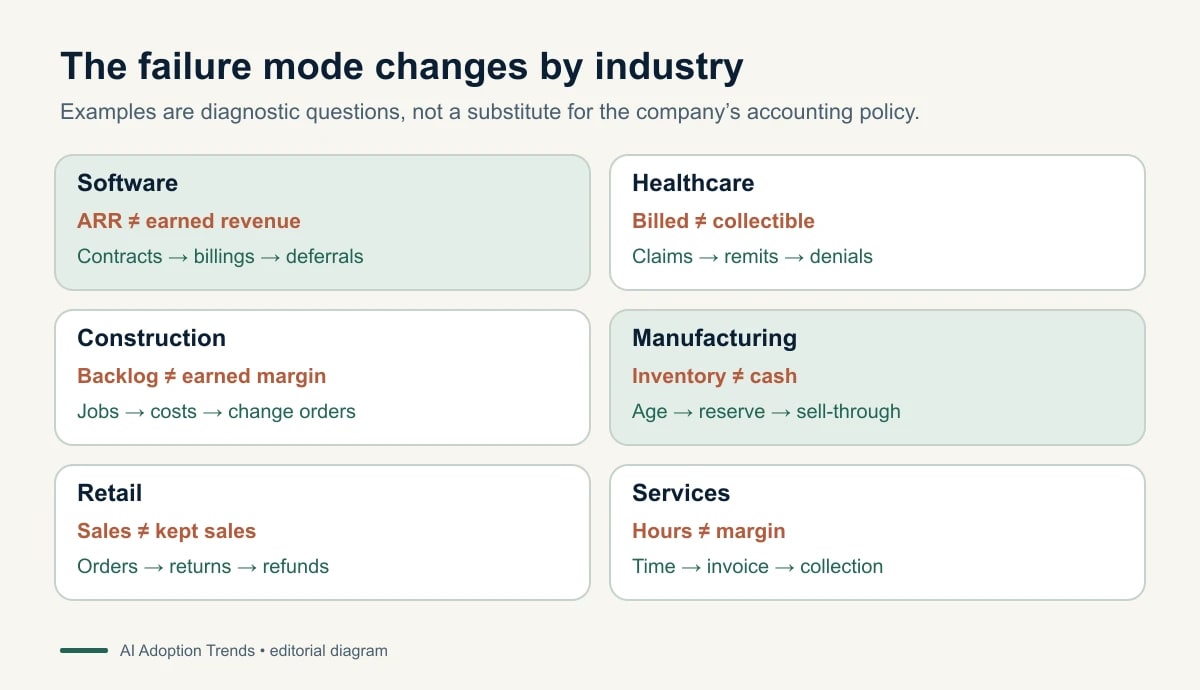
Software and subscriptions: contracted is not recognized
Join customer, product, contract dates, amendment, billing, deferred revenue, revenue recognition, credits, and collections. Test expansion, contraction, churn, free periods, and implementation fees. Annual recurring revenue (ARR) is an operating metric, not GAAP revenue; a public company filing explicitly says its SaaS ARR and retention definitions are not standardized under US GAAP. The AI job is to rebuild cohorts under a declared definition and show every account that changed status. The reviewer tests contract terms and recognition under Topic 606. A $1 million booked annual contract with a cancellation right is not a $1 million cash annuity.
Healthcare: billed is not collectible
Join encounter or service date, claim, payer, allowed amount, denial, adjustment, remittance, patient responsibility, and cash. The Centers for Medicare & Medicaid Services explains that remittance advice contains claim- and provider-level adjustments and their reasons. AI can cluster denial codes and estimate which aging buckets warrant review; a revenue-cycle specialist must assess contract terms, appeal prospects, and whether reserves are sufficient. A surge in gross charges with flat remittances is a diligence question, not earnings growth.
Construction: backlog is not earned margin
Join signed contract, change order, job budget, incurred cost, cost-to-complete estimate, billings, and cash. A model can flag jobs where recognized margin rises while estimated remaining cost falls abruptly, or where unsigned change orders carry profit. The IFRS 15 explanation describes recognition over time when an obligation is satisfied over time; the IFRS Interpretations Committee discusses construction costs in such a fact pattern. A reviewer applies the company’s actual framework and tests estimates with project managers. A backlog schedule is a forecast input, not evidence that all its profit has been earned.
Manufacturing and distribution: inventory can hide the loss
Join item-level age, quantity, purchase and production cost, returns, scrap, later sales, and vendor credits. AI can find slow-moving stock and margin anomalies by product family, then estimate the bridge if a reserve changes. Under IAS 2, IFRS inventory is measured at the lower of cost and net realizable value; the reviewer must apply the company’s accounting basis and inspect condition, demand, and subsequent sales. A favorable EBITDA add-back for “temporary” scrap is weak if the same failure occurs in every production cycle.
Retail and marketplaces: count sales kept, not orders placed
Join order, shipment, acceptance, return window, refund, promotional credit, channel fee, and bank settlement. AI can rebuild net revenue by cohort and spot period-end discounts that shifted demand forward. The FASB’s revenue guide describes variable consideration and amounts collected on behalf of third parties. The reviewer tests expected returns, principal-versus-agent presentation, and the actual contract. For a holiday retailer, compare the full return season before treating December gross sales as durable earnings.
Professional services: utilization does not pay the bill
Join timesheets, project budgets, milestones, invoices, write-offs, staffing costs, and collections. AI can show which teams appear fully utilized but routinely write down work, and whether a departed rainmaker owned the clients now assumed to transfer. Test an owner-compensation add-back against a credible replacement and client-retention cost. If the buyer must hire two senior people to maintain relationships, those are operating costs, even if the seller did not pay them in the historical period.
Make the machine prove it deserves a place in the workflow
Before using AI across the data room, create a small gold set: perhaps 50 contracts, 50 invoices, and all material period-end adjustments, reviewed by humans. Measure extraction accuracy by field, missed high-impact exceptions, false alarms, reconciliation differences, and reviewer minutes per resolved exception. Require a human to verify every model-extracted term that could change a material adjustment; set the acceptable error rate for lower-impact fields before scaling. Re-test after changing the model, prompt, document parser, or account map. The NIST AI Risk Management Framework calls for defined human oversight and documented testing; the generative AI profile treats fabricated output as a risk. Those sources support testing and governance, not a claim that any specific model is safe for financial diligence.
Set stop rules before the impressive demo. Stop automatic extraction when source-page citations are missing or accuracy on material terms falls below the team’s threshold. Stop the earnings bridge when source totals do not tie. Escalate if a material adjustment depends on a verbal explanation alone, if later credits contradict a sale, or if the result changes materially when a few unsupported items are removed. Keep a log of accepted, rejected, and unresolved exceptions. A “confidence score” from the model is not a substitute for measured error rates on this company’s documents.
The output worth paying for
- A source inventory and reconciliation map, with missing periods, entities, and unexplained differences visible.
- Monthly reported results and an adjustment register whose signed arithmetic can be reproduced without the language model.
- For every material adjustment: ledger entry, original document, contrary evidence, recurrence test, reviewer, date, and decision.
- Revenue and margin cohorts, cash conversion, working-capital and debt-like schedules, plus a short list of the largest unresolved questions.
- Four brief decision packets for buyer, seller, lender, and operator, each generated from the same approved records and clearly dated.
The most useful AI result is not a 60-page report written in five minutes. It is a living evidence map that lets a buyer ask, “Show me exactly why this $300,000 belongs in earnings,” and get the ledger, contract, cash, counterexample, and reviewer call in one place. If the answer changes when one file is corrected, the bridge and every audience packet should change together. That is what makes AI worth using in quality of earnings: more coverage, faster challenges, and a decision the team can still defend after the model is switched off.
Weekly Newsletter
AI Adoption Weekly
New research, field guides, training studies, and tool decisions for operators.
No spam. Unsubscribe anytime.
Related Comparisons
Calculator
AI seat cost calculator
List price × headcount. You enter the hours and the operating assumptions.