
Stop Overlapping Zapier Paths from Routing a Request Twice
Make Zapier routing rules mutually exclusive, test boundary cases and keep fallback handling separate from failed-action recovery.
Published October 26, 2026

If one incoming request reaches two owner queues in Zapier, inspect the branch conditions before changing their order. Several Paths branches can match the same request. Running them sequentially does not make their rules mutually exclusive, so moving the preferred branch first does not establish a single owner.
Start by deciding whether the business wants one responsible owner or several independent actions. Then write conditions that express that decision, test the boundary cases and verify the resulting records. A notification to a second team may be intentional; a second ticket that nobody realizes is a duplicate usually is not.
This guide is for an operations owner routing service requests, leads or internal approvals. It uses a constructed intake policy with urgency and contract tier. It does not repair repeated trigger events or explain every failed destination action. Those problems require different evidence and recovery steps.
Diagnose the run before touching the rules
Find a representative duplicated request and record its source identifier. Open the relevant run history and compare the trigger data, branches that executed and destination records. Distinguish three cases: one run entered two owner branches; two runs processed the same request; or one intended branch entered a failed action.
In the first case, compare the branch conditions against the same input values. In the second, investigate event identity and trigger behavior. In the third, inspect the action's error and the destination state. Changing branch order is unlikely to resolve all three, and an unnecessary replay can create more work.
Keep a copy or clear record of the existing configuration before editing. Pause or isolate the affected workflow according to your team's normal change process if it is creating harmful duplicates. Identify how incoming work will be handled during the repair, so preventing duplicates does not silently abandon new requests.
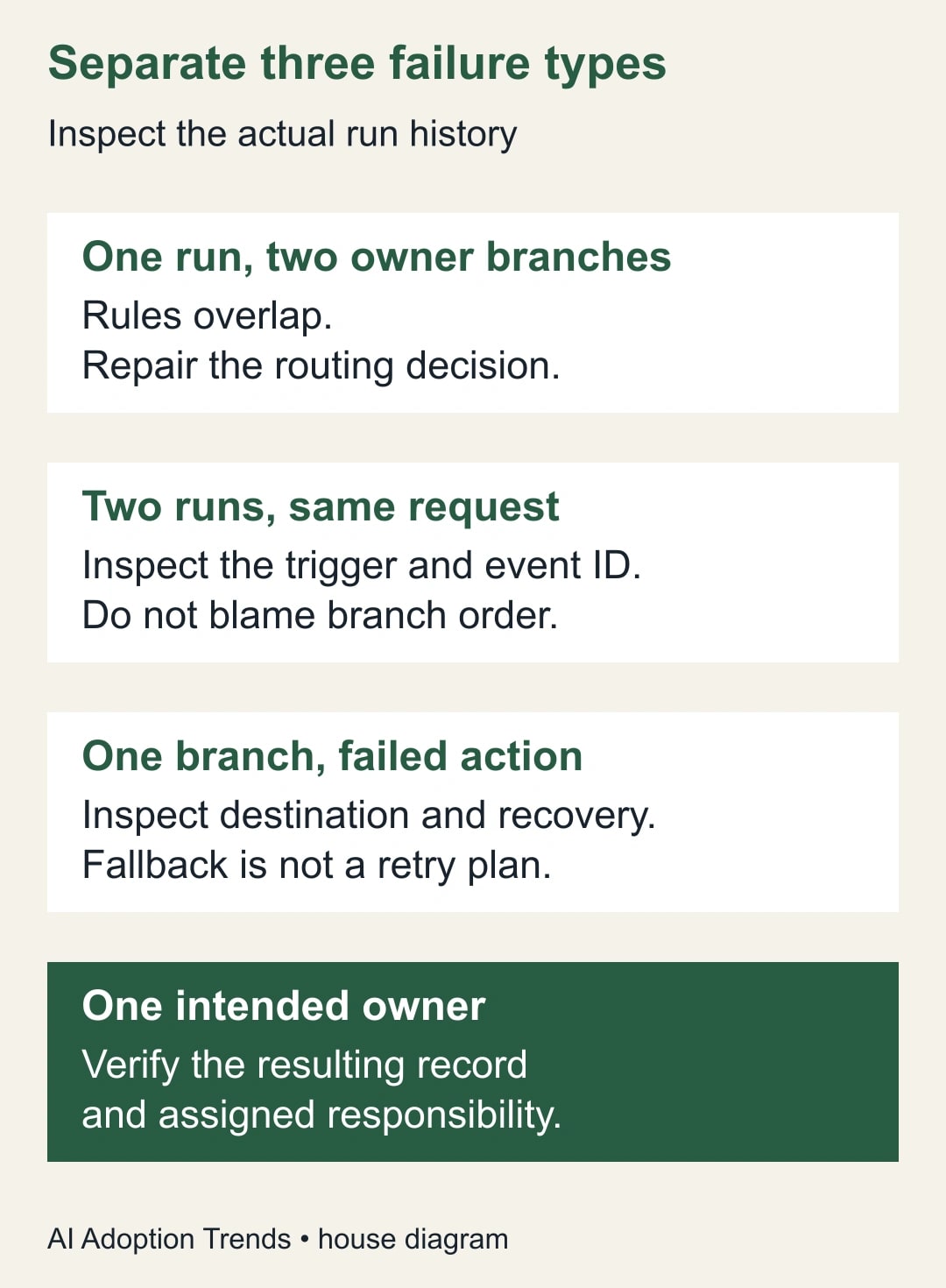
Zapier's Paths documentation describes conditional branches and sequential execution. Its sequential-path announcement also makes clear that the execution change does not change the conditional rules. The practical consequence is that timing and eligibility are separate questions.
Write the ownership policy in plain language
Consider a service operation with two input fields: Urgency and Contract tier. Initially, branch A handles urgent requests, while branch B handles enterprise customers. An urgent enterprise request satisfies both conditions. If both branches create an owner ticket, the automation has implemented two assignments even if the team intended one.
The defect is in the policy as encoded, not necessarily in Zapier. Before editing, ask the service lead to choose what should happen when priority dimensions overlap. In this example, the agreed rule is that urgent work always belongs to the duty owner. Contract tier determines ownership only for standard work.
The revised policy is: urgent requests go to the duty owner; standard enterprise requests go to the account team; standard basic requests go to the general queue; everything else goes to manual review. The manual-review queue has a named owner, rather than being a place where requests disappear.
This is one possible business rule, not a universal support model. A different organization may intentionally involve two teams. In that case, distinguish the accountable owner from observers or contributors, and avoid representing every notification as a separate assignment.
Encode priority as conditions, not position
For the constructed policy, the urgent branch tests Urgency equals urgent. The enterprise branch tests Urgency equals standard AND Contract tier equals enterprise. The basic branch tests Urgency equals standard AND Contract tier equals basic. Those conditions cannot all be true for the same single-valued urgency and tier fields.
Do not weaken the enterprise rule to Urgency does not equal urgent unless the business has explicitly approved what happens to blanks and unknown values. A missing urgency is not confirmed standard work. Positive tests for the recognized values make that uncertainty easier to see.
Use the actual stored values from representative trigger records. A field displayed as Enterprise in a form may arrive differently from the label you expected. Check spaces, capitalization, alternate labels and blank values during the rehearsal. Normalize inputs only under an agreed mapping; do not invent a new category when a value is unfamiliar.
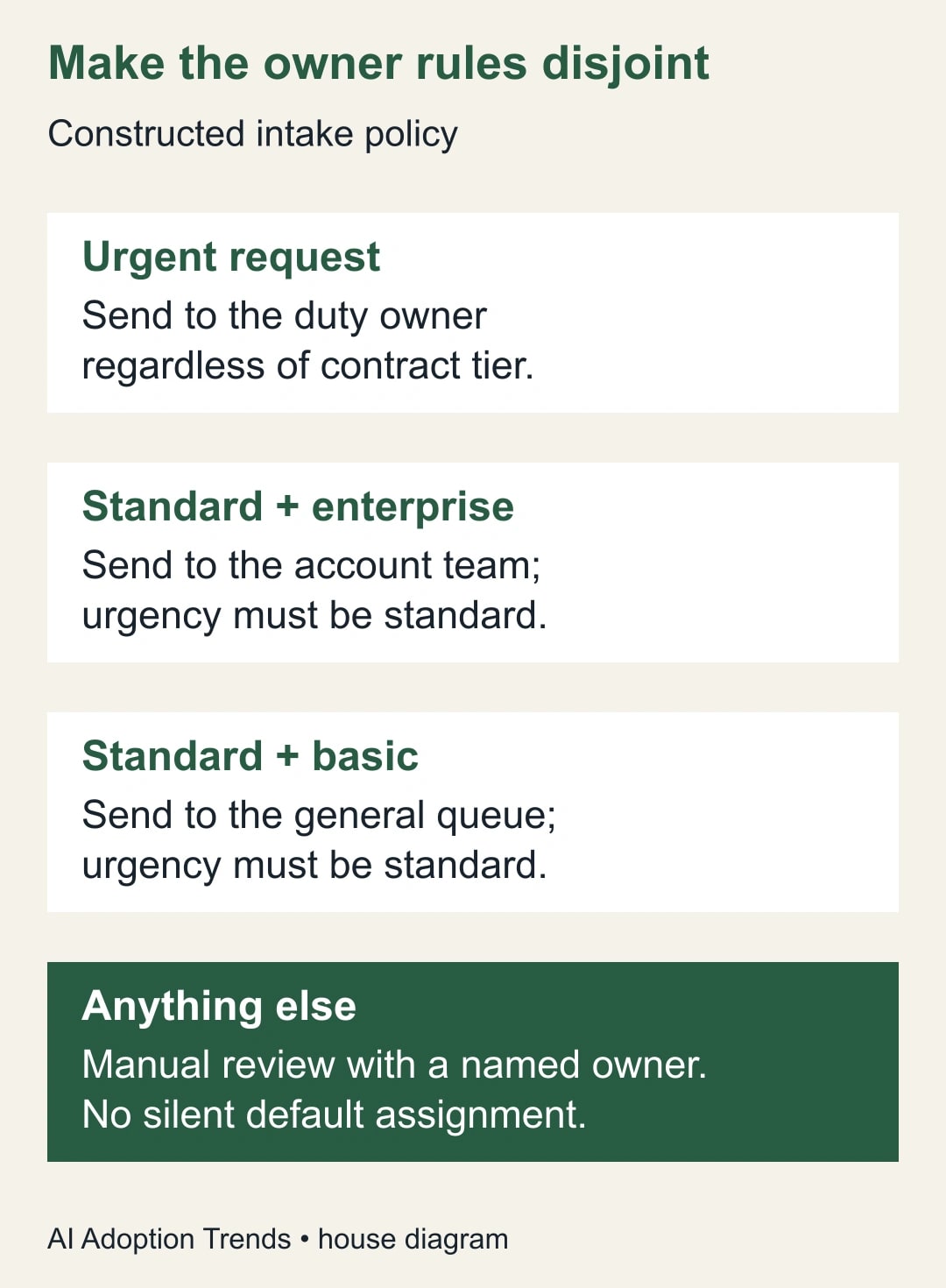
Keep the branch names readable to a future maintainer: Urgent duty owner, Standard enterprise owner and Standard basic owner. A name such as Path B tells the reviewer little about the intended policy. The action that creates or updates the destination record should also make the responsible owner visible.
As of October 26, 2026, Zapier's Paths documentation lists availability on Professional, Team and Enterprise plans. It says the Paths step itself does not consume tasks, while eligible action steps within branches do. Confirm your account's entitlements and action usage before rollout; this guide does not quote a plan price or assume an upgrade is necessary.
The main implementation cost is the operator's testing time, plus any action usage and downstream effects caused by tests. Use a test destination or clearly marked test records. Avoid sending real customer messages just to prove that two conditions overlap.
Use six cases to challenge the routing
Build a small acceptance worksheet before running the tests. Use a fresh test identifier for each case and record the expected owner. The following six records exercise both normal routes and missing information in the constructed policy.
- T-01: urgent plus enterprise should produce one duty-owner assignment.
- T-02: urgent plus basic should produce one duty-owner assignment.
- T-03: standard plus enterprise should produce one account-team assignment.
- T-04: standard plus basic should produce one general-queue assignment.
- T-05: blank urgency plus enterprise should go to manual review.
- T-06: standard plus an unknown tier should go to manual review.
For each case, inspect the branch result and the destination record. A successful condition test does not prove the action assigned the intended person or queue. Verify the request identifier, owner, status and any notification recipient. Record the created destination identifier so the test can be traced and cleaned up through the normal process.
T-01 is the important regression case because it previously matched two independent owner rules. If it still produces two owner records, stop the release. Check both the explicit conditions and any other automation that creates the same destination record. A second system can reproduce the symptom after the local branch rules are fixed.
T-05 and T-06 prevent the happy-path cases from giving false confidence. The test passes only if manual review receives the request and someone owns the next action. A branch that does nothing is not a working exception process merely because it avoids a duplicate.
These six cases are a starting set. Add every meaningful input category in your actual policy, including combinations that should deliberately create several actions. The goal is coverage of the decision, not a ritual test count.
Keep fallback separate from action recovery
Zapier documents a fallback branch for input that matches no other branch conditions. That is useful for the unknown or incomplete values in this example. It is not a general promise that a request will reach manual review whenever a later destination action fails.
For example, an urgent request can match the duty branch and then fail while creating its ticket. The routing decision was made; the action still needs recovery. Keep an operational check for failed runs and confirm the destination state before retrying. Do not assume the fallback branch creates the missing ticket.
Write two separate procedures. The first handles unmatched input: inspect the request, obtain the missing classification and route it once. The second handles failed actions: inspect what completed, determine whether a record already exists and recover the remaining work without duplicating completed actions.
Zapier's documentation describes sequential branch execution, including the effect of an earlier delay on later branches. If the business intentionally runs several matching branches, test their timing as well as their conditions. Do not make a service-level promise from the branch diagram alone.
For this single-owner example, the central control is the disjoint conditions. It should not depend on one branch finishing fast enough to prevent another from running. Any shared downstream update also needs a clear owner and an understood effect on the destination record.
Create a short routing change record
The person maintaining the automation needs both the business decision and the evidence that the implementation matches it. Save a small change record alongside the team's ordinary workflow documentation.
- Decision owner: name the person who approved the routing priority.
- Input contract: list the recognized urgency and tier values, including how blanks are handled.
- Expected routes: write each owner rule in plain language and its exact field conditions.
- Test cases: record the source identifiers and expected destinations.
- Observed results: capture branch outcomes and created or updated destination identifiers.
- Exception handling: name the manual-review owner and the failed-action recovery owner.
- Release and rollback: record the configuration version, release time and restoration method.
- Acceptance check: state what will be inspected in the first live requests.
Keep the record short enough that a colleague will use it. A screenshot of the branch layout can help, but it does not replace the input values or destination evidence. The diagram can look correct while a condition refers to the wrong field.
After release, inspect the first relevant live cases under your normal access controls. Compare the actual owner with the policy. If the first batch contains only standard basic requests, it has not verified urgent enterprise handling; retain the rehearsal evidence and check that boundary when it occurs naturally.
Repair existing duplicates without creating another wave
Fixing the routing rule prevents future overlap under the tested conditions. It does not decide what to do with existing duplicate records. Make a list of affected request identifiers and compare their destination records before deleting, merging or replaying anything.
Choose the authoritative record through the team's normal procedure. Preserve customer replies, attachments and completed work that may exist on either copy. Tell the responsible teams which record now owns the request so both do not continue working independently. Do not erase history simply to make a duplicate count look better.
If you discover two trigger runs for the same source request, use the separate Zapier duplicate CRM record guide. If the problem is held work or task capacity, use the held-run recovery guide. Those repairs complement exclusive routing; they are not interchangeable with it.
Stop the rollout if you cannot explain why a test produced its owner, if a blank field silently reaches a normal queue, or if retries create new records without a clear check for existing work. Restore the last understood configuration or route requests manually while the uncertainty is resolved.
Measure assignment quality, not just completed runs
Track requests with exactly the intended ownership, requests entering manual review, unresolved failed actions and confirmed duplicate assignments. Keep these categories separate. A low manual-review count is not necessarily good if unfamiliar values are being forced into an ordinary route.
Review both the source request count and destination identifiers. One missing request and one duplicate can cancel in a simple count. The evidence you need is that each request received its intended treatment, including a visible unresolved status when action is still required.
For the next change, write the overlap case first: the request that qualifies under two apparently reasonable rules. Decide who should own it, encode that priority explicitly and test the resulting record. That single exercise often reveals the business decision that branch order was never designed to make.
Weekly Newsletter
AI Adoption Weekly
New research, field guides, training studies, and tool decisions for operators.
No spam. Unsubscribe anytime.
Related Comparisons
Calculator
AI seat cost calculator
List price × headcount. You enter the hours and the operating assumptions.