
Google Vault External Chat: Prepare for the February 2027 Change
Prepare for Vault's announced February 2027 external Chat coverage with a membership timeline, records inventory and a retrieval test.
Published November 24, 2026

Prepare an inventory of your external Google Chat conversations now, but do not assume Google Vault already preserves the expanded set. Google has announced a change starting in mid-February 2027. The useful work before then is to identify conversation owners, membership dates, history settings and the separate files that an eventual Chat export will not automatically include.
This readiness guide helps a Workspace administrator work with the organization's records owner. The records owner or counsel decides what must be preserved to meet the organization's obligations; the administrator verifies what the product actually keeps and can retrieve. Keep those decisions connected without treating them as interchangeable.
Google's November 20 announcement says Vault will expand to external spaces and group conversations containing your organization's users. Each organization will keep its own copy under its retention rules and holds. Coverage begins when its first user joins, including messages as they exist then; prior edits and deletions are not reconstructed. New activity is saved until its last user leaves. History-off conversations remain unavailable. Chat-interface visibility continues to follow the creator organization's policy. Google says the new behavior applies automatically and cannot be disabled independently. These are announced future behaviors, checked November 24. See the external Chat coverage announcement.
The change could close a practical evidence gap for supplier conversations. It can also create false confidence if an owner hears “external chats are covered” and stops recording decisions in the approved project system. A membership boundary, a history setting and a file link can each change what an export proves.
Identify the work that depends on a conversation
Start with one business process, such as an agency working with a production supplier. List the conversations used for changes to delivery dates, approved creative work, or service instructions. Name the employee who owns the relationship and the administrator who can investigate the system. Do not begin by copying everyone's chats into a new spreadsheet.
For each conversation, record its identifier, the organization that created it, its business purpose, the internal participants and the relevant dates. Record whether history is on, what approved retention policy applies to your organization, and where authoritative documents live. Use metadata and harmless descriptions in the inventory; avoid spreading message contents into another broadly shared file.
This work fits teams already using Vault with appropriate licenses and authorized administrators. If your organization does not have Vault configured, establish that prerequisite before promising future retrieval. The announcement is not a substitute for a license and access review. Costs may include licensing, administrator time, records review and storage or review of exported material; obtain actual account-specific costs instead of assuming that expanded coverage has no operating cost.
Skip a broad technical pilot if a live preservation matter is involved. Use the established records and legal process, which can define the scope and prevent an experimental change from affecting evidence. The test proposed below uses synthetic messages in a purpose-built conversation. It does not require deleting, editing or changing membership in a real supplier record.
Separate three questions people often combine
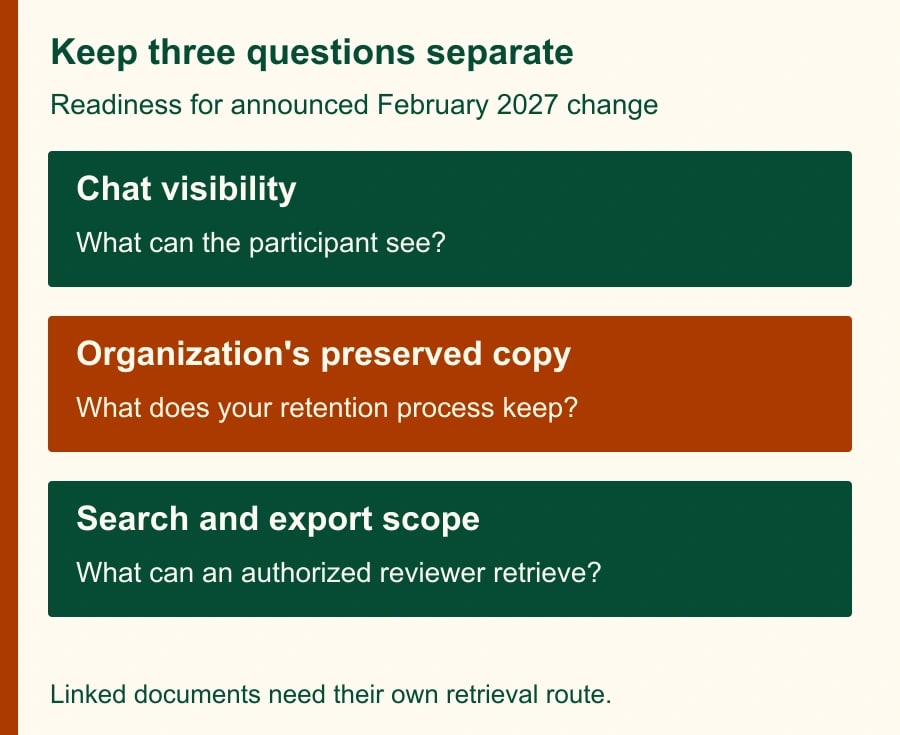
First: what can a participant see in Chat? That is the working interface. Second: what copy does your organization retain in Vault? That is a preservation question. Third: what can a particular authorized search retrieve and export? That depends on the scope of the search and supported data. A disappearing message in the working interface does not, by itself, answer the other two questions.
As of November 24, the Vault Chat search documentation still lists external spaces among unsupported search data. That is consistent with treating the announcement as a future rollout rather than a present guarantee. The same documentation distinguishes attached files from linked Drive files: a Chat search can include supported attachments, but it does not export the contents of a Drive document merely because a message contains its link.
Preserve that distinction in your inventory. A chat saying “approved, see this design” and the design itself are two related objects. Your records owner needs to decide how the authoritative design version is retained under the appropriate process. The Chat copy should not be described as a complete project archive when it contains only a reference to a changing file.
The practical question for a manager is therefore not “Do we have Vault?” It is “Can the authorized reviewer reconstruct this decision from the approved sources, with the relevant dates and versions?” Answer that with an evidence list. A broad product capability is useful context; a successful retrieval of the defined test material is the operational checkpoint.
Use a membership timeline as the answer key
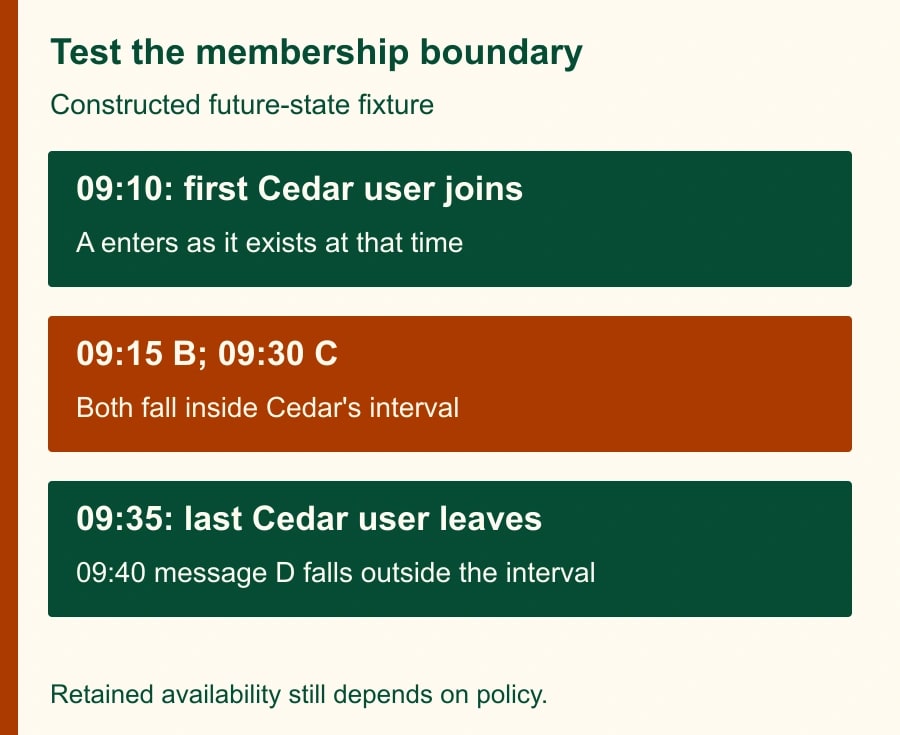
Here is a constructed fixture for testing after rollout is confirmed. It is not an observed product result. Two fictional organizations, Cedar and Harbor, use a test conversation created by Harbor. At 09:00 Harbor sends message A. At 09:05 it edits A. At 09:10 the first Cedar user joins. At 09:15 Harbor sends B. At 09:20 a second Cedar user joins. At 09:25 the first Cedar user leaves. At 09:30 Harbor sends C. At 09:35 the last Cedar user leaves. At 09:40 Harbor sends D.
Under the announced model, Cedar's initial copy starts at 09:10, so A should be considered in the form existing at that boundary, not as a reconstruction of the 09:00 version. B and C fall within Cedar's membership interval. D occurs after Cedar's last member leaves and falls outside that collection interval. Whether collected material remains available later depends on Cedar's applicable retention and holds.
The second member is important. The first person's departure at 09:25 should not be treated as the end of Cedar's organizational interval while another Cedar member remains. A search focused on one employee may also need different interpretation from a conversation-level reconstruction. Have the authorized reviewer record the search scope, accounts, dates and time zone before interpreting a missing result.
Extend the fixture with a harmless attachment and a link to a separate test Drive document. The attachment and the linked document must not be treated as the same export object. Record the expected retrieval route for each. If a search returns the message containing the link, that does not prove the target document's contents or version were included in the export.
Do not run this as a claim of current coverage. Prepare the fixture now, schedule the administrator to confirm rollout, and execute it only in a suitable authorized test environment when the capability is available. A failed test before availability tells you little about the announced behavior. A successful test after availability still covers only the conditions actually tested.
Build the readiness worksheet
Give each process owner one row per important conversation, then have the administrator and records owner complete the fields they control. Avoid making the relationship manager guess technical or legal answers.
- Business purpose: which decision or instruction might need to be reconstructed, and who owns that work?
- Conversation identity: what is the stable identifier, and which organization created it?
- Membership: when did the first internal user join, and is at least one internal user still a member?
- History: what setting is actually in use, and who verifies it for this conversation?
- Preservation: which approved retention rule or hold applies, and who is authorized to interpret it?
- Related material: which linked documents, attachments or external systems contain essential context?
- Search plan: which authorized account, conversation scope, date range and time zone will be used for the test?
- Evidence and recovery: where will the test record be kept, and who investigates missing or unexpected results?
The output is a coverage map with explicit unknowns. “Not checked” is better than a guessed yes. Put each unknown beside an owner and a due date. For example, the supplier manager identifies a conversation, IT verifies its creator and membership, and the records owner confirms the applicable preservation instructions. Nobody needs to infer the entire answer from one person's account access.
Keep an inventory version and review date. If a project moves from one conversation to another, the old and new spaces are separate scopes. A renamed conversation does not necessarily mean a new record, while a newly created replacement can have a different membership boundary. The identifier and the actual timeline matter more than the familiar project name.
Avoid a policy change disguised as a technical fix
Google's external Chat administration guidance explains that external-chat controls affect collaboration access and do not simply erase existing conversations. It also distinguishes access to a space from access to resources shared there, such as Drive files. Therefore, turning external communication off is not a complete preservation or access-cleanup plan.
If the inventory reveals a sensitive workflow in the wrong place, involve the business and records owners. They may choose to move future decisions to an approved system, restrict future participation or adjust a policy through the normal process. Do not make a blanket access change merely to simplify the test. It can interrupt supplier work while leaving separate document access untouched.
Likewise, do not lengthen every retention period as an automatic response to expanded coverage. The product announcement describes capability, not your organization's required retention schedule. The decision should reflect the approved records policy and any applicable preservation instructions. Document who made it and why, so a later administrator can distinguish an intentional choice from an inherited default.
For AI-assisted review, use only approved tools and approved material. A model can help draft an inventory description, but it must not invent membership dates or decide that a missing result means no conversation existed. Keep the original export, the search parameters and any model-generated summary separate. A summary helps a reviewer navigate evidence; it does not replace the evidence.
Verify retrieval before calling the work complete
After the rollout reaches your environment, execute the synthetic fixture and compare the result with the written expectations. Capture the actual account, search scope, date range and time zone. Record which messages, versions and attachments were returned, and which linked objects require a separate route. Explain differences with the administrator before changing the expected answer.
Use a second authorized reviewer to confirm that the export can be opened and understood. A successful download is not enough if the reviewer cannot connect a message to the conversation and date being investigated. Keep the test small enough that every expected object can be manually accounted for. This is an acceptance exercise, not a performance benchmark.
Stop the rollout claim if coverage is missing, a boundary behaves differently from the announced model, or access is broader than intended. Preserve the test evidence and raise a product-support question with exact conditions. Do not compensate by manually copying real messages into an unapproved location. Maintain the existing approved recordkeeping route while the discrepancy is resolved.
Measure the share of inventoried conversations with a named owner, a verified preservation route and a completed retrieval test. Also count unresolved gaps and the time required to reconstruct the fixture. Reduced review time is capacity released for records work; cash savings require a separate budget effect. The next action today is the inventory, not a claim that February's change is already protecting every external exchange.
For a related retrieval exercise, see our Vault export test for Gemini in Workspace. If temporary administrator access is needed for the review, use the role-expiry checklist. Recheck Google's rollout and help documentation before executing the future-state test.
Weekly Newsletter
AI Adoption Weekly
New research, field guides, training studies, and tool decisions for operators.
No spam. Unsubscribe anytime.
Related Comparisons
Calculator
AI seat cost calculator
List price × headcount. You enter the hours and the operating assumptions.