
Test a Google Vault Export of Gemini in Workspace Before Relying on It
Run a small, authorized Gemini in Workspace export rehearsal in Google Vault. Check scope, dates, missing items and source links before relying on the result.
Published October 24, 2026

Before relying on a Google Vault export of Gemini in Workspace, run a small, authorized rehearsal with conversations whose contents and dates you already know. Record the scope, inspect the downloaded data and account for missing or unexpected items. A completed export job is evidence that a job finished; it is not, by itself, evidence that every relevant business conversation was preserved.
This guide is for a Workspace administrator working with a business records owner. It describes an operational acceptance test, not a legal opinion about preservation duties or admissibility. If a live dispute, investigation or formal preservation request is involved, the responsible legal and records specialists should define the collection and handling requirements before anyone changes settings or gathers data.
Skip the rehearsal if you lack authority to inspect the selected accounts, cannot protect the downloaded material or cannot distinguish harmless test conversations from actual employee records. The first useful deliverable is a narrow test plan, not an export of the whole company.
What changed, and what remains uncertain
Google's October 22, 2026 announcement introduces filtered exports for Gemini conversations inside Workspace apps. It describes account or organizational-unit selection, date and timezone filters, and JSON output containing prompts, responses and context. Conversation history must have been enabled. The announcement lists Business Plus and other eligible editions or Vault access, says the interface is available, and places API support within 14 days of that rollout. Google's launch announcement
The same announcement says retention rules and litigation holds for this particular Workspace conversation source will follow later. Do not transfer assumptions from the separately supported Gemini app. Export availability and a preservation mechanism are different capabilities, and the distinction belongs in any internal handoff.
There is also a documentation mismatch as checked October 24: Google's supported-data page still excludes Google Workspace with Gemini in its Gemini-app section, while the launch post describes the new Workspace export source. Record that discrepancy and verify the actual account behavior before making a dependency on it. Supported services and data types
The general export-content page describes Gemini app XML files and associated counts; it does not establish the exact structure of this new Workspace JSON export. Do not build a parser by copying those older field assumptions. Inspect a real authorized sample first. Vault export contents
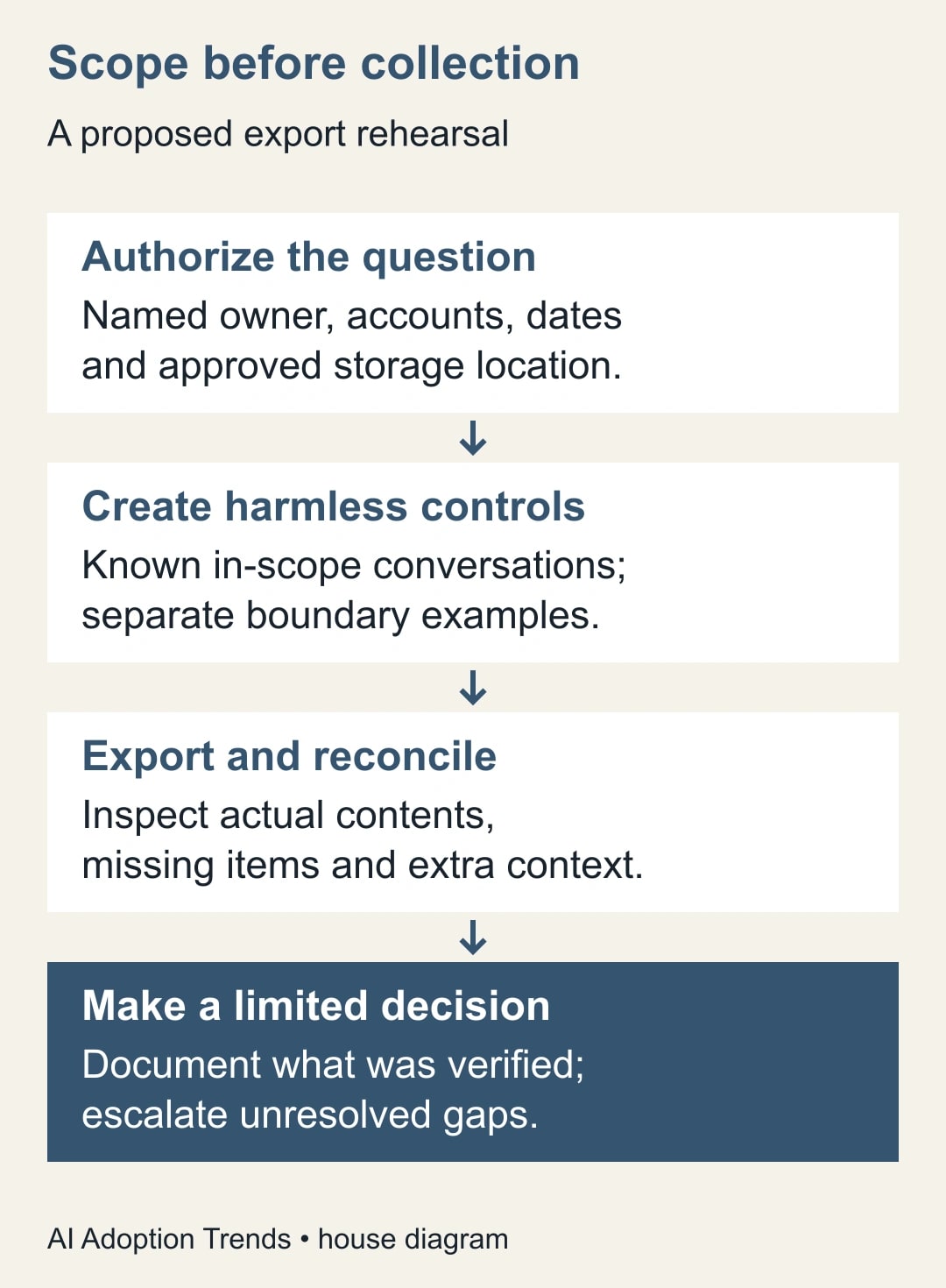
Write a collection question before opening Vault
An appropriate rehearsal question could be: “Can we retrieve eight harmless conversations created by two designated test users in Docs and Gmail during an agreed two-day period?” It identifies accounts, applications, a time window and a known expected population. It can produce a meaningful pass or failure.
“Can we export our AI history?” is too broad. Which product? Which users? Which dates? Does “history” mean conversations, prompt-response pairs, generated files or the documents referenced in an answer? Unless those terms are settled, two reviewers can inspect the same archive and reach incompatible conclusions about completeness.
Have the business records owner approve the purpose and recipients. Have the administrator confirm licensing and privileges in the actual tenant. Choose an approved restricted storage location and a named person to inspect the result. Avoid using a personal account, public file converter or unapproved AI assistant to read the exported conversations.
The cost includes existing Vault access, administrator time, reviewer time and storage or handling work. This guide does not quote a subscription price because eligibility and purchasing arrangements vary. Check current account entitlements before proposing an upgrade. If you already have authorized access, the smallest useful test is cheaper than collecting a large archive that nobody can interpret.
Build a harmless answer key
Use designated work test accounts and synthetic material. A conversation can ask for a summary of a fictional stock-count note containing a distinctive marker such as TEST-STOCK-24-A. Record the application, account, time with timezone and the number of prompt-response pairs. Save the expected text in the approved test record.
Create examples that test the boundaries as well as the happy path. Include an in-scope conversation, one outside the requested date window and one from an account outside the approved collection scope. Do not expand the collection merely to find the control from the excluded account; its purpose is to check that it stays out.
If the test involves referenced files, use harmless documents you are authorized to access. Record which reference should appear and whether the business question requires the underlying file content or only a link. A hyperlink to a document is not a preserved copy of that document, and its contents may change independently of the conversation.
Keep the answer key outside the exported archive so you can compare expectation with result. Do not modify the key after seeing the output without recording why. Otherwise a missing item can quietly disappear from the definition of success.
Run the smallest useful export
In Vault's Search tab, use the Gemini in Workspace service if it is present, set the approved account and time filters and start the export. This route is described in Google's launch post. Retain the exact settings and job identifier in the test record rather than reconstructing them from memory afterward.
Confirm the selected timezone before submitting. A calendar day in the team's local timezone can cover a different set of timestamps than the same labeled day in UTC. Use boundary controls near the start and end of the requested interval, and observe the product's actual inclusion behavior instead of assuming whether an endpoint is inclusive.
If the service is absent, check the account, privileges and applicable rollout with the administrator or Google support. Do not substitute a Gemini app export and label it equivalent. Record the rehearsal as unavailable for that configuration, with a concrete next check and owner.
When the export completes, retain the original downloaded package unchanged in the approved location. Make a separate working copy for examination. Record download time, filenames and file sizes. If your organization uses file hashes to detect later changes, calculate them locally using its approved method and retain the values with the manifest.
A hash can help detect that a file changed after collection. It does not prove that the export was complete, that the account scope was correct or that the underlying conversation was accurate. Keep those claims separate in the acceptance record.
Inspect the archive before automating its use
Open the JSON with an approved local or organizational tool. JSON is a structured text format made of named fields and values; its field names and nesting need to be understood before data is converted into a spreadsheet. Start with one known conversation and trace its owner, timestamps, prompts and responses.
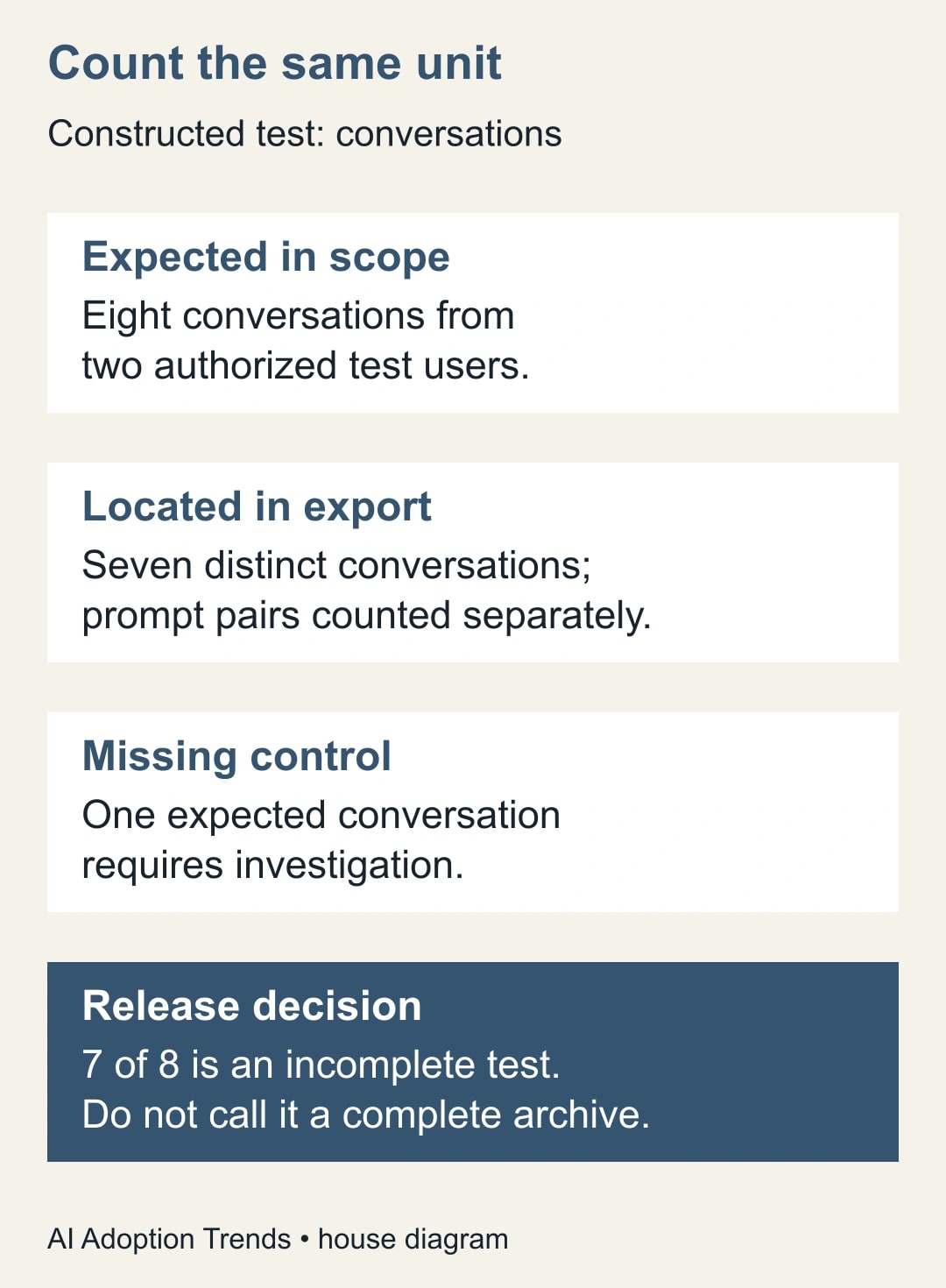
Count the same unit on both sides. Eight conversations are not necessarily eight prompts, eight responses or eight files. One conversation with three prompt-response pairs may legitimately create more rows in a flattened worksheet than a conversation with one pair. Record separate counts rather than forcing them into a single “records exported” number.
Inspect any status, error or metadata files actually delivered with the package. Do not assume the new source uses filenames described for another Vault service. If a field's meaning is unclear, keep the original value and ask for clarification before building a rule around it.
Check source references separately from generated attachments. Verify whether the package includes content, a link, an identifier or some combination. In the handoff, say exactly what you observed. “Reference link present” is a narrower and more useful statement than “all source documents archived.”
Reconcile an eight-conversation test
Here is a constructed example, not a result from a customer tenant. Two test users create four in-scope conversations each. The expected population is eight conversations. Three conversations contain two prompt-response pairs and five contain one, so the answer key contains eleven pairs in total.
Suppose the inspected archive contains seven of the eight conversation identifiers. One of the missing conversation's two pairs is not a separate eighth conversation; both pairs belong to the same missing item. If that conversation had two pairs, the observed pair count would be nine. The test remains incomplete even if the export job reports completion.
The investigator checks the account filter, timezone, application used and history setting at creation time. They find that the missing example was created in the standalone Gemini app rather than in the selected Workspace source. The correction is to document the source mismatch and create a new appropriately scoped control, not to claim the first export captured everything.
Keep the first result and the revised test distinct. The original test had a flawed expectation; the revised test can establish behavior for its own scope. This is why an answer key should contain the application as well as the user and timestamp.
Use a manifest another person can follow
The manifest is a short inventory of what was requested, collected and checked. It should travel with the handoff to the authorized reviewer, while the original package remains in its approved location. Avoid placing confidential conversation text in a broadly accessible ticket just to make the ticket self-contained.
- Purpose, approving business owner and authorized recipients:
- Product source, accounts and requested time window:
- Timezone and observed boundary behavior:
- History-setting evidence and known coverage limitations:
- Export job, completion status and download time:
- Original package names, sizes and integrity record:
- Expected versus observed conversations and prompt-response pairs:
- Missing items, extra context, references and attachments checked:
- Reviewer, unresolved questions and permitted next use:
Write the conclusion in bounded language. For example: “The revised rehearsal retrieved the eight expected test conversations from the specified source and period. Referenced file links were present; underlying file contents were not evaluated. This does not establish retention coverage for other accounts or earlier periods.” That statement gives the next owner something concrete to rely on.
Handle gaps without making the evidence worse
For a missing item, compare the saved criteria with the answer key before rerunning a broader export. If you widen a date range, retain the original job and explain the change. If an error report identifies a retrieval problem, follow the source-specific recovery guidance and preserve the failed result alongside the retry.
For unexpected account data, stop distributing the working copy and ask the authorized owner to review scope. Do not use the surprise as permission to inspect unrelated content. For unexpected additional conversation context, determine whether it reflects the product's behavior and document it without silently deleting parts of the original package.
Do not change deletion or history settings in the middle of a formal collection without direction from the responsible records and legal owners. A rehearsal can expose a policy question, but it cannot decide a retention schedule or replace the organization's preservation process.
If there is no reliable way to reconcile the output, hold the proposed downstream automation. A parser that successfully reads every JSON field can still deliver an incomplete business record. The acceptance criterion should be understood coverage, not merely error-free code.
Choose a limited next step
Measure how many expected controls were found, how long reconciliation took and which limitations remain. A small rehearsal that reveals a source mismatch is useful even though it fails the original completeness test. It prevents the team from building a process on an assumption that would be harder to detect later.
For planning, suppose preparation takes 30 minutes, export handling 15 and review 45. That is 90 minutes of staff effort, excluding waiting time and any investigation. Record actual effort when you run the test; do not present this constructed estimate as a vendor benchmark or a cash-saving claim.
Start with the signed-off question and two harmless test accounts. Then connect the result to your employee AI-use policy and your questions before connecting business data. The export test should clarify what the organization can verify today and what still needs a responsible human decision.
Weekly Newsletter
AI Adoption Weekly
New research, field guides, training studies, and tool decisions for operators.
No spam. Unsubscribe anytime.
Related Comparisons
Calculator
AI seat cost calculator
List price × headcount. You enter the hours and the operating assumptions.