
Use Google Meet Speech Translation for a Checked Supplier Handoff
Prepare a multilingual supplier status call with Meet speech translation, confirm quantities and dates, and handle errors before they become commitments.
Published October 23, 2026

Use Google Meet speech translation to make a routine supplier status call easier to follow, then confirm the quantities, dates and unresolved conditions in writing. A translated conversation is useful working material. The person responsible for the order still needs to check what each party actually agreed before changing a delivery plan or notifying a customer.
Google's October 22, 2026 expansion adds automatic language detection and more supported languages. That makes calls involving several languages more practical, but it does not remove the need for short statements, clear units and a shared written record. This guide gives a proposed preparation and follow-up routine for purchasing and operations coordinators, with a constructed delivery example.
Start with a low-consequence status discussion where a mistaken phrase can be corrected before action. Skip this approach as the sole interpretation method for negotiations, safety instructions or other decisions where misunderstanding could cause serious harm. Bring a qualified interpreter or another agreed language support arrangement when the stakes require it. The decision here is how to improve a routine handoff, not how to eliminate every human language role.
Prove that the actual call will support translation
Google's October 22 release notice announces speech translation across 63 languages, with individual listening preferences and automatic detection. Rapid Release begins October 22 over one to three days; Scheduled Release starts November 2 over as many as 15 days. Visibility can vary during rollout. Check the actual accounts and devices before inviting a supplier to rely on it.
The same notice lists eligible Workspace editions, including Business Standard and Plus, and Google AI plans. It gives a 90-minute meeting limit for eligible base Workspace and Google AI Pro plans, with longer access on specified higher tiers. Meet room hardware can receive translated speech but does not translate speech originating in the room. The announcement also excludes scenarios such as live streams, recordings, encrypted meetings and dial-in participation. Read the current source for your exact configuration rather than assuming every route into a call behaves alike.
Create a short rehearsal using the intended host, a guest account and the devices people will actually use. Confirm that each person hears the intended language and can see how to switch translation off. A successful internal test between two laptops does not establish that a supplier joining from a conference room will have the same experience. Include that participant route in the rehearsal.
On desktop, Google's speech translation help directs users to the captions and translation control, then Translate speech. First-time setup asks for the listening language and whether the user's own speech may be translated. Other participants must enable their own listening experience. Captions can accompany translated audio, but Google notes that delays and language-identification errors can occur. Treat those controls as a setup check, not a guarantee of correct interpretation.
If the feature is unavailable, keep the meeting's business objective and change the method. Share the written questions in advance, use the team's established interpreter arrangement, or move the status exchange to an agreed written channel. Do not ask a guest to change accounts or buy a subscription during the call. The host should resolve access and cost questions before the supplier gives up time to attend.
Prepare a shared fact sheet, not a long script
The order owner should prepare a one-page fact sheet with the order reference, product description, quantities, unit of measure, current dates and open questions. Use the same references as the supplier's documents. A part described internally as a valve kit may have a different commercial name outside your company. Put both names beside the common reference rather than expecting speech translation to reconcile them.
Write dates with the month spelled out and include a time zone where a time matters. Separate dispatch from arrival. Separate units from cartons, pallets or sets. Avoid phrases such as next Friday when attendees may be talking about different local dates. These are communication choices your team controls even when the translation quality is uncertain.
Keep three statuses visible on the fact sheet: confirmed, proposed and unresolved. A supplier saying that a shipment might leave on Tuesday should not become a confirmed arrival on Tuesday in your own planning document. Give the meeting note-taker permission to leave fields blank or marked unresolved. An incomplete but accurate handoff is more useful than a complete-looking plan built from assumptions.
For the rehearsal, use harmless sample details rather than a live customer's confidential order. Try a quantity, a date, a correction and a statement containing a condition. Ask the other participant to repeat the meaning in their own words. This does not measure overall translation accuracy; it reveals whether the team knows how to detect and repair a misunderstanding in the particular meeting setup.
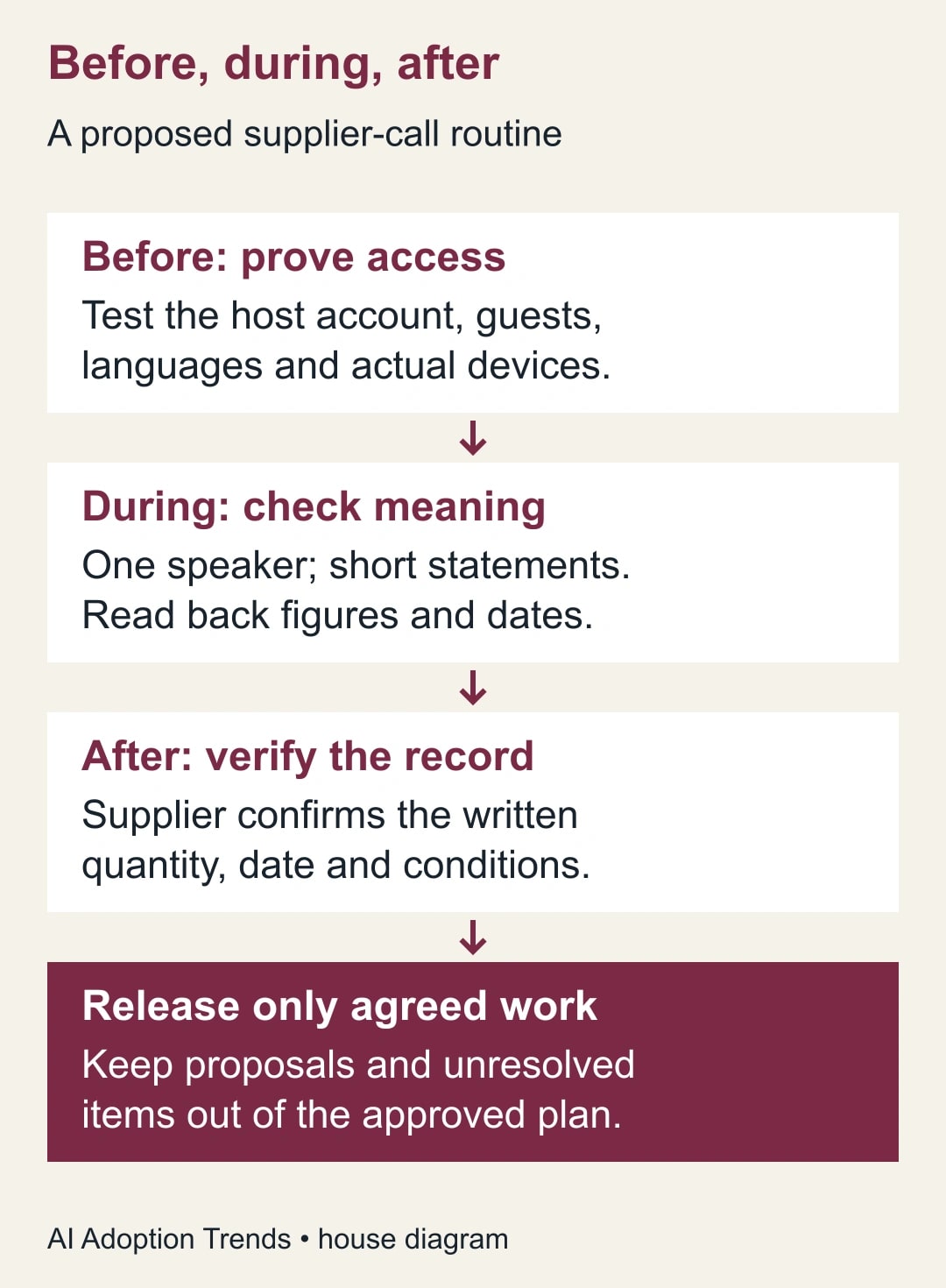
Use a call structure that makes corrections easy
Open by naming the purpose and the record owner: today we are checking shipment readiness, and the coordinator will circulate a written status for confirmation. Explain that translation is active and that anyone can pause to correct a phrase. Ask speakers to finish one short statement before another person starts. A brief pause gives listeners time to hear the translated meaning and identify a question.
Discuss one order line at a time. State its reference, then the quantity, unit and status. For a critical number, write the value in the shared document or meeting chat and ask the supplier to confirm it. Do not interpret silence, a nod or a translated yes as approval of a long paragraph containing several different commitments. Break the paragraph into the decisions that actually need agreement.
When someone corrects a number, have the note-taker replace the provisional value visibly and read the corrected version back. Avoid carrying both versions forward in separate notes. The record should show the accepted value and, if useful, a concise correction note. If participants cannot resolve the meaning, assign a named person to check the source document after the call and leave the item unresolved.
Keep the meeting within the access window you verified, with enough time for the final read-back. A 90-minute entitlement is not a recommendation to schedule a 90-minute translated discussion. A shorter agenda with a small number of concrete questions is easier to check. If translation becomes unavailable or unreliable, pause the affected decision and switch to the agreed fallback rather than rushing through the remaining commitments.
Work through a split-delivery example
Consider a constructed order for 1,200 units, packed twelve units per carton. The full order is therefore 100 cartons. The supplier proposes sending 75 cartons first and the remainder later. The coordinator's first task is to confirm that carton still means twelve units for this product, rather than applying a packaging assumption from a previous order.
At that pack size, the first shipment contains 75 × 12 = 900 units. The balance is 25 cartons, or 300 units. Those quantities reconcile to 1,200 units. If the translated conversation instead says 75 units, the result would be radically different. Put both the carton count and unit count in the written read-back, alongside the product reference.
Suppose the supplier says the first shipment could dispatch on November 3 if final inspection finishes that morning. Record proposed dispatch: November 3, conditional on inspection. Do not record confirmed arrival: November 3. The carrier transit time and arrival commitment remain separate questions. The second shipment's date is also unresolved until someone provides and confirms it.
The constructed handoff could read: order reference SAMPLE-1200; first tranche 75 cartons / 900 units; proposed dispatch November 3 subject to inspection; arrival date unconfirmed; balance 25 cartons / 300 units; supplier coordinator to confirm remaining dates by the agreed review time. This is a sample artifact, not a vendor communication to copy without checking its facts.
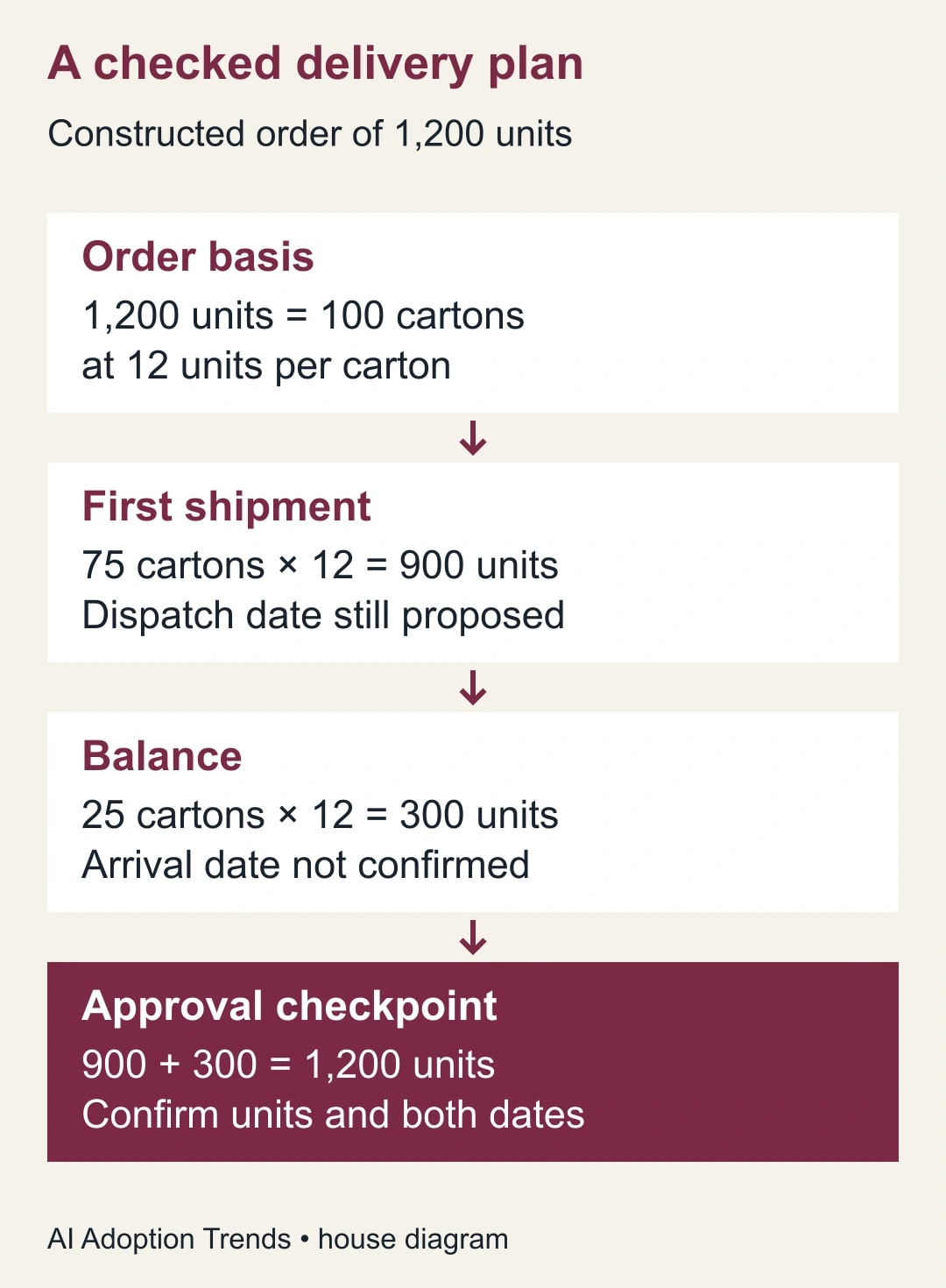
Before closing the call, the purchaser reads back those fields. The supplier checks the written quantities and distinguishes what is confirmed from what is still proposed. The internal planner then uses only the confirmed information for commitments to other teams. If a customer needs an update before the missing dates arrive, the account owner explains the uncertainty rather than converting it into a promise.
Send a record that can be corrected
The follow-up should be short enough for the recipient to check. Use the order reference as the organizing field and separate agreed facts, proposals and open questions. Give each open question an owner and a requested response time. Include the actual unit and date wording, even if the prose feels slightly repetitive. Repetition earns its place when it prevents a carton-to-unit error.
Here is an adaptable drafting brief for an approved AI assistant: prepare a supplier-call status note using only the checked worksheet; retain every quantity and unit exactly; separate confirmed facts, conditional proposals and unresolved questions; do not infer arrival from dispatch; list missing owners or dates instead of supplying them. Review the generated note against the worksheet before sending it. The prompt is a drafting aid, not a control over every action the software might support.
Keep the approved source worksheet with the sent version. If the supplier corrects a value later, update the record and notify the people who received the earlier version. Identify the changed field and whether any action must be reversed or paused. Quietly editing a shared document may leave a planner working from an old email or exported copy.
Do not depend on a recording to recover translated audio later. The feature documentation distinguishes live translation from recordings. If your organization keeps other meeting records, follow its normal arrangements and verify what those records actually contain. The checked written handoff should stand on its own, with the supplier's confirmation and unresolved items visible.
A reusable readiness and release checklist
- Call owner: name the person responsible for the order and final written status.
- Access: test the host plan, guest route, languages, devices and expected meeting duration.
- Data: prepare only the order information needed for this discussion.
- Vocabulary: confirm product references, pack sizes, units and names for key events.
- Method: use short turns, written critical values and explicit correction pauses.
- Decisions: separate confirmed facts, conditional proposals and unresolved questions.
- Release: compare the final message with the checked worksheet before sending.
- Recovery: name who will correct the record and notify downstream recipients if a fact changes.
The coordinator owns the preparation and read-back. The supplier owns confirmation of its information. Your internal purchasing or operations owner decides what may change in the plan. Translation helps those people communicate; it does not transfer their authority to a tool. Make that division explicit when several departments attend and nobody feels responsible for the final note.
Measure the handoff, including the extra checking
For a small trial, compare three similar status calls with the existing method. Track preparation minutes, meeting minutes, checking minutes, follow-up corrections and unresolved fields at release. Record whether the recipient accepted the handoff without another clarification round. Do not use the number of translated minutes as a measure of business success.
For illustration, suppose a previous call required 15 minutes of preparation, 30 in the meeting and 15 for the follow-up: 60 coordinator minutes. A translated trial takes 20, 25 and 20 respectively: 65 minutes. Even if the conversation feels easier, that trial has not released coordinator time. It may still improve participation or accuracy, but the owner should name that benefit and its evidence instead of claiming five minutes saved.
Stop using the method for consequential decisions if quantities or conditions remain disputed after read-back, if participants cannot verify their intended meaning, or if the required access fails. Repair the process before repeating the call at higher stakes. To connect the checked record with later work, use the site's meeting follow-up and task handoff guide. Your next step is one short rehearsal and one fact sheet with no ambiguous units or dates.
Weekly Newsletter
AI Adoption Weekly
New research, field guides, training studies, and tool decisions for operators.
No spam. Unsubscribe anytime.
Related Comparisons
Calculator
AI seat cost calculator
List price × headcount. You enter the hours and the operating assumptions.