
Anthropic After the IPO: Keep an Exit Without Paying for Everything Twice
Keep a tested alternative to Claude without duplicating every system. A practical switching test, reusable brief and 90-day cash-and-capacity worksheet.
Published November 26, 2026

For a business that depends on Claude, the useful response to Anthropic's stock-market debut is to keep a tested alternative for one important job. Keep using the service that works. Preserve the instructions, source material, acceptance tests and permissions needed to move that job if the economics or service cease to fit. Paying for two complete production operations is a much bigger decision.
This is Day 7 of our Anthropic initial public offering (IPO) series, checked November 26, 2026. It is for technology and operations leaders who own a recurring AI-assisted workflow. If your team uses Claude only for occasional brainstorming and can readily work without it, a documented manual process may be enough. If the workflow makes consequential decisions or changes customer records, an alternative needs a controlled trial before anyone calls it ready.
What changed, and what did not
Anthropic's Form 8-K, signed November 25, confirms that its IPO completed on November 20. That is a dated confirmation of the completed transaction, not another fundraising event on November 25. Read the company's current report, Item 8.01.
Axios reported a November 24 close of $81.91, below the $83 offering price. Read the original November 24 market report. Nasdaq's calendar lists November 26 as closed for Thanksgiving. There is no regular-session November 26 closing price to analyze this morning. Check Nasdaq's holiday calendar.
Our analysis: a share-price movement is a poor trigger for an operational migration. It does not tell you whether your document-review workflow is accurate, whether next month's usage fits your budget, or whether a replacement will preserve access controls. Those are the tests that make an alternative useful. Public-market scrutiny makes the supplier more visible; it does not perform those tests for the customer.
Decide how much independence you actually need
Start with the business task, not a list of model vendors. A useful scope might be “draft a service-renewal briefing from approved account records for a manager to review.” An unhelpful scope is “replace all our AI.” The first has an owner, inputs and a definition of success. The second invites an expensive exercise without a finish line.
There are three reasonable levels of preparation. At the lightest level, keep the working materials portable and maintain a manual fallback. At the middle level, periodically test another developer's model on a narrow, approved task. At the heaviest level, operate both providers in routine production. Each level purchases a different capability; they are not interchangeable service guarantees.
- Portable materials and a manual process fit work that can wait or be completed by people. Keep an up-to-date brief, source list, output example and permissions record. You have preparation for a move, not a working second AI service.
- A tested standby fits a workflow whose interruption or price change would justify modest ongoing expense. It can cover only a subset of cases, with more human review and lower throughput than the primary service. Record those limits explicitly.
- Two production services fit work with an approved business case for maintaining both. Someone must own monitoring, access, testing, billing and incident response for each. Buying a second account alone does not establish that capability.
Another cloud route to Claude can address some purchasing or delivery concerns, but it remains a route to the same model developer. Today's question is different: can another developer's model complete the business job? Use our analysis of Claude purchasing routes and supplier dependencies for the first decision, and the test below for the second.
A compatible request is only the beginning
An application programming interface, or API, is the connection software uses to send requests to a service. A software development kit, or SDK, supplies code that helps developers use that connection. Compatibility can reduce the engineering needed to try a model. It does not establish that two models interpret instructions, select tools or handle missing evidence in the same way.
Anthropic's OpenAI SDK compatibility documentation illustrates the distinction. Checked November 26, it says the function-calling strict parameter is ignored, prompt caching is unsupported through that layer, and some instruction messages are combined into the top-level system field. These are documented limitations of that particular compatibility layer, not claims about every integration. The documentation warns: “Most unsupported fields are silently ignored rather than producing errors.” Read Anthropic's compatibility limitations.
A successful connection therefore deserves a small checkmark: the request reached a service. The business check comes later. Did the output cite the correct account? Did it preserve the distinction between a confirmed renewal date and a salesperson's expectation? Did it decline to invent a missing amount? Did it leave the customer record untouched until an authorized person approved the change?
Model Context Protocol, or MCP, can help applications connect to tools and sources. Its official architecture describes its scope as the “protocol for context exchange”; it does not prescribe how an application uses models or manages that context. Read MCP's scope and architecture. A shared connector is useful infrastructure. The customer's acceptance criteria, permissions and review process still have to travel with the work.
Do not strip away every valuable provider-specific feature just to make the software look portable. A feature that materially improves a critical job can justify dependence. Preserve the business requirement separately from the implementation: for example, “every renewal amount must point to an approved source” rather than “every future provider must use this exact tool call.” That gives a replacement room to work differently while meeting the same standard.
Build the replacement packet before buying more seats
Give the workflow owner one afternoon to assemble a small working packet. They need access to representative, approved input material and the people who judge the output. Security or data owners must approve what can go to the candidate service before testing starts. Use sanitized cases where possible; removing a customer's name alone does not necessarily remove confidential information.
The packet should make sense to a colleague who has never seen the original implementation. Store it in the team's controlled repository or document system. Keep credentials out of it. Export only material the organization is entitled to move, and preserve source references and permission boundaries rather than copying everything into one indiscriminate folder.
- Job and owner: what decision or deliverable the workflow supports, who accepts the output, and who maintains the alternative.
- Inputs: approved source locations, example records, document dates, required context and information that must never be submitted.
- Output contract: required fields, source references, acceptable uncertainty and examples of both an acceptable answer and a necessary refusal.
- Allowed actions: read-only tools, any later write permissions, approval steps and the system that records completed actions.
- Test set: representative cases, expected outcomes, critical failures, review instructions and the date of the last successful trial.
- Versions and limits: model identifier, prompt version, integration settings, tested workload and unsupported cases.
- Operating decision: who can activate the alternative, what work stays manual, and how the team returns to its normal process.
- Budget and expiry: approved cash spend, internal hours, next test date and the condition that ends the experiment.
The expected output is a reproducible job description and test package, not a procurement recommendation. If the owner cannot explain what constitutes a correct result, pause here. Testing several models against an undefined standard produces more opinions, not a dependable exit.
Test the business job, including the awkward cases
Use a historical set with outcomes the team can judge, plus deliberately constructed failure cases. Start with read-only output and human review. Include incomplete records, contradictory documents, outdated prices, inaccessible sources and an instruction embedded in an input document that the model should treat as data rather than authority. Measure performance against the same business standard used for the current service.
For a constructed renewal-briefing trial, imagine 100 cases. The primary workflow produces 97 acceptable briefs; the candidate produces 95. Those percentages are calculations for this illustration, not observed customer results or product benchmarks. Now suppose one candidate brief reveals information from an account the reviewer is not authorized to see. A 95% acceptance rate does not offset that failure. The candidate remains unapproved until the access problem is repaired and tested again.
Record failures by cause. Missing source data calls for a different repair from an incorrect amount, a weak explanation or a permission leak. Changing the prompt may help the first two; it is not a substitute for enforcing access outside the model. After repair, rerun the failed cases and the original set, then add fresh cases to reduce the risk of merely tuning to the answers you already know.
Keep a separate checklist for actions that change systems. Test a simulated timeout after a write: the service may have changed the record even though your application did not receive confirmation. Check the business system's action history before retrying or switching providers. Replaying an uncertain action through a different model can duplicate the damage. Require human approval and a reliable record of completed actions before enabling consequential writes.
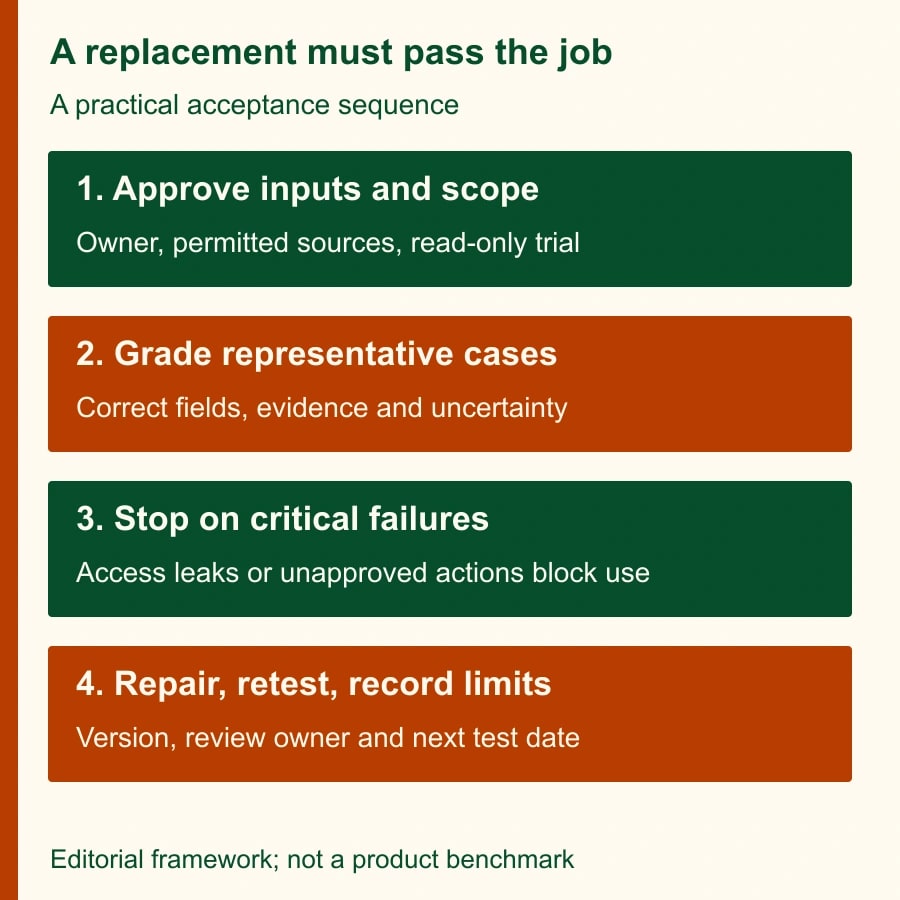
The checkpoint is a signed acceptance note: approved scope, known limitations, review requirement, tested version and next review date. “It worked in the demo” is insufficient. If only ordinary English-language briefs passed, do not silently extend approval to multilingual documents, complex account histories or automated customer messages.
What a modest alternative can cost
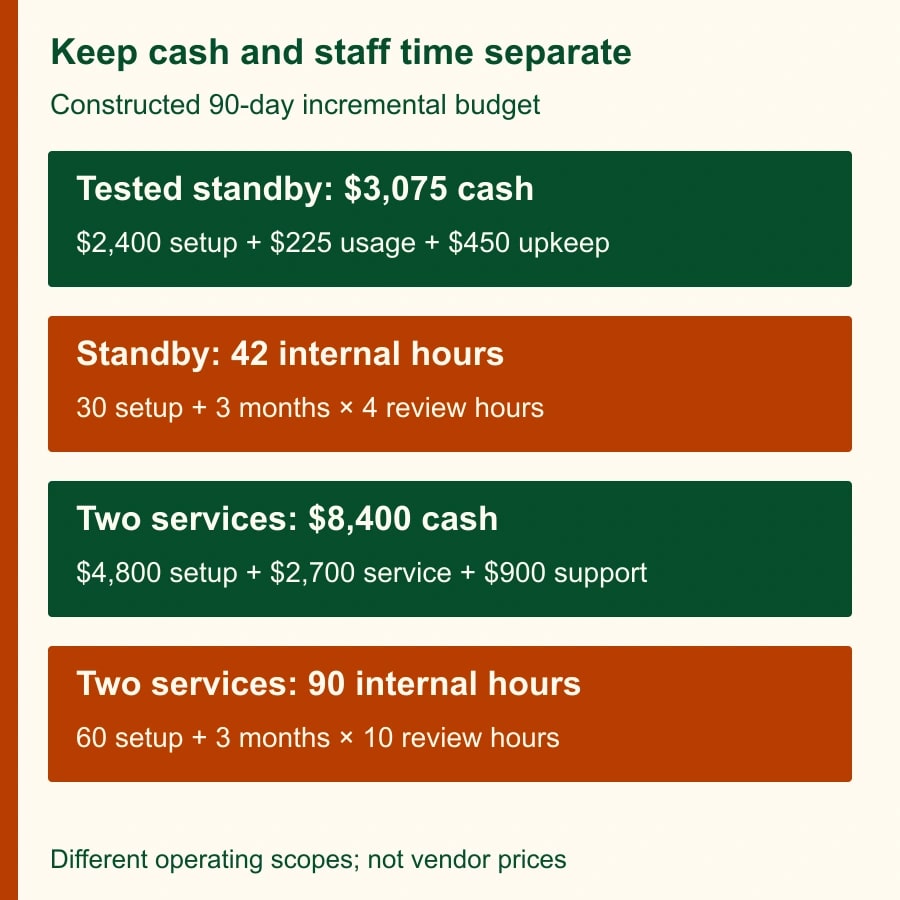
The following is a constructed 90-day planning worksheet, not vendor pricing. It compares incremental spending beyond the existing primary workflow. Assume three equal monthly billing periods, no tax, no credits and no existing contract minimums. Replace every assumption with an actual quote and your own staffing estimate before approving expenditure.
For a narrow tested standby, assume $2,400 of external setup work, $75 a month in trial usage and $150 a month in external maintenance. Cash cost is $2,400 + $225 + $450 = $3,075 for 90 days. Separately, the team allocates 30 internal setup hours and four hours a month for review and retesting: 42 internal hours in total.
For the broader two-production-service option, assume $4,800 of external setup, $900 a month for the additional service and $300 a month for external support. Cash cost is $4,800 + $2,700 + $900 = $8,400. Internal effort is 60 setup hours plus ten hours a month: 90 hours. These assumptions describe a larger operating scope, not a faster version of the same standby.
The difference is $5,325 of cash and 48 internal hours over the period. Those are differences between the two constructed plans, not proven savings against your current operation. Internal hours represent staff capacity allocated to the work. They become incremental cash expense only where they lead to actual additional payments, such as overtime or contracted work. Do not add a notional salary value and label the entire amount a cash saving.
The finance owner should add omitted real costs: data preparation, security assessment, storage or transfer charges, minimum commitments, monitoring and the time spent reviewing additional exceptions. Check whether trial usage remains available at the required volume and whether a standby can actually obtain the capacity needed. A tested model with insufficient approved capacity is a limited option, not a guaranteed substitute.
Approval should state what the $3,075 buys in this example: a tested narrow alternative and an understood set of limits. It does not buy seamless switching or uninterrupted service. Compare that purchase with the disruption the business can tolerate and the manual option it already has. Our supplier-continuity analysis covers recovery deadlines; this worksheet covers the recurring cost of maintaining a different-model option.
What this means for the market and the future of AI
Anthropic's final prospectus identifies intense competition, including rival model developers and the risk of competitors bundling offerings into broader products. These are company-disclosed risks, not a forecast that a particular competitor will win. Read the competition discussion in the final prospectus.
Our inference is that credible switching options matter more than the number of provider logos on a purchasing slide. A buyer who can move a valuable task has something concrete to compare during renewal. A buyer with three unused accounts and no acceptance tests may still depend entirely on the original workflow. Portability can strengthen bargaining power, but it cannot guarantee a discount or make a weaker replacement acceptable.
For the AI market, that creates two competing pressures. Easier connections make trials cheaper, which can expose suppliers to more comparisons. Reliable outcomes, useful integrations and the accumulated work of approval make a functioning workflow harder to replace. Both can be true. Calling every model interchangeable overlooks the second pressure; assuming customers can never move overlooks the first.
The durable opportunity for buyers is to retain their own definition of good work. Keep evaluation cases, approved source material, access rules and action records under organizational control. Allow providers to compete on how well they meet that standard. This is our practical interpretation of the IPO's relevance to adoption, not a prediction about Anthropic's share price or a claim that public ownership changes Claude's capabilities overnight.
Make one decision this week
Choose one recurring task and name its owner. Assemble the replacement packet, estimate the manual fallback, and decide whether a small approved trial would answer a real business concern. Put cash expenditure and internal hours on separate lines. Set a review date and a spending ceiling before the first trial request.
Stop or reduce the effort if there is no owner, no approved data path, an unresolved critical failure or no plausible benefit from keeping the alternative current. If the trial passes, retain the narrow scope and retest after material changes to the model, instructions, sources or permissions. The useful result is a maintained option whose limits the team understands. Return to the series entry on the IPO, cash and business budgets to connect that operating decision with the broader financing story.
Weekly Newsletter
AI Adoption Weekly
New research, field guides, training studies, and tool decisions for operators.
No spam. Unsubscribe anytime.
Related Comparisons
Calculator
AI seat cost calculator
List price × headcount. You enter the hours and the operating assumptions.