
Anthropic’s Compute Commitments: A Continuity Test for AI Buyers
Read Anthropic’s computing obligations by payment date and delivery condition, then test whether your AI workflow can recover before its deadline.
Published November 22, 2026

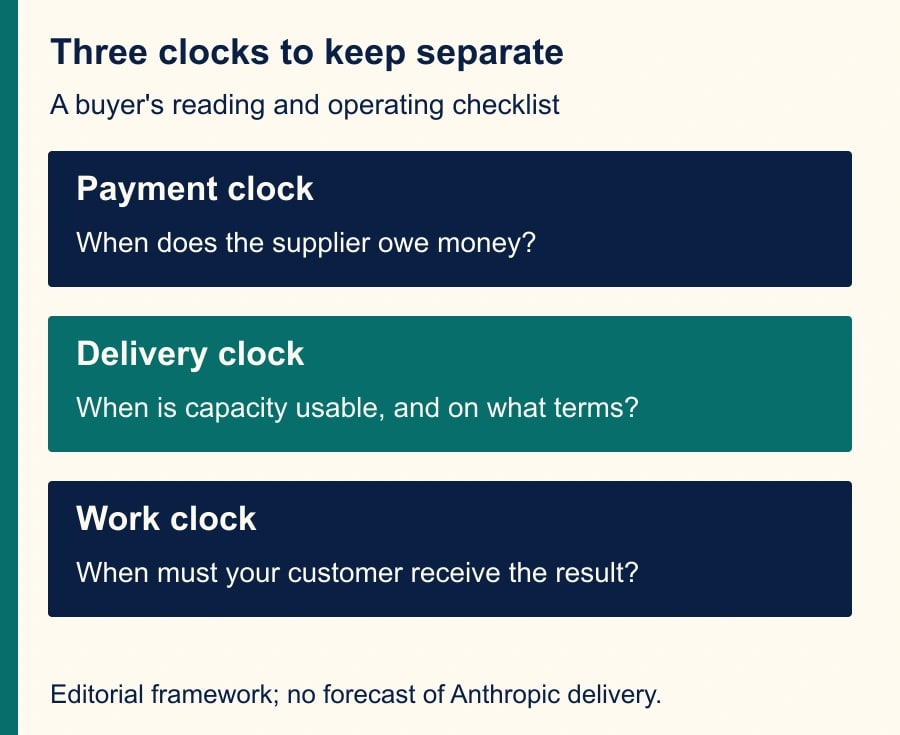
Anthropic's computing commitments deserve scrutiny, but the total alone cannot tell a business whether Claude will be available when a customer needs an answer. Buyers should separate three questions: when the supplier must pay, when usable capacity arrives, and how their own work continues during an interruption. The practical response to the IPO is to test that last link before expanding a critical workflow.
This is Day 3 of our Anthropic IPO series, checked November 22, 2026. It is for operations leaders and technology procurement owners who depend on AI to meet a deadline. If Claude helps with occasional brainstorming, a short interruption may need little preparation. If it helps prepare hundreds of customer responses, delayed work can accumulate faster than people can clear it. That is where a continuity test earns its cost.
What the financing resolves, and what remains to prove
Anthropic's November 20 announcement confirms completion of its public offering and concurrent private placement. The company reports approximately $91.6 billion of gross IPO proceeds received by Anthropic and a separate approximately $26 billion private placement. Gross proceeds precede relevant deductions; they are not a current cash balance. The closing announcement establishes that financing event. This Sunday analysis does not assume a new trading session or a fresh infrastructure announcement.
Financing gives a supplier more options to fund its plans. Our editorial judgment is that a buyer should still require evidence at the point where the service meets the work. Raising money, installing equipment, making a model accessible and completing an acceptable customer response are separate achievements. A weakness in any connection can interrupt delivery even when the other parts are strong.
The optimistic interpretation is straightforward: securing resources ahead of demand can let a supplier serve customers who would otherwise wait. The skeptical interpretation is that expensive reservations become a burden if demand, equipment or deployment arrives differently from plan. Neither interpretation establishes that your account will fail next week. They suggest different evidence to monitor rather than a reason to migrate because of a headline.
Read the payment clock before the headline total
Anthropic's final prospectus reports approximately $900.9 billion of aggregate commitments, substantially all for computing and infrastructure. About $70.7 billion is due in the twelve months following September 30, 2026. It expects $451.6 billion before December 31, 2030, with substantially all the remainder in 2031–2045. These are company disclosures, not amounts all payable today. The final prospectus's contractual-obligations section supplies the dates and scope.
The filing says some commitments require payment “regardless of actual utilization.” It also identifies approximately $186.2 billion subject to termination rights or conditions before commencement. Separate arrangements without fixed dollar commitments carry estimated payments of $150–175 billion, excluded from the headline total. Some delivery failures permit termination; others provide “service credits or adjustments to the timing of our commitments.” Those remedies differ. Read them alongside the payment schedule, rather than assuming every obligation is unconditional or every delay cancels a bill.
Here is the general reading method we recommend for any important supplier. Start with the period covered, identify which amounts are estimates, and mark the event that starts payment. Then locate the consequence of late delivery. A refund, a later payment date and a right to stop a contract solve different problems. None automatically completes the work your customer is waiting for.
Avoid dividing a multiyear obligation by one financing round and calling the result a solvency test. That shortcut omits future collections, other costs, payment timing and financing conditions. It also answers a different question from service reliability. A proper financial assessment needs a consistent cash-flow model; an operations manager needs a tested response to missing service. Escalate the former to finance while completing the latter with the people who own the queue.
Turn supplier uncertainty into a specific operating question
A continuity plan becomes useful when it names an output and a deadline. “Keep AI running” is too broad. “Prepare reviewed responses to today's urgent support requests before the evening handoff” gives the team something it can test. The plan should say which requests can wait, which must move to people immediately, and who decides when normal processing resumes.
Begin with one workflow whose delay would matter. Bring its normal arrival rate, a sample of accepted outputs, existing response commitments, current access limits and an export of unfinished work. The operations manager owns the deadline; the technical owner owns the queue and error records; procurement owns supplier escalation. Assign a deputy for each role. The first test should use synthetic or approved historical records and should not send customer messages.
As a planning allowance, reserve half a day across those owners for a small initial exercise, plus any engineering needed to preserve pending jobs. That is a proposed budget, not a reported implementation result. Existing logs and a spreadsheet may be enough to evaluate a manually recoverable process. Buying another model subscription before identifying the actual failure can add cost while leaving the same queue problem unsolved.
Two prerequisites matter. First, the team must be able to identify unfinished items independently of the AI service. Second, it must know which outputs a person has already approved or sent. Without those records, a recovery can silently lose work or send duplicate responses. Repair that recordkeeping before testing more ambitious failover, which means switching processing to another route when the normal route fails.
A two-hour interruption can create more than two hours of delay
Consider a constructed support team, not an Anthropic customer case study. Requests arrive at a steady 120 per hour. During an interruption, an approved manual process can finish 40 per hour. The team starts with no backlog. After a two-hour interruption, 240 requests have arrived and 80 have been completed. The unfinished queue contains 160 requests.
Once the normal service returns, assume the whole workflow can finish 200 requests per hour, including review. New requests still arrive at 120 per hour. The net clearance rate is therefore 80 per hour, not 200. Clearing the 160 waiting requests takes another two hours. The system returns after two hours; the queue returns to its starting position after four hours from the initial interruption.
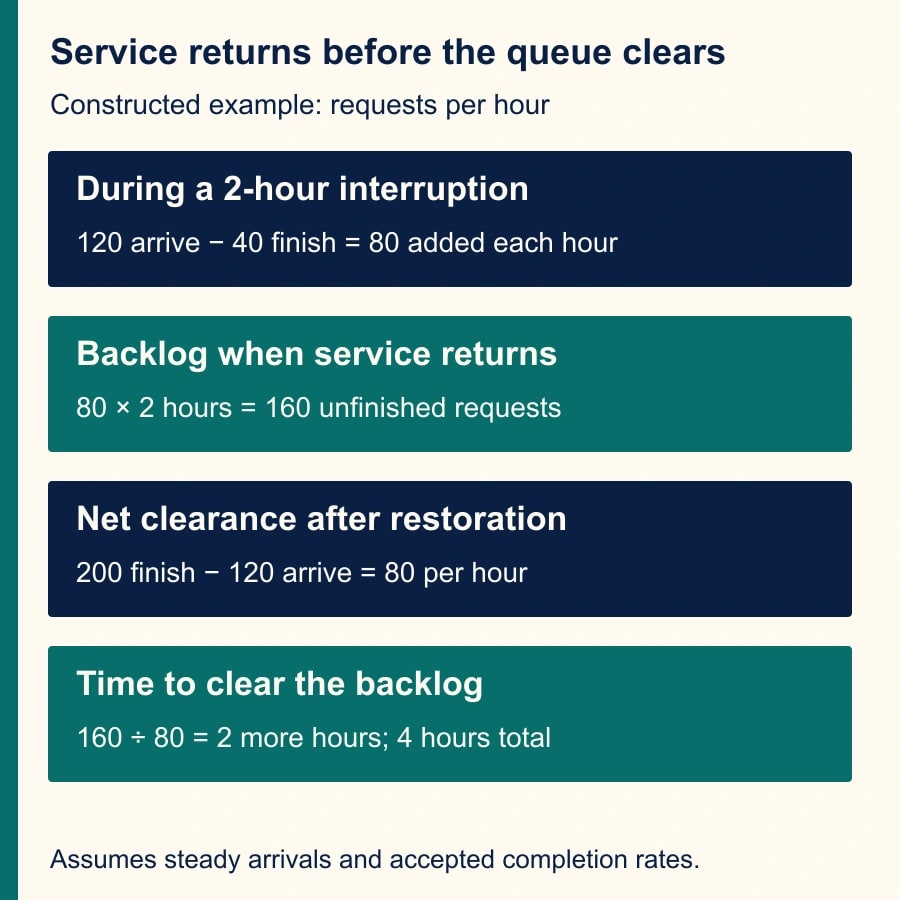
That distinction changes the operating decision. If the team promises to eliminate the backlog within one hour after restoration, 200 completions per hour is insufficient under these assumptions. It would need 280 completions per hour during that hour: 120 for incoming work plus 160 for the backlog. A faster model alone would not meet the target if human review remained the bottleneck.
The arithmetic describes queue size, not every customer's waiting time. Urgent items may be prioritized; older ordinary requests may wait longer. Real arrivals also vary. Repeat the calculation using a busy period and the actual processing order before treating it as a service promise. If sustained completed throughput is only 120 per hour after recovery, the backlog never shrinks while arrivals remain at that level.
Now add an explicitly hypothetical cost. Suppose one additional trained reviewer costs $50 per hour for three paid hours and can add 40 accepted completions per hour during recovery. Incremental cash cost is $150. Combined throughput rises from 200 to 240 per hour, leaving a net clearance rate of 120. The 160-item backlog then takes 80 minutes to clear, assuming no other bottleneck. That improves the result but still misses a one-hour clearance target.
If an existing employee is reassigned instead, the same hourly wage calculation is not automatically new cash spending. Record the displaced work and the capacity used. Do not present a theoretical value of staff time as an avoided invoice. The useful comparison includes the actual staffing choice, queue delay and work postponed elsewhere.
Diagnose the interruption before buying a different route
The current Claude API documentation distinguishes account limits from service overload. The API is the connection software uses to request model output. Anthropic describes a 529 overload response as: “The API is temporarily overloaded.” Its documentation also explains that errors can occur during a streamed response after an initial HTTP 200 success status. Read Anthropic's error guidance, checked November 22. A successful initial connection therefore should not be your only definition of a completed job.
Rate limits constrain usage over time; spend limits constrain expenditure. Anthropic's current guidance says a tier spend-cap 429 response has no retry-after header and retries fail until access resumes. For rate-limit responses that include that header, it specifies how long to wait. The rate-limit documentation explains the distinction. The technical owner should inspect the returned message and account settings before labeling every failed request a supplier-wide outage.
Our recommended recovery rule is to preserve the job, record the error and stop uncontrolled retries. A retry is another attempt to perform the same request. It may be appropriate after a temporary failure, but it should not multiply outgoing emails or business transactions. Use an internal job identifier and check whether the business action already completed before repeating it. For this exercise, keep external actions disabled.
An approved manual route can be enough for urgent work. Another AI supplier is useful only if it has passed the task's quality and data-access requirements. Sending sensitive records somewhere new during an incident is a poor substitute for preparation. Detailed supplier diversification is a later installment; today's test is whether the current plan preserves work and meets the deadline it claims to meet.
The worksheet to take into Monday's review
Use one row per critical workflow. Keep evidence attached so a deputy can execute the plan without reconstructing a conversation. The expected output is a short decision record with a measured recovery result, an owner and a next test date.
- Business promise: name the output, deadline and priority rules. State which customer commitments remain in force during an interruption.
- Normal load: record arriving work per hour and accepted completions per hour, including human review. Keep busy-period observations separate from averages.
- Preserved state: identify where pending jobs, approved outputs and completed actions are recorded. Show how the owner reconciles the counts.
- Interruption route: name the approved manual process or alternate service, its tested throughput, allowed data and incremental cash cost.
- Escalation: record the supplier support route, internal decision owner and who can authorize a change to the response promise.
- Recovery test: record interruption length, backlog at restoration, net clearance rate, time to clear and any missed deadlines or duplicate actions.
- Decision: continue within current limits, repair a named defect, or pause expansion. Give the repair an owner and a date.
Run the exercise in three stages. First, send a small sample through the normal process and verify the completion records. Next, simulate an unavailable service in a test environment and process the agreed urgent subset manually. Finally, restore the normal route and reconcile every sample item. A count of submitted requests is not a count of accepted results.
The checkpoint is whether a second person can match each input to a completed output or a clearly held item. If a job disappears, stop the exercise and repair tracking. If duplicate actions occur, repair the completion check before a live test. If the queue clears but quality falls below the existing acceptance requirement, the recovery has failed its business purpose.
Pause expansion when the tested recovery misses the workflow's deadline or depends on someone unavailable during the actual operating hours. Resume after the owner demonstrates the repaired process on a new sample. For low-priority work, accepting a longer delay may be cheaper and more sensible than maintaining a second processing route. Record that choice explicitly so an incident does not turn it into an accidental promise.
What investors and AI users should watch next
For the market, our interpretation is that infrastructure commitments are a bet on future useful demand. The favorable case combines well-timed delivery, customers willing to pay and enough productive use to support the cost. The weaker case combines fixed obligations with idle resources, delayed deployment or pressure on what customers will pay. A larger commitment is not inherently a stronger business; a smaller commitment is not inherently a safer one.
Watch for comparable disclosures about delivery, payment timing and operating performance. A change in the aggregate figure deserves explanation, but may reflect a changed scope rather than a suddenly worse business. Do not infer a customer's service outcome directly from a share-price move. Finance should assess the supplier's financial condition; operations should bring actual evidence about availability, accepted throughput and recovery.
For the future of AI, this separates impressive capability from dependable infrastructure. Businesses can adopt more consequential uses when they can predict how work finishes and recover when it does not. Capacity that arrives at the wrong time, or cannot pass the customer's checks, has less practical value than its headline scale suggests. That is our analysis, not a forecast of Anthropic's next quarter.
Choose one deadline-bound workflow this week and calculate its backlog after a two-hour interruption. Then have its owner demonstrate how the backlog would clear. Use our analysis of Anthropic's financing for the capital context and our customer-demand worksheet for the evidence that spending produces repeat useful work. The next useful decision is the smallest repair that makes your recovery promise credible.
Weekly Newsletter
AI Adoption Weekly
New research, field guides, training studies, and tool decisions for operators.
No spam. Unsubscribe anytime.
Related Comparisons
Calculator
AI seat cost calculator
List price × headcount. You enter the hours and the operating assumptions.