
Anthropic’s IPO: What the Cash and Market Debut Mean for AI Buyers
Follow Anthropic’s IPO proceeds, distinguish the debut price from business value, and use a practical worksheet before changing your AI budget.
Published November 20, 2026· Updated Nov 22, 2026

Anthropic’s initial public offering gives business leaders a reason to revisit their AI supplier assumptions. It does not, by itself, justify a bigger software budget. The useful question is whether new capital eventually produces more reliable service, better work and a lower total cost for the jobs you actually need done.
This is the first of our daily Anthropic IPO analyses, running November 20 through December 3. Each installment will examine a different decision for AI users, the market and the industry’s future. Today’s decision: what should change in your AI budget after the offering and trading debut?
The short answer is to keep useful deployments moving, require evidence before expanding them, and add public-company disclosures to your supplier review. This article is for business owners, finance leaders and teams buying AI. Readers looking for a short-term share-price target should use a different framework: an opening trade cannot establish fair value or predict the next session.
The verified baseline: offering price, opening trade and cash
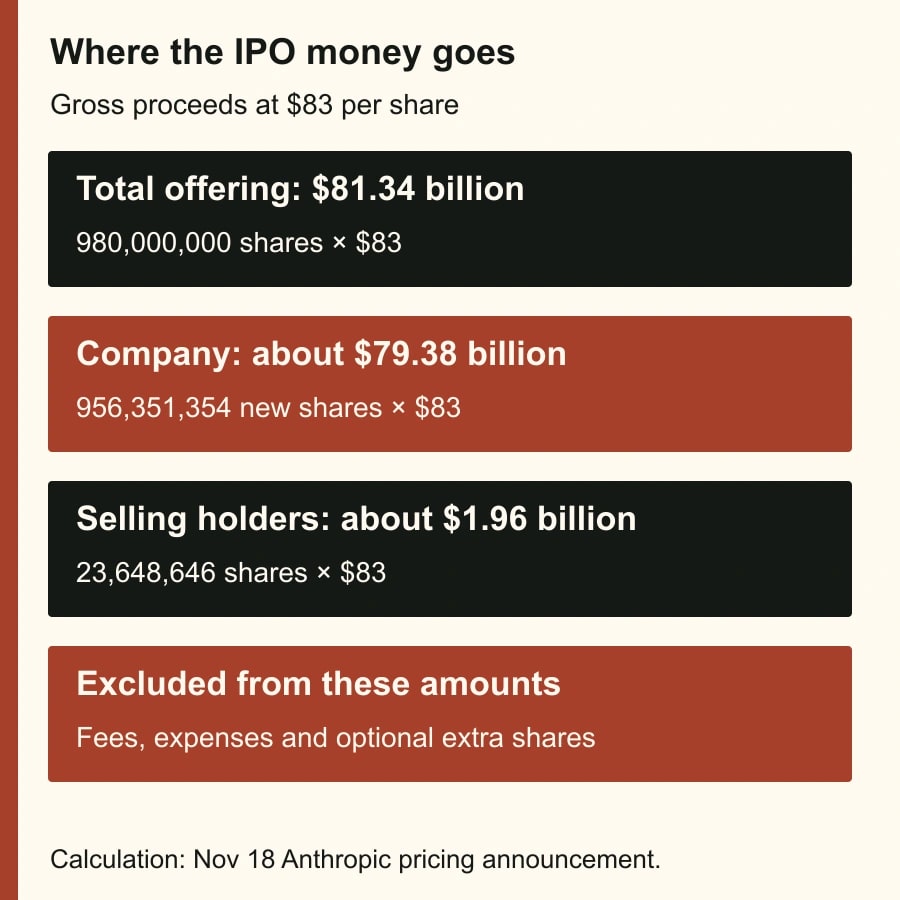
As checked November 20, 2026, Anthropic priced 980 million shares at $83 on November 18. Of those, 956,351,354 are company shares and 23,648,646 come from selling stockholders. The announcement expected closing on November 20, subject to conditions; we have not independently confirmed settlement. It also describes a 30-day option for underwriters to buy 147 million additional shares. Anthropic’s pricing announcement
Our calculation puts the base offering’s gross proceeds at $81.34 billion. About $79.38 billion is attributable to company shares and $1.96 billion to selling holders, before relevant fees and expenses. These amounts exclude the optional shares. Anthropic states: “Anthropic will not receive any proceeds from the sale of shares by the selling stockholders.” Offering terms and proceeds
Nasdaq confirms that trading began November 19 under ANT, opening at $111.50. That is approximately 34.3% above the $83 offering price, calculated as ($111.50 − $83) ÷ $83. This is an opening-price comparison, not a closing return or a current quote. Nasdaq’s report of the debut
Keep three quantities separate. Offering proceeds describe money raised through the transaction. Market capitalization measures the market’s valuation of the outstanding equity at a particular price. Your organization’s AI budget pays for a service and the people needed to make its output useful. A change in one does not establish a proportional change in either of the others.
That distinction matters when a headline reaches the budget meeting. A large valuation is not a deposit into the supplier’s bank account. An enthusiastic opening is not evidence that a support agent will answer customers more accurately. And gross financing is not the same as cash available after transaction costs and other obligations. A sensible buyer starts by identifying which number the argument actually uses.
What changes for you: supplier scrutiny becomes more concrete
Our interpretation is that public reporting should make it easier to challenge broad claims about commercial progress. Buyers can compare management’s narrative with financial statements, contractual commitments and later disclosures. That is useful even if they never own the shares.
The task belongs jointly to procurement, finance and the person responsible for the deployed workflow. Procurement tracks terms and continuity. Finance checks whether the cost model still holds. The operating owner measures whether the work is accepted, corrected or rejected. Giving all three the same short record prevents a stock-market story from becoming an unexamined purchasing decision.
Start with the contract you already have. Record renewal date, actual monthly spending, approved uses, data handling terms, service commitments, escalation contact and an export or fallback procedure. These are inputs to a supplier review, not claims that Anthropic’s terms have changed. Ask the account team to identify any change in writing. If there is none, preserve the existing operating assumptions until evidence changes them.
For a small team using AI to draft internal material, a monthly review may be enough. For a customer-facing workflow that can create financial or reputational harm, review service and quality signals more frequently. The frequency should follow the consequences of failure. Owning shares in the supplier, or reading favorable market coverage, provides no substitute for this work.
Before starting, have the last full month’s invoices, usage records and a sample of accepted and rejected output. Allow time for a finance owner and a workflow owner to reconcile them. The process needs staff time; it does not require buying another monitoring product. If your team cannot identify the workflow owner or retrieve a trustworthy sample, fix that gap before expanding the deployment.
What the market is testing: durable demand versus expensive capacity
A favorable interpretation of the offering is that access to capital can support research, infrastructure and distribution over a longer horizon. If those investments produce useful, dependable services, businesses may adopt more AI for economically sensible reasons. Investors would then have operating evidence to examine beyond initial trading demand.
The skeptical interpretation deserves equal attention: capital can finance capacity before there is enough profitable work to use it. A supplier can grow revenue while its obligations grow faster. Customers can try a product enthusiastically and later reduce use when the full cost of supervision becomes clear. Neither possibility is resolved by a successful debut.
Anthropic’s November 17 preliminary prospectus warns that some resource agreements require it to “pay for resources regardless of actual utilization.” It describes roughly $900.9 billion of aggregate committed spending as of and subsequent to September 30, substantially all associated with computing capacity and infrastructure, across multiple future periods. This is a company disclosure, not an amount due immediately. The document predates final pricing; we use it here for disclosed operating risks, not final offer terms. Preliminary prospectus, risk factors and commitments
That risk creates a practical question: how much useful customer demand can each wave of capacity serve? Follow spending obligations alongside usage and revenue quality. Do not divide one large financing headline by one multiyear commitments headline and call the result a runway estimate. Such a calculation would mix timing, scope and sources of funding without accounting for customer receipts or existing resources.
Cash-flow labels also need care. The same preliminary filing reports positive operating cash flow for the first nine months of 2026. Its investing outflows include purchases of short-term investments as well as other uses. Treating every investing outflow as operating cash burn would misdescribe the statements. Preliminary prospectus, liquidity and cash flows
Our market conclusion is conditional: a strong financing event is valuable if it supports productive investment. It becomes a weaker argument if the expected customer economics fail to arrive. The next useful evidence will come from disclosures that connect commercial demand, delivery costs and future obligations on comparable terms. A share-price move alone cannot make that connection.
The future of AI depends on what the capital buys
At the Nasdaq ceremony, chief executive Dario Amodei said, “we have a rare opportunity to shape it for the better.” President Daniela Amodei described a desired relationship with Claude as “one that makes you more capable, but leaves you in charge.” These are leadership aspirations, quoted by Nasdaq, rather than independently measured customer outcomes. Leadership remarks at the trading debut
For the industry, those ambitions become meaningful through implementation. Better models matter when they solve a useful task at a cost and level of reliability the customer can accept. More capacity matters when customers can obtain dependable service. Human control matters when someone can stop a mistaken action, recover the work and understand why it happened.
There are two plausible paths. In the productive path, additional investment reduces bottlenecks and helps businesses use AI for work they previously could not complete economically. In the disappointing path, firms spend more on capability that looks impressive in demonstrations but still requires costly correction in ordinary operations. These are editorial scenarios, not forecasts assigned invented probabilities.
There is also a governance test. Public investors will assess commercial performance, while users and society will judge other consequences. The preliminary prospectus describes a public benefit corporation and a Long-Term Benefit Trust with significant board-election powers. Preliminary prospectus, governance structure The structure is relevant evidence about formal incentives; it cannot establish how a future difficult decision will be handled.
What would persuade us? Specific disclosures about capability, reliability and deployment constraints; clear explanations of significant incidents; and customer economics that remain useful after human review is counted. What would weaken the thesis? Repeatedly shifting definitions of success, costs that outgrow demonstrated value, or an inability to explain operational failures. These are standards for our analysis, not allegations about current conduct.
A budget example: count accepted work, including review
Consider a constructed customer-support example. A team produces 10,000 AI-assisted draft responses in a month. Software and model charges total $1,200. Staff spend 300 hours checking and correcting drafts, with an illustrative loaded labor cost of $40 an hour. The team accepts 9,200 responses for use after review. The remaining 800 need a separate recovery process.
For this deliberately limited model, software plus review cost is $13,200: $1,200 + (300 × $40). Dividing by the 9,200 accepted responses gives approximately $1.43 per accepted response. This is a comparison measure for the assisted workflow, not a complete customer-service profit model. It excludes initial setup and the separate cost of resolving rejected drafts, which the team must track before making a full business case.
Now suppose a tested workflow change reduces review to 150 hours while software spending, acceptance and service quality remain unchanged. The modeled cost becomes $7,200, or approximately $0.78 per accepted response. That releases 150 staff hours, valued at $6,000 under the stated assumption. It creates cash savings only if a budget action actually reduces expenditure. Otherwise, it releases capacity for other work.
Compare that with a hypothetical 50% software-price reduction and no review improvement. Cost becomes $12,600, or about $1.37 per accepted response. The direct software saving is $600. Both changes could be useful, but they are different decisions with different effects. Neither is a prediction of Anthropic’s prices or performance after the IPO.
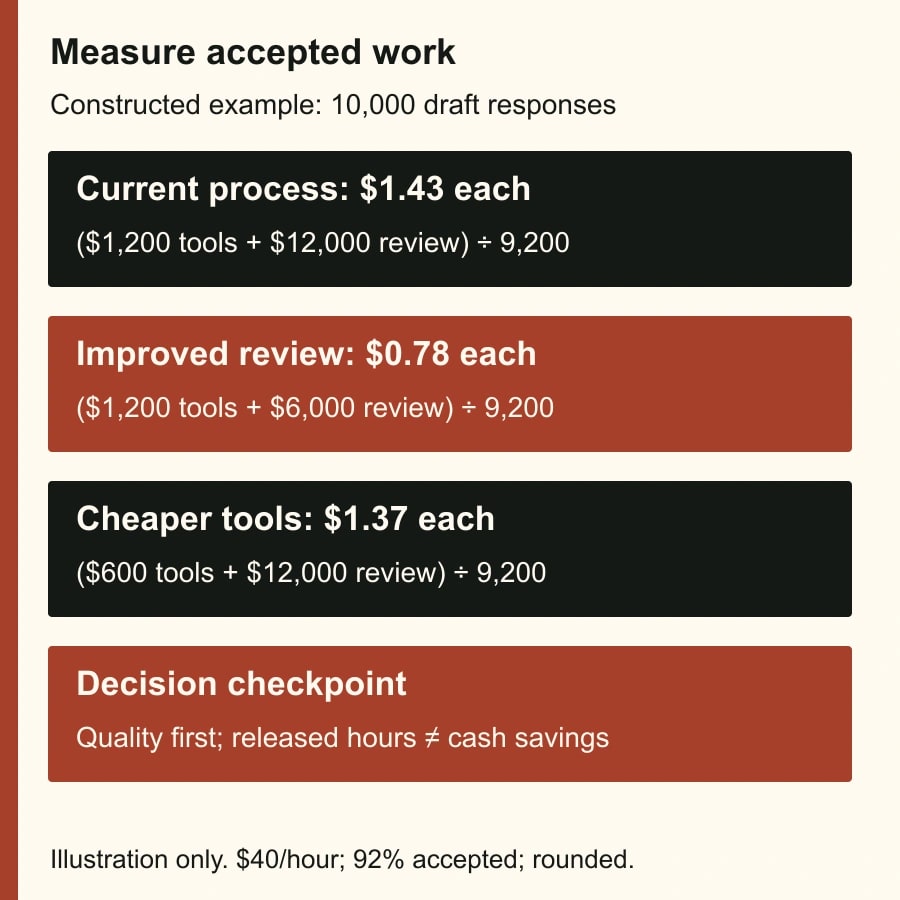
The checkpoint is quality. A shorter review process that lets more wrong responses through can make the worksheet look better while making the business worse. Keep the acceptance standard fixed, audit a sample after release, and track complaints, rework and escalation separately. Do not count a response as accepted simply because a system generated or sent it.
Measure the rejected work too. If those 800 responses require more expensive manual resolution, their cost can erase an apparent improvement. Give each rejection a reason, record the recovery time, and check whether the new workflow changes the mix. A comparison is useful only when the team uses the same boundaries in both periods.
A reusable 30-day review for AI buyers
Use this checklist at the next budget or supplier meeting. A small team can keep it in a shared document. A larger organization can add the fields to its existing vendor review. The output should be a decision with an owner and a review date.
- Name one workflow and its accountable owner. Specify what the AI produces, who checks it and what must never be released without approval.
- Capture a baseline from one complete operating period: volume, accepted outputs, rejected outputs, software charges, review time, recovery time and customer impact. Record what is missing.
- Ask procurement to confirm current contract terms, renewal timing, continuity arrangements and how work can be exported or completed manually. Save the written answer.
- Ask finance to distinguish recurring spending, one-time setup, released capacity and cash savings. Include the work needed to recover from rejected output.
- Run one controlled improvement with the same quality standard. A limited trial should produce a comparison against the baseline, not an anecdote about a particularly good answer.
- Review a sample of accepted work after release. Stop expansion if a critical error occurs, recovery becomes unreliable, or the full cost exceeds the business’s approved ceiling.
- Record the decision: expand a specific use, continue at current scope, repair the workflow or stop it. Name the next piece of evidence that could change that decision.
The business must set its own ceiling and error rules before the trial. A drafting assistant for an internal memo and a workflow that changes customer records should not share an arbitrary universal threshold. Human judgment remains necessary to define acceptable harm, resolve ambiguous cases and decide whether a gain is worth the operational change.
If you are introducing AI to a team for the first time, begin with a small, reviewable task. Our guide to a first useful week with Microsoft Copilot provides a separate beginner workflow. Its product guidance is specific to Copilot; the discipline of starting with a defined job is relevant to the buying decision here.
What we will watch next
Tomorrow’s analysis will revisit the verified transaction status and examine a distinct question: which financial signals can show whether demand is becoming durable? Later installments will address infrastructure obligations, customer dependence, pricing, governance, competition and what operating teams should do with the evidence. Quiet news days will get substantive analysis of a defined question; they will not be dressed up as new market events.
For today, take one AI invoice and one month of accepted work into the same meeting. Calculate the cost of producing an acceptable result, including review and recovery. That gives you a number your team can act on while the public market works through a much larger argument.
Weekly Newsletter
AI Adoption Weekly
New research, field guides, training studies, and tool decisions for operators.
No spam. Unsubscribe anytime.
Related Comparisons
Calculator
AI seat cost calculator
List price × headcount. You enter the hours and the operating assumptions.