
Claude After the IPO: When a Spending Commitment Pays Off
Before renewing Claude, compare a minimum spending commitment with flexible usage. A worked example shows break-even, unused spend and the effect of cheaper models.
Published November 23, 2026

Anthropic’s stock-market debut is a reason to review your Claude renewal, not a reason on its own to spend more or sign for longer. Change the budget when the price of your actual workload, the services you receive or the obligations in your proposed agreement change. A discount can justify a commitment. It can also make an expensive minimum look attractive on the first slide of a sales proposal.
The practical question for a finance or procurement leader is whether a proposed spending floor remains worthwhile when usage disappoints or models become cheaper. This fourth installment in our Anthropic IPO series builds that decision around an annual renewal example. It is for an organization already buying meaningful amounts of Claude usage. If you are choosing a personal subscription or testing your first small workflow, start with the work itself rather than a negotiated annual minimum.
As of November 23, 2026, before the US stock-market opening, Anthropic’s November 20 announcement confirms the offering has closed. That is a financing milestone, not a customer price-change notice. Today’s analysis uses the final prospectus and current purchasing information; it does not treat a premarket indication, an opening trade or a previous close as a current subscription price. Read Anthropic’s offering-closing announcement.
Start with the bill you would actually receive
Anthropic’s current pricing page describes Enterprise as “Seat price + usage at API rates.” It lists US$20 per seat per month, billed annually, with a 20-seat minimum. The same page says volume and committed-spend discounts can be customized through sales, but it does not publish discount rates. Those are provider-listed terms checked November 23, not a quotation for your organization. An application programming interface, or API, lets software call a model; API usage charges vary with the model and work performed. Check the current Enterprise pricing and discount information.
Keep the seat charge, usage charge and any negotiated spending obligation in separate rows. Forty seats at that listed rate would mean $9,600 a year before usage and applicable taxes: 40 × $20 × 12. The useful next question is whether the proposed agreement counts those seats toward a minimum, adds them on top, or treats them under a different order. Do not infer the answer from the word Enterprise.
The final prospectus says a growing number of enterprise customers enter annual or multiyear, non-cancelable arrangements with minimum spending obligations in return for an agreed price list. It also describes usage and model selection as primary spending drivers. That explains why a committed customer can still have a variable bill. It does not establish the terms of your renewal or guarantee that a quoted minimum buys reserved capacity. Read the final prospectus’s revenue-model explanation.
Ask the account team for an itemized order, the applicable rate card and a written explanation of how actual usage reduces the obligation. Obtain the renewal deadline and the date a changed price would apply. A summary email saying you have secured a discount leaves too much unresolved if finance cannot reproduce the first invoice.
The strongest argument for committing—and its limit
There is a reasonable case for negotiating now. A supplier benefits when a customer makes future demand more predictable, and a buyer with a stable workload can seek a better rate or useful operating protections in exchange. In an October 27 analysis updated November 3, Forrester’s Brian Hopkins urged buyers to “Sell your commitment for protection.” His argument connects Anthropic’s infrastructure spending with buyers’ negotiating position. That is an analyst’s interpretation, not evidence that every customer can obtain the same concessions. Read Hopkins’s analysis of enterprise buying power.
The counterargument is strongest for a buyer whose work is still changing. A pilot may fail. A team may discover that a cheaper model performs adequately. A new process may eliminate half the calls it originally needed. Each can be a successful operating outcome while making a fixed spending promise less valuable. You should not have to generate unnecessary work to make an AI contract look fully used.
Our judgment is to trade only the demand you can defend, and specify what you receive for taking that risk. A lower rate alone may be enough for a mature, predictable process. An uncertain deployment may need a smaller minimum, a shorter term or a staged decision. These are negotiating requests; this article does not claim Anthropic offers them as standard rights.
A discount has two thresholds, not one
Consider a constructed example, not an Anthropic offer or a reported customer result. A company expects its annual eligible model usage to cost $120,000 at an unchanged reference price list. Proposal A has no usage minimum and charges that reference amount. Proposal B discounts eligible usage by 20% but requires at least $90,000 of annual usage spending. Assume unused spending does not roll forward, the discounted bill counts toward the minimum, and there are no other usage fees. Both proposals add the same seat fee separately.
Under those explicit assumptions, Proposal B’s annual usage bill is the larger of $90,000 and 80% of the reference usage cost. This is a model to adapt to an actual quotation, not a description of all commercial contracts. If the seller measures the minimum at undiscounted prices, excludes some models or defines a separate credit allowance, rebuild the calculation before comparing proposals.
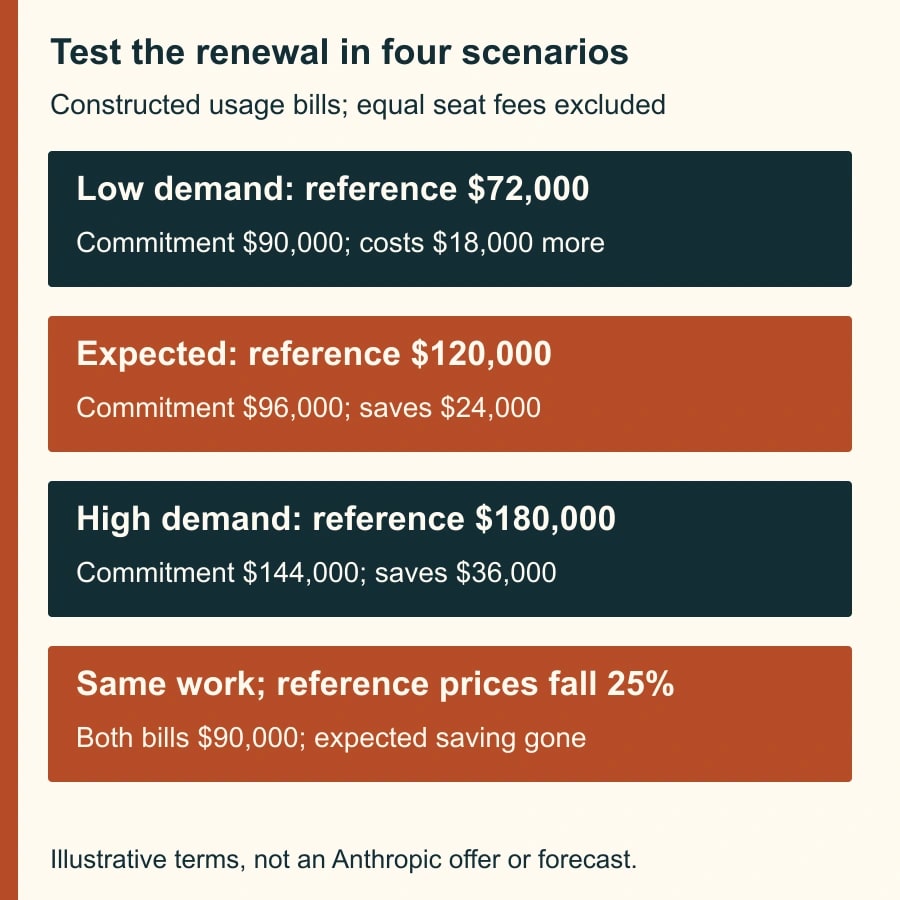
At the expected $120,000 reference usage, the discounted amount is $96,000. It exceeds the floor, so Proposal B costs $24,000 less than Proposal A. Add the illustrative $9,600 seat fee to both and the annual totals become $105,600 and $129,600. The equal seat charges do not change the difference, but they belong in the budget.
In a low-demand case, eligible usage would cost only $72,000 at reference rates. Discounted usage is $57,600, yet the commitment still costs $90,000. Proposal B is now $18,000 more expensive than flexible spending. The totals including seats are $99,600 versus $81,600. The unused portion of the minimum is $32,400; that is different from the $18,000 disadvantage compared with Proposal A. One measures utilization, the other compares decisions.
In a higher-demand case with $180,000 of reference usage, Proposal B costs $144,000, saving $36,000 on usage. That benefit assumes the additional work is wanted, eligible and affordable. A discount is not a reason to let an automated process run without an owner or a spending limit.
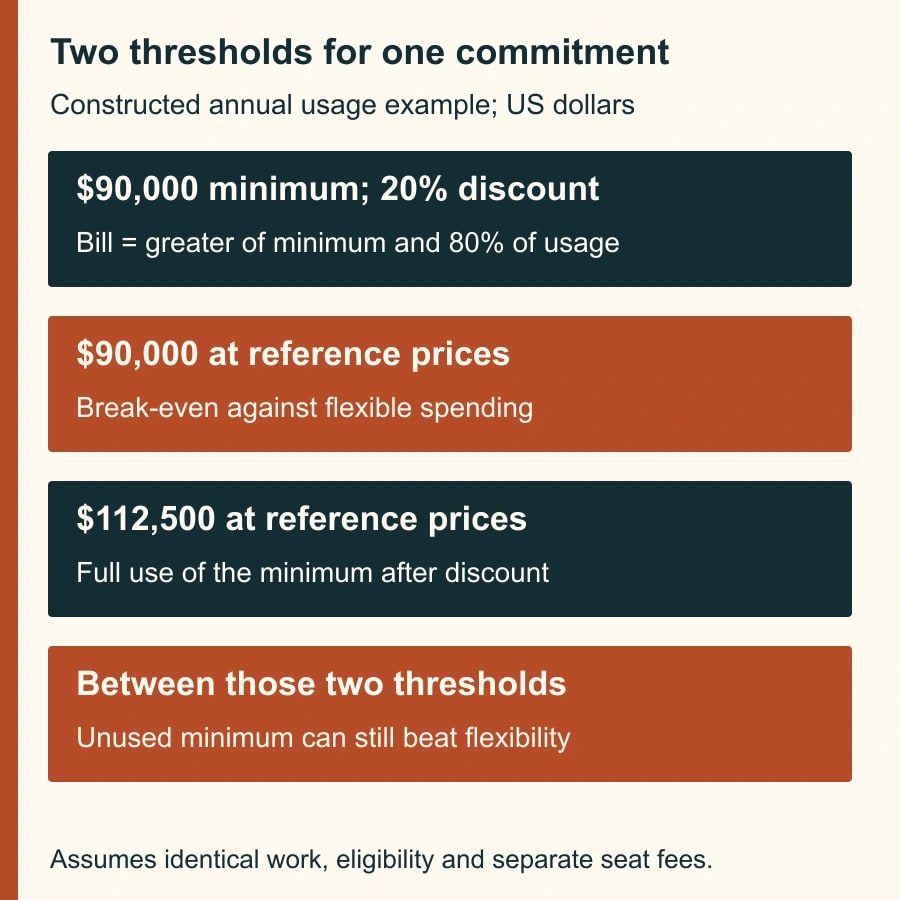
The first threshold is the point where the committed proposal stops costing more than flexible spending: $90,000 of annual reference usage in this example. At exactly that amount, both usage bills are $90,000. Above it, the commitment is cheaper under the stated terms.
The second threshold is full use of the spending floor at discounted rates: $90,000 ÷ 0.8 = $112,500 of reference usage. Between $90,000 and $112,500, some minimum remains unused, but the commitment can still beat flexible spending. Confusing these two thresholds can make finance reject an economical agreement—or celebrate a fully utilized agreement whose underlying work is wasteful.
A cheaper model can erase the expected saving
Now hold the work constant and change only its price. Suppose the expected workload’s reference cost falls 25%, from $120,000 to $90,000, and both proposals pass that reduction through. Flexible spending falls to $90,000. Discounted usage under Proposal B becomes $72,000, but the $90,000 floor remains. The two proposals now cost the same on usage. The anticipated $24,000 saving has disappeared, even though the product became cheaper.
This is a sensitivity calculation, not a price forecast. It demonstrates why procurement should test a lower-cost model or a more efficient workflow in the renewal model, alongside the usual low-volume case. Do not assume a discount is applied to future public prices rather than a fixed historical price list. Ask which price list changes, when it changes, and whether the commitment changes with it.
There is a real distinction between published list prices and temporary promotions. Anthropic’s rate card effective November 9 says promotional pricing does not modify the listed rates and applies only for the promotion’s period and terms. The document predates the IPO. It should not be described as a new post-listing price increase or decrease. Preserve the effective date and purchase route of the price evidence attached to your decision. Read the dated model list-price document.
A commitment can also affect incentives inside your company. When a finance dashboard treats unused credits as the only problem, teams may expand low-value activity to consume them. Keep the operating measure separate: work accepted by the responsible person, at the required quality and deadline. More tokens—small units of text used to meter many model calls—are not themselves more business value.
Negotiate the promises that make the model usable
The commercial owner should turn uncertain assumptions into questions that the supplier can answer in writing. Which models, tools, regions and purchasing routes count toward the minimum? Are new releases eligible? Is there a monthly floor as well as an annual one? What happens to unused amounts at expiry? Can different teams use one pool? When are payments due? A commitment settled annually and prepaid credits can have different cash-timing consequences even when their total cost looks similar.
Have the technical owner check the expected workload against the actual limits and service arrangements. A spending floor and a service-availability promise are separate things to verify. Ask what occurs if the relevant model is retired, a limit changes or delivery cannot support the agreed workload. Keep the outage-recovery assessment in our separate Claude supplier-continuity guide; today’s decision is how much spending to promise and what protections justify it.
The public Commercial Terms, effective June 17, 2025, say published rates can be updated and refer to rates otherwise agreed between the parties. Their fee section also describes the timing of published-rate changes. Read those terms with the actual order and have the person responsible for contracts resolve which provisions apply. A public webpage alone cannot establish your negotiated protections. Review the Commercial Terms’ fee section.
Do not award financial value to an unresolved promise. If a proposed capacity assurance has no clear scope, finance should not count it as the reason to accept a larger minimum. If a model-transition provision is important, test how it would work using one plausible replacement and its current workload. The decision record should name who confirmed the answer and where the evidence is stored.
Make one renewal sheet that somebody owns
Use a recent billing period with normal work and a separate peak period. Reconcile model charges to the invoice before projecting a year. Remove duplicate tests and unexplained retries from the forecast, but retain any costs that will genuinely recur. Separate approved production demand from hoped-for projects; an unapproved roadmap is a weak basis for a non-cancelable obligation.
- Finance owner: record the flexible annual bill, equal fixed fees, proposed minimum and payment dates.
- Workflow owner: identify eligible recurring work, expected demand and the smaller workload that remains if a planned rollout is delayed.
- Technical owner: record the model mix, limits, repeated calls, required quality checks and evidence that the forecast fits actual usage.
- Procurement owner: attach the signed or proposed price list, discount scope, expiry treatment, renewal deadline and written answers to open questions.
- Decision comparison: calculate low demand, expected demand, high demand and the same work at a lower reference price.
- Approval record: state the chosen option, rejected alternative, reasons, spending authority and date for the next review.
The worksheet’s expected output is a choice with a bounded downside, not a single optimistic savings number. In our example, a leader might accept the commitment because the business can support the low-demand disadvantage and the expected work is already established. Another might retain flexibility because the same $18,000 downside would consume the funds needed to finish the rollout. Both decisions can be rational; the organization’s cash constraints and confidence in the work determine the answer.
After signing, compare the billed eligible spend with the forecast each month and investigate material differences. Do not multiply an unusual launch month by twelve. Agree in advance when the owner must revisit the forecast—for example, when a major planned workflow is cancelled or a tested model materially reduces cost. If the agreement cannot be changed midterm, use the finding to control further expansion and prepare the next renewal rather than pretending the obligation has vanished.
What this means for the market and the future of AI
For investors, a minimum commitment can make some demand more predictable, but its existence alone does not show customer satisfaction or sustained value. The distinction matters after a heavily watched listing: spending secured by an agreement and spending willingly expanded after a useful deployment are different signals. Our earlier analysis of durable Anthropic demand examines the customer side of that question.
For business buyers, the optimistic interpretation is that suppliers will compete for reliable workloads and share efficiency gains through better commercial offers. The skeptical interpretation is that discounts will be paired with restrictions that shift utilization risk to customers. Neither outcome follows automatically from being publicly traded. The evidence to watch is the next real quotation, the price of completed work and whether customers can adopt improved models without wasting existing commitments.
For AI’s future, falling unit costs and rising total spending can coexist. Businesses may buy more useful work, or complex systems may consume more calls to finish one task. Our inference is that successful procurement will increasingly require agreement between the people building workflows and those signing contracts. A low advertised rate cannot settle a decision when the amount of work and the payment floor are both moving.
Before your next renewal, ask finance to reproduce the four scenarios on one page and ask procurement to resolve every assumption that changes the preferred option. Keep the current arrangement while those questions are unresolved, where your existing renewal terms allow it. Increase the commitment only when the work and written terms support the decision. For the financing context behind this series, return to what Anthropic’s IPO cash and market debut mean for AI buyers.
Weekly Newsletter
AI Adoption Weekly
New research, field guides, training studies, and tool decisions for operators.
No spam. Unsubscribe anytime.
Related Comparisons
Calculator
AI seat cost calculator
List price × headcount. You enter the hours and the operating assumptions.