
Anthropic After the IPO: Choose the Cloud Route, Check the Dependencies
Cloud billing, model dependence and chip supply are different decisions. Use a practical worksheet and a 90-day cost example to choose how your business buys Claude.
Published November 24, 2026

If you buy Claude for a business, choose the cloud route that gives your team the right controls, features and total cost. Then check which dependencies remain underneath it. Paying through a second cloud can change the invoice, service operator and capacity pool while leaving Anthropic as the developer of the model. Those are different decisions, and the public offering makes the distinction more useful to examine.
As of November 24, 2026, Anthropic has completed its initial public offering (IPO). Its November 20 closing announcement also records an approximately $26 billion private placement with AMD, Broadcom, Google, Micron, Microsoft, NVIDIA and TSMC Partners. That is investment capital, not customer revenue or a discount promised to Claude users. These partners span important parts of the computing supply chain. Anthropic’s closing announcement supplies the completed transaction, rather than preliminary offering estimates.
Today’s installment asks how those relationships should affect a purchasing decision. It is for technology, finance and procurement leaders choosing how an application accesses Claude. A small team using the ordinary Claude chat subscription can skip the route comparison until it has a concrete requirement that its current plan cannot meet. This analysis does not assume a new partnership was announced this morning, and it does not forecast the share price.
Four relationships sit behind one model name
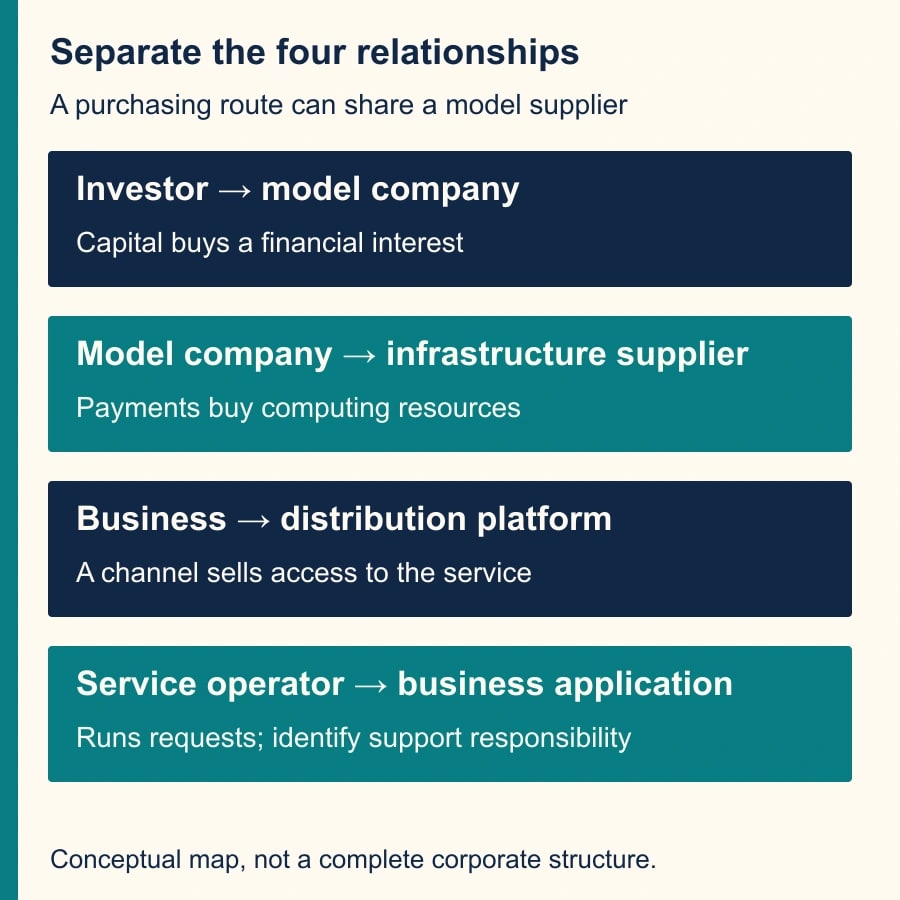
It helps to separate four transactions. An investor supplies capital in exchange for a financial interest. An infrastructure supplier sells computing resources. A distribution platform helps sell access to a model. A service operator runs the system that responds to your application. A company can occupy several of these positions, but the responsibilities do not become interchangeable.
In its final prospectus, Anthropic identifies Amazon, Google and Microsoft as investors, customers, distribution partners and competitors. It warns that those relationships “create potential conflicts of interest that are difficult to fully anticipate or mitigate.” The filing also describes computing across Amazon Web Services (AWS) Trainium, Google tensor processing units, and NVIDIA and AMD graphics processing units. These are different families of specialized chips used for AI. Anthropic says this approach helps it optimize price and performance. The benefits are company claims; the conflicts are disclosed risks, not evidence that a partner has mistreated a customer. Final prospectus, supplier risks and approach to compute.
The practical inference is to draw separate lines for money, computing and customer service. A chip supplier investing in Anthropic does not become responsible for your application’s support ticket. A cloud marketplace collecting payment does not, by that fact alone, operate the model service. Ask the seller to name the operator instead of treating the logo on the bill as the answer.
What the partners say, and what a buyer can conclude
The partnerships offer a credible positive case. Anthropic’s April 20 Amazon announcement described capacity expansion and continued investment, with AWS remaining its primary training and cloud provider. Amazon chief executive Andy Jassy said its custom chips offered “high performance at significantly lower cost for customers.” That is Amazon’s claim, not a measured reduction in your Claude bill. The same announcement tied capacity growth to a commitment of more than $100 billion over ten years. A multiyear purchase commitment is neither cash already spent nor capacity already delivered. Anthropic and Amazon’s April announcement.
Google’s April 6 announcement described additional capacity expected to start coming online in 2027, delivered through Google Cloud services and Google-designed chips supplied through Broadcom. The expected start date matters: a buyer should not count future infrastructure as an available reservation for this quarter. Google’s announcement.
The November 2025 Microsoft and NVIDIA partnership announcement described Claude expansion on Azure and joint engineering intended to improve performance and efficiency. That is useful historical context for the supplier relationships visible after the IPO; it is not a new November 2026 launch. The original partnership announcement.
Our interpretation is that access to several hardware families can give Anthropic more ways to improve its service. But a business buyer receives that benefit only when it appears in an accessible model, a reliable service or a better commercial offer. Do not budget a saving from a chip announcement. Put a dated supplier quote, an approved workload and a measured result in the budget instead.
The AWS example shows why the route needs a full name
“Claude through AWS” is too vague for an approval memo. AWS’s current comparison says Amazon Bedrock is AWS-operated, while Claude Platform on AWS is Anthropic-operated. It also assigns their quotas to different operators. AWS warns that the latter offering is not covered by standard AWS compliance programs, certifications or audit reports. A familiar purchasing channel therefore cannot substitute for review of the actual service. AWS’s comparison, checked November 24.
Anthropic’s current documentation distinguishes Claude Platform on AWS, Claude in Amazon Bedrock, a Claude Enterprise chat plan bought through AWS Marketplace, and direct Anthropic accounts. It says Claude Platform on AWS has a separate capacity pool from the first-party Claude API and Bedrock. It also says existing first-party keys, workspaces and settings do not carry over to the new organization. An application programming interface, or API, is the connection software uses to send requests to a service. Anthropic’s platform documentation, checked November 24.
Separate capacity is useful evidence when planning an alternative route. It is not proof that every possible failure is independent. The buyer still needs to test the required model version, account permissions and application behavior. Changing routes may help with a particular capacity shortage without changing the organization that develops Claude. Describe the failure you want to survive before paying for a second route.
This is also why a blanket recommendation to buy direct, or to put everything through an existing cloud, would be weak. Direct procurement may fit a team that values a specific platform capability. A cloud route may fit a team whose existing operations make support and purchasing easier. The deciding evidence is the actual workload and offer, including the work needed to make that route usable.
Compare one approved workload before comparing every feature
Start with an application that already has a business owner. For example, a service operations team might want drafts of internal incident summaries, with source links and human approval before circulation. The owner supplies approved sample records, a definition of an acceptable summary and the deadline each summary must meet. Security identifies which records may enter the trial. Finance supplies the actual billing agreement and any eligible credits.
The technical lead then asks each candidate seller for the exact product, model version, permitted location, usage limits, support contact and required features. Record a verification date beside each answer. Use the provider’s feature documentation to check the particular capability; do not assume a feature mentioned on a general Claude page exists on every route. Claude’s feature overview links to the individual feature descriptions.
Run the same approved sample set through the candidates without sending drafts to customers or changing production records. Keep the inputs, model settings, outputs, review decisions and billed usage together. A business reviewer should judge the drafts without knowing which purchasing route produced them where that is practical. This reduces the temptation to reward the route the technology team already prefers.
A useful trial output is a short acceptance sheet: correct summaries, missed facts, unsupported statements, time to an approved result, failed requests and total cost. Set thresholds before the run. For this internal example, a team might require every critical fact to survive review and at least 95 of 100 summaries to meet the deadline. Those are illustrative business rules, not published product performance. One missed safety-critical fact could still stop the trial regardless of the aggregate score.
A $12,000 credit is worth what you can actually use
Consider a constructed 90-day comparison for that incident-summary application. These are invented purchasing assumptions for arithmetic, not vendor prices, negotiated offers or observed customer results. Both candidates are assumed to pass the same quality and security checks, process the same workload, and incur identical human review costs. Taxes are excluded. The numbers below isolate costs that differ between the routes.
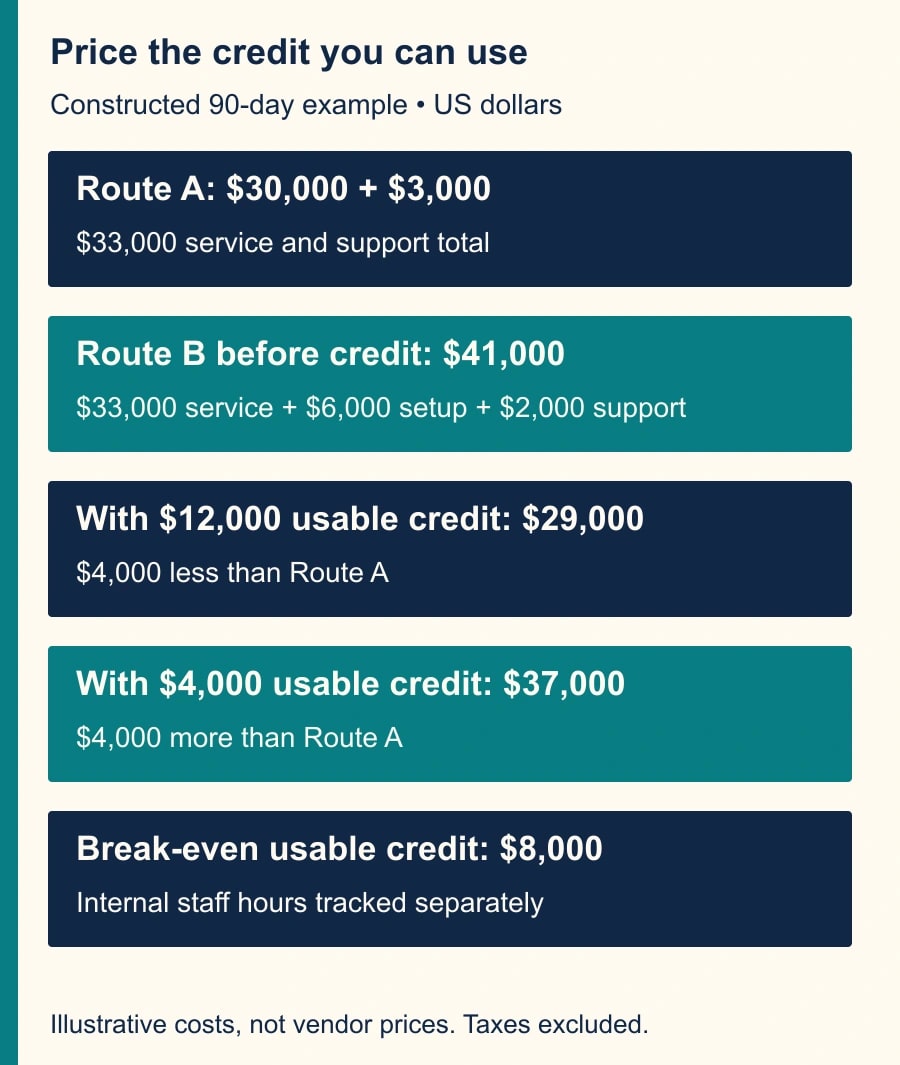
Route A is an existing direct service. Its expected service bill is $30,000 for 90 days, with no new integration work and $3,000 of incremental support expense. Total incremental cash cost: $33,000.
Route B is a proposed cloud service. Its expected service bill is $33,000. Finance confirms that an existing $12,000 credit is eligible, would otherwise expire unused, and can be fully applied during this period. Migration requires $6,000 of paid external integration work; incremental support costs $2,000. Total incremental cash cost: $33,000 minus $12,000 plus $6,000 plus $2,000, or $29,000. Under those assumptions, Route B costs $4,000 less over 90 days.
Now change only credit eligibility. If just $4,000 can be applied, Route B costs $37,000, which is $4,000 more than Route A. The break-even usable credit is $8,000: the amount needed to bring Route B’s $41,000 before-credit total down to $33,000. Do not substitute the headline credit balance for that verified usable amount.
The comparison gets more interesting when the credit could pay for other necessary cloud work. In that case, applying it to Claude consumes an alternative benefit. Finance should compare the company’s total cash spending across both uses, rather than counting the same credit twice. Similarly, an existing spending commitment can alter the marginal cost of a new workload. Have finance model the actual agreement; a credit and a minimum-spend commitment are not the same instrument.
Internal engineering time belongs in the decision even when it does not create a new invoice. Suppose the migration also consumes 40 hours of salaried work. Record those hours separately as capacity displaced from other projects. Do not call them a cash expense unless the business actually pays additional cash, and do not call fewer review hours cash savings without a budget change. Route B might win the cash comparison and still be the wrong use of a scarce engineering week.
Use this purchasing worksheet in the approval meeting
Copy the following questions into a one-page decision note. The procurement owner should bring completed answers rather than an unranked list of cloud brands. Unknown answers are work to finish before approval, not reasons to assume the favorable outcome.
- Business owner and job: Which recurring task is moving, what output must be accepted, and who can stop the rollout?
- Exact route: Which product and account will send the request, which company operates the service, and who handles an incident?
- Required capabilities: Which model version, tools, locations and usage limits have been confirmed for this account? Attach dated evidence.
- Data approval: Has the security owner approved this specific service and its processing arrangements for the intended records?
- Cost: What are the service, migration, support and overlapping-operation costs? Which credits are eligible, usable and otherwise unused?
- Trial result: How many inputs were tested, how many outputs passed review, which failures occurred, and what did an accepted result cost?
- Remaining dependencies: Which model developer, cloud service, identity system and application components remain shared with the current route?
- Exit decision: What would make the business retain the current route, accept the new one, or stop? Who owns the next check and its date?
For a small deployment, keep the comparison proportionate. If there is no unresolved control problem and the potential saving is smaller than the cost of migration, renew the working route and revisit it at the next meaningful contract or product change. Buying through several channels creates work of its own. It should answer a named need.
What can go wrong after the decision
The first failure is commercial: the credit or discount does not apply. Detect it on a small, approved billing sample before moving the full workload. Finance should match the billed product and account to the written offer. If they do not match, pause the migration and ask the supplier to resolve the discrepancy. Do not keep spending on the assumption that an adjustment will arrive later.
The second is functional: a model name matches, but a needed feature, permission or usage limit differs. Detect this with the exact task and account, including a deliberately failed request. Keep the original route available until the new one passes. If the new route cannot meet the requirement, return the application to the working service and document which capability blocked the move.
The third is operational: changing the route changes who can diagnose an incident. Before launch, make the application owner locate one request in the available logs and identify the appropriate support path. Check that the reviewer can still see the source material behind a draft. Stop if the team cannot reconstruct what happened. A lower bill does not compensate for losing the ability to explain a business output.
After approval, watch cost per accepted summary, missed deadlines and correction rates for the first billing period. Compare like-for-like work: a shorter input or an easier queue can improve the numbers without the new route contributing anything. Reopen the decision if a required control fails, the actual usable credit falls below the agreed threshold, or quality falls outside the acceptance rule.
The market can reward both expansion and dependence
The optimistic market interpretation is straightforward: infrastructure suppliers helping finance a model developer can accelerate capacity, distribution and useful applications. More places to sell Claude could make the business less reliant on a single sales channel. Engineering across chip families could improve bargaining options and efficiency. These are plausible mechanisms, not a forecast that every investment will earn an adequate return.
The skeptical interpretation is also credible. Investment announcements and infrastructure purchasing can reinforce one another while outside customer demand remains the harder question. Investment capital received by the model developer and revenue the supplier earns selling computing to it are different economic events. Adding them together as evidence of end-user demand would double-count the story. The information a reader wants next is whether businesses keep buying useful work at sustainable costs.
For the future of AI, our inference is that competition may occur at several levels at once: model capability, chip efficiency, cloud distribution and the application that earns the customer’s trust. A stronger position at one level need not produce lower prices at another. Buyers can encourage useful competition by maintaining a clear task specification and comparable acceptance results, so a credible alternative can be evaluated without rebuilding the entire business case.
The next action is modest: ask your procurement and technical leads to complete the worksheet for one important Claude workload. Resolve who operates it and what the usable credit is before approving a route change. For the financial backdrop, start with the series entry on Anthropic’s IPO cash and market debut. For a renewal already on the desk, use the minimum-spend and flexible-budget comparison. The supplier-continuity installment covers the separate question of what to do when service is interrupted.
Sources and method
Primary announcements, the final prospectus and current product documentation were opened and checked November 24, 2026. Partnership announcements retain their original dates; expected capacity is not described as delivered. Quoted statements are attributed to their original speakers or document. Product operation and financial disclosures are provider statements. The purchasing process, competing interpretations and 90-day example are editorial analysis, not a vendor benchmark or customer case study. No stock-price forecast or unverified trading quote is used. This is Day 5 of the daily Anthropic IPO series.
Weekly Newsletter
AI Adoption Weekly
New research, field guides, training studies, and tool decisions for operators.
No spam. Unsubscribe anytime.
Related Comparisons
Calculator
AI seat cost calculator
List price × headcount. You enter the hours and the operating assumptions.