
Anthropic After the IPO: Who Can Say No to Growth?
Who controls Anthropic after its IPO? Separate trust, founder and board powers, then test what supplier governance means for your business.
Published November 25, 2026

Anthropic's governance deserves attention before you give Claude more responsibility in your business. The useful question is who can change a decision when commercial pressure and safety concerns collide. Our assessment: treat the company's unusual structure as a reason to examine its decision process, while keeping your own approval limits, incident procedures and contractual protections in place.
This is Day 6 of our Anthropic IPO series, checked November 25, 2026. Anthropic announced that its initial public offering closed on November 20; public trading began November 19. Those are completed events, not a proposed listing. Anthropic's closing announcement establishes that sequence. Today's focus is the division of authority after the offering, rather than another account of the money raised.
There is fresh market pressure around that question. Axios reports a November 24 closing price of $81.91, below the $83 offering price. Read the dated market report. These figures are dated. A falling share price can raise difficult questions about growth, but it does not establish that a company has weakened a safeguard or explain why any particular product decision was made.
This analysis is for a business technology leader, procurement owner or executive deciding how much operating responsibility to give an AI supplier. Investors can use the same distinctions to examine incentives. Skip the detailed worksheet if Claude only helps draft low-stakes internal notes with human review. Use it before expanding into customer communications, important records or workflows that would be difficult to pause.
Start with the powers, rather than the mission statement
The final prospectus describes several distinct rights. The Long-Term Benefit Trust generally elects and removes Class T directors, who constitute a majority of authorized board members. The Trust does not manage day-to-day operations or set strategy. A founder-controlled entity holds Class F stock carrying 50.1% of voting power on matters submitted to shareholders generally, including election of non-Class T directors. Class E employee shares have limited voting rights on specified matters; they do not create a general employee vote over releases. Procedures allow changes to Trust rights, including conditional routes without trustee consent. See the final prospectus's governance and capital-stock sections.
The company's corporate governance guidelines add a qualification worth understanding: one specified Class T director nomination requires committee approval, with an employee vote available if the committee does not approve and the Trust proceeds. The guidelines assign the board “responsibility for risk oversight.” These are governance documents, not evidence that a particular intervention has occurred. Read the guidelines adopted October 23, 2026.
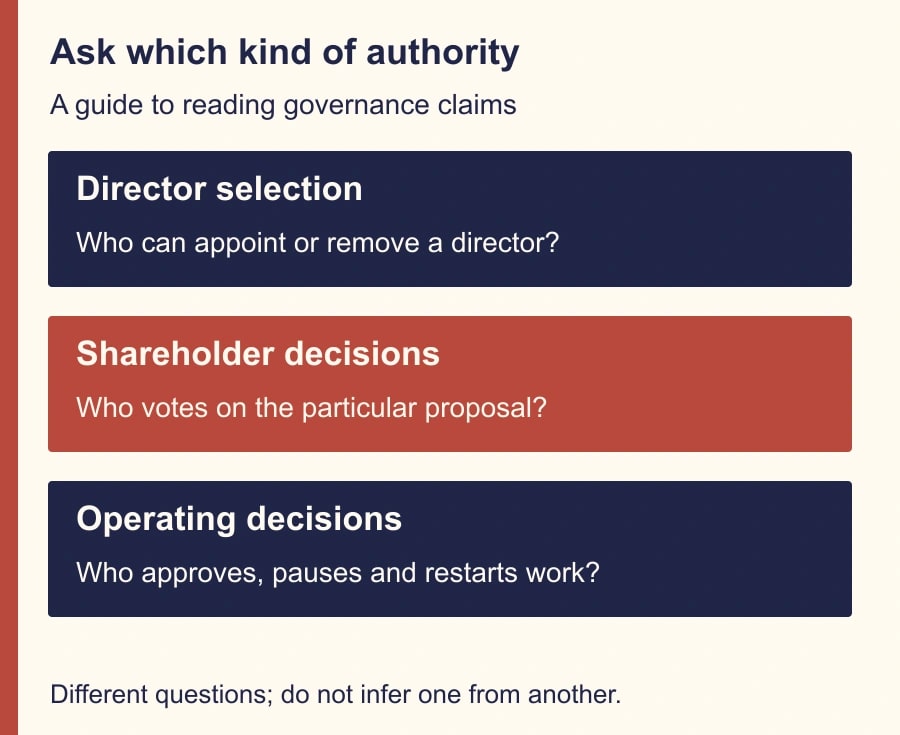
For a reader, the distinction is practical. Selecting a director, voting on a shareholder proposal and authorizing a product launch are different acts. Ask which act a claim describes before drawing a conclusion about control. Neither a percentage of shareholder votes nor a statement about board composition tells you the entire decision process.
The Trust's original 2023 explanation called it “an experiment.” That historical description matters because the company itself presented the arrangement as something to evaluate, with amendment mechanisms, rather than a proven answer to every future conflict. The older announcement should not replace the offering documents when checking current rights. Read Anthropic's original explanation of the Trust.
Our interpretation is that the structure creates several places where disagreement can become consequential. It also creates questions about how participants coordinate and how outsiders learn what happened. A useful assessment therefore needs two columns: formal authority and observable conduct. Leave the second column blank when the evidence is unavailable. Do not fill it with confidence borrowed from the first.
Public benefit is a duty to balance interests, not a customer warranty
A Delaware public benefit corporation remains a for-profit corporation. Sections 362 and 365 require balancing shareholders' financial interests, the interests of people materially affected by the company's conduct and the stated public benefit. Section 365 also limits duties owed to people merely because they have an interest in that benefit. Section 366 requires a shareholder statement at least every two years; public availability and third-party certification are not universal statutory requirements. Read Delaware's public-benefit corporation provisions.
The business implication is narrower than a claim that a supplier is inherently safe. A mission and its legal framework help explain the organization's objectives. They do not specify your response time during an incident, your right to retain a model version or the remedy if a service becomes unavailable. Your purchasing team still needs to establish those terms in the documents governing your service.
Keep legal interpretation with counsel. Give counsel a concrete question: which signed term or applicable rule supports this particular protection? A general request to bless the supplier's governance is hard to answer usefully. A request to verify whether your agreement promises notice before a specified change produces a decision you can act on.
There are two reasonable readings of a strong public-benefit commitment. It may support long-term judgment when immediate revenue would favor a riskier choice. It may also permit decisions that disappoint customers who expected a faster rollout. Neither possibility makes the commitment meaningless. Both mean buyers should plan around products they can use today and protections they can identify, rather than treating an announced roadmap as a delivery obligation.
Watch the evidence process as closely as the organization chart
Anthropic's current Responsible Scaling Policy page identifies version 3.4, effective July 8, 2026. It describes a voluntary framework addressing catastrophic AI risks. Its July update explains changes to risk-report coverage dates, internal distribution and external review. These are the company's descriptions of its process, not our certification that every requirement has been met. Read the current policy and version history.
The public Frontier Safety Roadmap says, “These roadmaps are subject to change.” It records a May 5 decision to move a project target from May 15 to September 30 while prioritizing other safety work. That is evidence of a disclosed prioritization change, not proof of a current missed obligation or a post-IPO retreat. Read the roadmap and dated updates.
For your own assessment, a changed target should trigger a sequence of questions. What changed? What reason was given? What evidence supports the replacement approach? Does the change affect a dependency in your approved workflow? Who will decide whether that dependency is still acceptable? The answer may be that nothing in your current use is affected. Document that conclusion instead of turning every corporate update into a purchasing emergency.
An effective review also separates the date of an assessment from the date of its publication. A report released this morning might describe an earlier system or period. Record both dates when you rely on it. Otherwise, an apparently fresh source can silently become evidence for a system it never examined.
A missing public detail is an uncertainty, not proof of misconduct. Some security information cannot sensibly be public. Ask for an appropriate customer assurance, a permitted review or a narrower deployment. Do not demand sensitive technical details your team cannot protect or interpret. The objective is enough evidence for your decision, not an unlimited collection of documents.
A constructed exercise: expansion meets an unresolved question
Consider a fictional business-services company that uses Claude to help prepare customer replies. It processes 2,400 cases a month. A person checks every draft and sends the final response. The operations director proposes allowing the system to send certain replies automatically after a model upgrade. At the same time, the supplier publishes a safety-policy revision that the security owner has not yet assessed. This is an illustrative scenario, not a reported Anthropic incident.
The wrong shortcut is to let a corporate governance description settle the operational question. The relevant decision is whether this particular workflow is ready for additional authority. The operations director owns that decision; security assesses the new information, the support lead owns customer outcomes, and procurement checks the service terms. None of those roles disappears because a supplier has a board-level oversight structure.
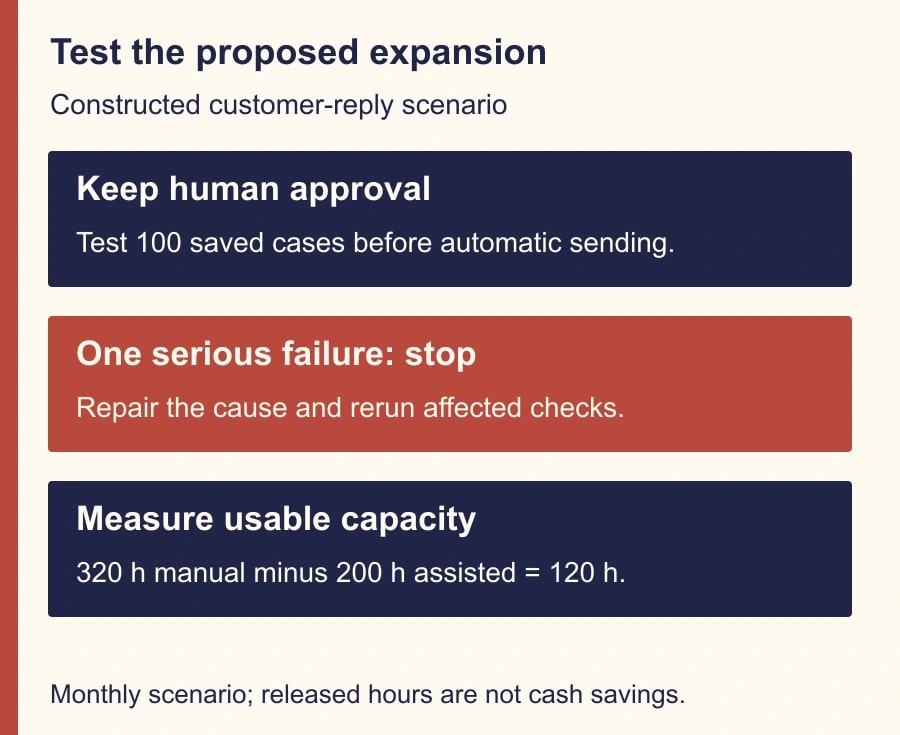
Begin with a saved set of 100 sanitized cases representing routine requests, ambiguous requests and requests that require escalation. The team writes expected handling before running the upgraded model. That prevents people from redefining success after seeing attractive answers. Keep the existing reviewed workflow in service while the proposed automatic-send route remains disabled.
Set explicit acceptance rules for the exercise. In this example, any disclosure of restricted information or any unauthorized promise blocks automatic sending. The support lead also checks whether replies preserve the customer's intent and route exceptions to a person. A 100-case check can expose problems; passing it cannot establish that rare failures are impossible. Broader release approval must consider the consequences and coverage of the tests.
Suppose the proposed route fails on six cases, including one unauthorized commercial promise. These are constructed results. The team keeps human approval, records the affected case types and asks for a correction or narrower scope. It does not average the serious failure into a reassuring 94% pass rate. An answer that is fluent but commits the company to the wrong terms requires judgment about authority, not just writing quality.
For the capacity calculation, assume manual handling takes eight minutes per case. Monthly work is 2,400 × 8 ÷ 60 = 320 hours. Assisted drafting with continued review takes five minutes per case: 200 hours. The difference is 120 hours of released capacity a month. It becomes cash savings only if a real spending decision reduces cost; this exercise assumes no such reduction.
Now price the additional assurance work. Assume eight hours of security review at an internal planning rate of $90 per hour and four hours of operations review at $60: $720 + $240 = $960. These are hypothetical labor allocations, not vendor charges or a claim that $960 buys adequate assurance. If existing staff do the work, it consumes capacity that could have served another task.
The director can therefore compare a usable, reviewed workflow with a proposed expansion whose evidence remains incomplete. Continuing the reviewed route preserves the modeled capacity benefit while the team resolves the automatic-send question. The exercise does not require predicting whether trustees, founders or directors would intervene in an unrelated corporate dispute.
Use this one-page decision record at the next review
Prepare the record before a supplier meeting. Inputs are the actual service agreement, your approved workflow description, the relevant dated supplier documents and the results of your own checks. Assign one owner to consolidate the answers. For a modest workflow, start with a 45-minute internal meeting; complex uses may require substantially more work.
- Decision: What exact new action would the AI be allowed to take? Name the system, customer group and limit.
- Current protection: Which actions require a person today? Who can pause the workflow, and has that person demonstrated the control?
- Supplier evidence: Which document supports the governance or safety claim? Record its version, publication date and assessment period.
- Authority: Does the claim concern director selection, shareholder voting, management action, a voluntary policy or your service agreement?
- Uncertainty: Which unanswered question could change approval? Name the person responsible for resolving it and the next review date.
- Customer protection: Which signed term covers notice, support, permitted use or remedies? Ask procurement and counsel to verify the relevant wording.
- Test: Which saved cases and acceptance rules represent the proposed work? Record failures individually, including their consequences.
- Decision and recovery: Continue, narrow, defer or approve. State who can reverse the decision and what evidence is needed to restart.
The expected output is a signed decision record with links to evidence, not a numerical supplier score assembled from impressions. If the answer is “defer,” describe the missing evidence precisely. “Wait for more clarity” leaves everyone guessing. “Security must assess version X against our approved data-handling requirements before automatic sending is enabled” assigns a finishable task.
Measure whether the process works. Track time from a relevant notice to an owner decision, unresolved questions past their review date, serious test failures and the time needed to pause the workflow. Do not confuse a fast review with a good one. A prompt decision to keep a restricted deployment may be more useful than a rushed expansion.
Stop the expansion if no owner accepts responsibility, the pause control fails, a critical test fails or required contract protection remains unverified. Recovery means repairing that specific gap, rerunning the affected checks and having the accountable owner sign again. A reassuring earnings call or a stronger share price should not substitute for that work.
What this means for the market and the future of AI
Our market interpretation is that investors must evaluate a company's ability to earn money alongside the constraints under which it chooses to operate. Two businesses with similar revenue can make different release decisions, disclose different evidence and give different groups influence over leadership. A revenue multiple alone cannot answer whether those arrangements improve long-term performance.
The optimistic case is that durable oversight makes difficult decisions more credible. If an organization can fund research, retain capable people and delay a release when evidence warrants it, customers may gain confidence in long-term reliability. That is a plausible mechanism, not an observed investment return attributable to Anthropic's structure.
The skeptical case is that formal rights may be difficult for outsiders to evaluate in practice. People can disagree about acceptable evidence, and an intricate structure may complicate accountability. Customers and investors need to know which decisions were made, what changed and what consequences followed. Counting committees or celebrating a mission statement does not resolve that information problem.
For the future of AI, the meaningful test is whether governance produces usable learning. A well-explained correction can help other organizations improve their own review. An unexplained reversal teaches little. We would watch for specific decisions, dated evidence, clear responsibility and candid accounts of trade-offs, rather than treating either relentless acceleration or repeated delay as an automatic sign of success.
For your business, choose one workflow scheduled for expansion and complete the decision record this week. Keep the supplier's corporate structure in the evidence file, then establish who inside your organization can say no. For the financial background, read the series entry on Anthropic's IPO and buyer budgets. Before making a larger commitment, use our Claude renewal and minimum-spend analysis and guide to choosing the cloud purchasing route.
Weekly Newsletter
AI Adoption Weekly
New research, field guides, training studies, and tool decisions for operators.
No spam. Unsubscribe anytime.
Related Comparisons
Calculator
AI seat cost calculator
List price × headcount. You enter the hours and the operating assumptions.