
The Future Last Week: AI Moves Into the Work, and the Bill Comes Due
GPT-6 turns answers into interactive tools, Google wants one agent across your workplace, and Anthropic makes small-model work cheaper. Meanwhile, AI science gets serious funding and the power bill becomes impossible to wave away.
Published October 10, 2026
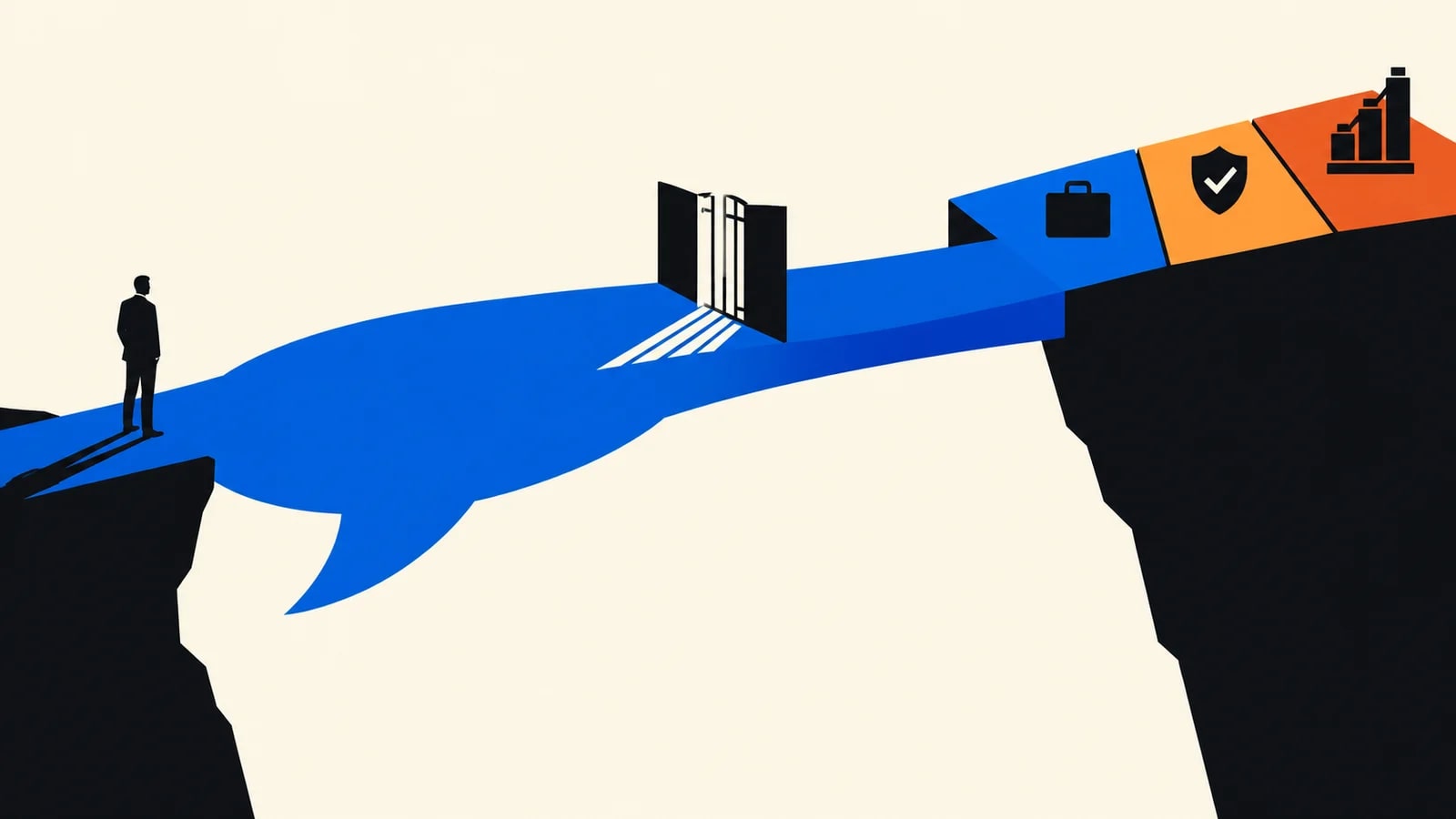
The most useful AI news this week was not that one model scored a few points higher. It was a change in the shape of the work. OpenAI began turning a chat answer into an interactive tool. Google presented an agent that can follow a job across the software a company already uses. Anthropic made smaller, faster tasks markedly cheaper. These are different products, but they point in one direction: more work can start with a request and continue beyond a paragraph of text.
That is exciting. It also moves the buying question. A handsome answer is easy to admire; a finished action needs a source, permission, review, and price. This issue covers developments announced October 5–9, 2026. I am more optimistic than worried about the direction, because the tools are becoming genuinely more useful. The organizations that benefit first will be the ones that make those four things visible.
The week in one minute
- OpenAI rolled GPT-6 into ChatGPT with “Intelligent UI,” which can make interactive charts, forms, and small task-specific tools inside a conversation. It is rolling out across paid and free tiers, subject to plan and workplace settings; this does not change the models in Codex or Work.
- Google announced a Gemini agent for work, designed to act across documents, email, code, and connected business systems. The design is broad; buyers should verify which pieces are available in their own edition and how an agent’s access is controlled.
- Anthropic released Claude Haiku 5.5 for high-volume tasks. Its listed input and output prices for requests up to 100,000 tokens are $0.10 and $0.50 per million tokens. Anthropic estimates typical running cost about 75% below Haiku 4.5; the completed-work cost still depends on mistakes and review.
- OpenAI described a new ChatGPT ad format that it plans to test later this month with an initial U.S. advertiser group. The ads are to appear during image generation for Free and Go users. This is an upcoming test, not a generally available channel or proof of return.
- Google and Constellation signed a power agreement intended to add 890 megawatts of nuclear output through upgrades at existing plants. A Senate investigation challenged whether data-center developers pay the full community and grid costs of growth. Both point to the same unanswered question: who pays, at a specific site?
1. The answer is becoming an interface
On October 7, OpenAI introduced GPT-6 with Intelligent UI in ChatGPT. Instead of returning only prose, the system can assemble a visual explanation, interactive comparison, or small calculator suited to the question. OpenAI’s examples include a bill splitter and a retirement-savings calculator. The company says GPT-6 can start a response while it continues reasoning, and reports that its Instant model begins answers involving web search 44% sooner on average than GPT-5.6 Instant in an internal test. That speed figure is a provider test, not a guarantee for your users or your network.
The immediate business application is not “replace the software department.” It is to let someone explore a choice without commissioning a new dashboard each time. A sales manager might compare three discount scenarios; an operations lead might vary staffing assumptions. OpenAI says the feature is rolling out in the Chat tab to paid plans and then Free and Go, with Enterprise availability depending on administrator settings. It specifically says the models powering Work and Codex are not changing in this release. If your team uses those products, do not assume this announcement altered them.
Real, hype, and your move
Real: a model can present an answer in a form people can use, and the interface can be created for the task at hand. Hype: a polished calculator has validated inputs. Try one low-risk decision with numbers you already know. Change an input, inspect the arithmetic, and ask a person who owns the underlying data to check it. The signal to watch is whether people reach a correct decision faster, not whether the interface looks impressive.
2. Google wants the agent to follow the job across work
At its October 8 Gemini at Work event, Google Cloud presented the Gemini agent as one assistant spanning questions, documents, email, analysis, and code. Google says it can run tasks after a user leaves, draw on connected systems, and use different underlying models for different jobs. It also described agent identities, logs, permission controls, and spending caps. This is an unusually explicit admission that an agent is not just a clever chat box. Once it touches shared records and acts over time, it needs an identity and a bill someone can inspect.
The most interesting detail is the proposed “coworker agent” with its own workspace account, email address, storage, and permissions. Think of a project coordinator that drafts a launch checklist from a team’s documents, then posts it back for review. That is a useful job. It is also a good test of whether old access rules still make sense: if a document is shared with a group, should the agent see it? Who notices if a draft goes to the wrong group? A vendor’s account of its controls is a starting point, not a completed security review.
Real, hype, and your move
Real: the major workplace platforms are converging on agents that can continue a job in the software people already use. Hype: one prompt means a finished, approved outcome. If you are a Google Workspace buyer, ask for a live demonstration using your own document permissions, one ordinary task, and a visible activity record. If you are not, the lesson still applies: before an agent updates a record or sends a message, name its owner and the exact approval point. Our guide to shadow AI in live work helps map the tools your teams already use.
3. Cheap intelligence is useful only if the whole task gets cheaper
Claude Haiku 5.5 arrived October 7, aimed at short, frequent work such as summaries, classification, quick lookups, and support responses. Anthropic lists much lower token prices than Haiku 4.5 and estimates roughly 75% lower average running cost. It also cut the price of reads from a previously stored prompt or context for Sonnet 5.5, which it says reduces the cost of many multi-step agent tasks by around 20%. These are vendor price and usage estimates as of October 10; model calls are only one part of the business cost.
The early customer details are more useful than a benchmark leaderboard. Asana says its task-completion test saw over 30% less delay than its current model for an AI teammate product. HubSpot says the model averaged 92.8% across three runs of its simulated customer-record tasks. Those are customer-reported tests, in different settings, not a head-to-head trial for your company. They tell you where to look: repeated, narrow work where a small model may be good enough.
Real, hype, and your move
Real: lower call prices make previously uneconomic small tasks worth retesting. Hype: a 75% cheaper model means a 75% cheaper process. Use twenty of your own cases, including awkward ones. Record model charges, retries, accepted outputs, and reviewer minutes. If the output needs more correction, the bargain may disappear. The AI business-case worksheet keeps released time separate from money actually saved.
4. The ad business meets the conversational answer
OpenAI said on October 5 it will test a visual ad format during image generation for Free and Go users, beginning later in October with an initial U.S. advertiser group. It also described conversion-data connections with Hightouch, Tealium, and LiveRamp, plus brand-suitability work with DoubleVerify and Integral Ad Science. OpenAI says ads will be labeled and separate from the image, and will not influence ChatGPT’s answers. That is the company’s policy statement; buyers and users will judge the experience in practice.
For a marketer, this is not a reason to move a budget from search next week. Image creation may be a moment of purchase intent, but an impression during an AI session is not a qualified lead. In OpenAI’s announcement, the company cites e-commerce analytics provider Triple Whale’s observation that 93% of Portland Leather visitors from ChatGPT Ads were new; the post does not give an independent study of conversion or profit. Ask what the ad reached, what people did afterward, and whether the extra sales were genuinely incremental rather than a different route to a purchase they would have made anyway.
Real, hype, and your move
Real: a major AI destination is building a measurable advertising business. Hype: a new surface is automatically a new audience at an attractive cost. If your customers discover products visually, prepare one small test only when access, placement reporting, and a conversion measure are clear. Keep a holdout group if possible; do not count every attributed sale as a new sale. The signal is repeatable profit after ad and creative costs.

5. Science is getting projects, not just predictions
Two science announcements deserve attention without pretending they will change every company on Monday. On October 8, the U.S. Department of Energy selected 12 Phase II projects for $159 million in awards. One, led by Commonwealth Fusion Systems, aims to build a computer simulation of its SPARC fusion device to test and improve operations before trying a change on the machine. Others target geothermal reservoirs, enzymes, quantum hardware, and scientific software. Anthropic separately committed $150 million over three years in Claude access, credits, training, and support for Genesis Mission projects. A funding award and a company commitment are inputs, not discoveries already delivered.
OpenAI also released mathematical results produced with an internal frontier model, including some computer-checkable proofs and more detail about how the work was obtained. That is a more promising direction than a press-release claim alone: other mathematicians can inspect the argument. It is not evidence that the same model can design a drug, manage a factory, or replace an expert reviewer. Scientific value appears when a result survives independent scrutiny and, where relevant, physical testing.
Real, hype, and your move
Real: scientists now have more funded projects, tools, and inspectable outputs. Hype: every announced project is a breakthrough. If you lead research and development, choose one slow step where AI could help generate candidates or check a calculation, then preserve the expert and experimental checks. Everyone else can watch for published results that another team reproduces. A frontier math result is important; it is not a procurement order for the average firm.
6. More power for AI is possible; who pays is still contested
On October 6, Google and Constellation announced a 20-year agreement intended to add 890 megawatts of output by upgrading 11 existing nuclear units in Illinois, Pennsylvania, and New Jersey. The companies say Constellation will invest more than $4.3 billion. This is a plan to increase generation, not 890 megawatts already connected today. It is a more concrete response to AI power demand than merely buying a claim to existing clean electricity.
Then on October 9, Senators Elizabeth Warren, Chris Van Hollen, and Richard Blumenthal released an investigation arguing that large data-center developers dispute paying for some shared grid upgrades triggered by their projects and often seek confidential agreements. Their report is a critical investigation based partly on company responses, not a finding that every project shifts the same costs. The constructive response is to make the cost allocation and local impacts public enough to test. Google and Constellation’s new supply may help; it does not, by itself, settle every town’s bill.
Real, hype, and your move
Real: AI growth has a physical price, and major buyers are now signing projects to add supply. Hype: a nationwide announcement proves local rates or water use are protected. If you build facilities, ask for the site-specific power date, upgrade payer, water plan, and public reporting. If you buy AI services, ask providers how capacity constraints could affect contract price and reliability. The signal is delivered generation and transparent cost allocation, not just megawatts announced.
The trust story under all of this
OpenAI reported this week that it banned accounts tied to two covert influence operations, one linked to Russia and one originating in Iran. The report says the Iran-origin group used seven deceptive bylines to pitch articles and that OpenAI identified almost 100 published or syndicated pieces across roughly a dozen outlets. The company also cautions that the operators exaggerated parts of their own impact. This is a provider investigation, but it is a useful warning: fluent writing, a plausible name, and publication on a real site do not establish who stands behind a claim.
That matters to this publication too. A named byline should never be a substitute for inspectable sources or a real editorial process. If your communications team is offered a polished guest article about a political or commercial claim, check the sender, funding, and cited documents before attaching your brand to it. If procurement receives a striking market report, trace any decision-changing number to the original record. The answer is not to distrust everything. It is to make verification easy enough that good information can win.
What people are saying
The reactions are telling because they focus on different costs. In Anthropic’s launch post, HubSpot engineer Ze’ev Klapow calls Haiku’s result “the best score we’ve seen on this suite yet,” referring to HubSpot’s own customer-record test. Google energy lead Amanda Peterson Corio says new power should come while “protecting energy affordability.” The three senators’ investigation challenges whether developers pay their “fair share” of grid and community costs. The first two are company and customer voices; the third is a critical public inquiry. Taken together, they make a better buying question than “Which model won?”: who gets the benefit, who checks the output, and who pays for the system around it?
Five moves for Monday
- Take one recurring decision and try an interactive AI answer with known inputs. Have its owner check the arithmetic and whether a person actually decides faster.
- Pick one cross-app agent task. Write down the records it may read, the actions it may take, the approval point, and where its activity can be reviewed.
- Retest a small model on twenty real cases. Count accepted outcomes, retries, reviewer minutes, and the complete charge—not just price per token.
- If you advertise, do not budget around the new ChatGPT image ad format yet. Define the conversion and comparison group you would need when the test becomes accessible.
- For any data-center or AI-capacity proposal that affects your business, ask who funds the specific grid upgrades and when new supply is expected to arrive.
My bet: the next meaningful gain will not be a model name. It will be an ordinary job completed with fewer corrections, a clear permission record, and a cost a manager can defend. This week made that future feel closer—and made the standard for claiming it much higher.
Source notes
Reporting window: October 5–9, 2026; checked October 10. Product availability, pricing, performance tests, and customer examples are attributed to the companies publishing them. Federal awards, company commitments, and planned power additions are not completed outcomes. The Senate report presents an investigation and argument; the Google–Constellation release presents the companies’ plan. The art is interpretive and AI-generated, not documentary imagery. Original source links appear at the relevant claims.
Weekly Newsletter
AI Adoption Weekly
New research, field guides, training studies, and tool decisions for operators.
No spam. Unsubscribe anytime.
Related Comparisons
Calculator
AI seat cost calculator
List price × headcount. You enter the hours and the operating assumptions.