
Turn a Gmail Thread Into a Project Brief With Gemini
Build a source-checked project brief from Gmail with Gemini. Preserve open decisions, verify commitments, and hand over a usable next action.
Published October 15, 2026

An account lead can turn a Gmail conversation into a useful project brief with Gemini, provided the brief preserves what is still undecided. Start with a small, explicit source set, extract commitments before drafting prose, and have the delivery owner check every deadline and promise. A polished document that quietly resolves a disagreement is a worse handoff than the messy email it replaced.
Google's September 9 announcement describes creating an editable Google Doc from Gmail with Gemini. That makes email-to-brief work a practical use of its cross-app capabilities. The feature creates a draft, not evidence that the customer approved it. Google's announcement explains the supported cross-app work and editions. Product details below were checked October 15, 2026; the workflow and examples are our proposed operating method, not a reported customer test.
Use this when email is the missing project record
This guide is for project managers, account leads, and implementation coordinators whose next worker needs to understand a conversation before starting work. It fits a defined handoff: a customer onboarding request, an internal launch brief, or a service change awaiting delivery review. The output should answer what someone may do next, what they must confirm, and where the evidence lives.
Skip it when a maintained project record already captures the decisions. Summarizing that record through email adds another version to reconcile. Also skip an AI-assisted draft when the messages contain information your organization has not approved for this service. A short manually written brief remains a good option for a sensitive or unusual engagement.
Appoint two people before opening Gemini. The conversation owner assembles the evidence and distinguishes proposals from commitments. The delivery owner checks whether the requested work is understood and executable. One person can hold both roles in a small business, but those are still two separate checks. A customer email containing a suggested date does not become a promise because a project manager finds the date convenient.
Check access and budget the review work
You need the source conversation, permission to use any supporting files, access to Gemini in the relevant Workspace apps, and an approved home for the draft. Google's announcement lists qualifying subscriptions, but an administrator's settings also matter. Confirm the capability in your own account before changing plans. The workflow does not require a new project-management platform.
Workspace Intelligence has administrator controls for which services can be searched. A missing source can therefore reflect a workplace setting rather than a poor prompt. Ask your administrator about the permitted source locations instead of expanding access yourself. Google documents the Workspace Intelligence controls.
For a first trial, reserve 30 minutes for the conversation owner and 15 minutes for the delivery reviewer. Those are planning allowances, not measured product performance. Track actual minutes for evidence selection, drafting, correction, and review. Include any incremental subscription cost separately. If the existing subscription already includes the feature, that makes incremental software cost small; it does not make staff review free.
Build a source packet before asking for a summary
Choose one decision and a cutoff time. For example: prepare the onboarding brief for the Monday planning meeting using messages received through Thursday at noon. Later replies belong in a subsequent update. Without a cutoff, two reviewers can disagree because they are looking at different states of the conversation.
Create a small source register in your working notes. Give each item a short identifier, such as E1 for the initial request, E2 for the scope clarification, and D1 for the approved service description. Record its date, author, link, and purpose. Do not paste an entire mailbox into the task. A forwarded chain can repeat the same statement several times without providing several independent confirmations.
Next, list the facts that would change delivery: requested output, approved output, owner, deadline, dependencies, budget constraints, exclusions, and unanswered questions. Mark which source should establish each fact. If no source establishes a deadline, the brief must say that the deadline is unconfirmed. Asking the model to produce a complete brief should never require it to complete missing facts.
Google's source controls let users select files and restrict search locations. Its help page also warns that previous conversational sources can persist, large source sets can exceed processing capacity, and citations can be wrong. Start a fresh conversation when changing the source boundary, inspect the selected locations, and verify consequential claims directly. A source list is a navigation aid, not a guarantee of accuracy. Read Google's guidance on Gemini sources.
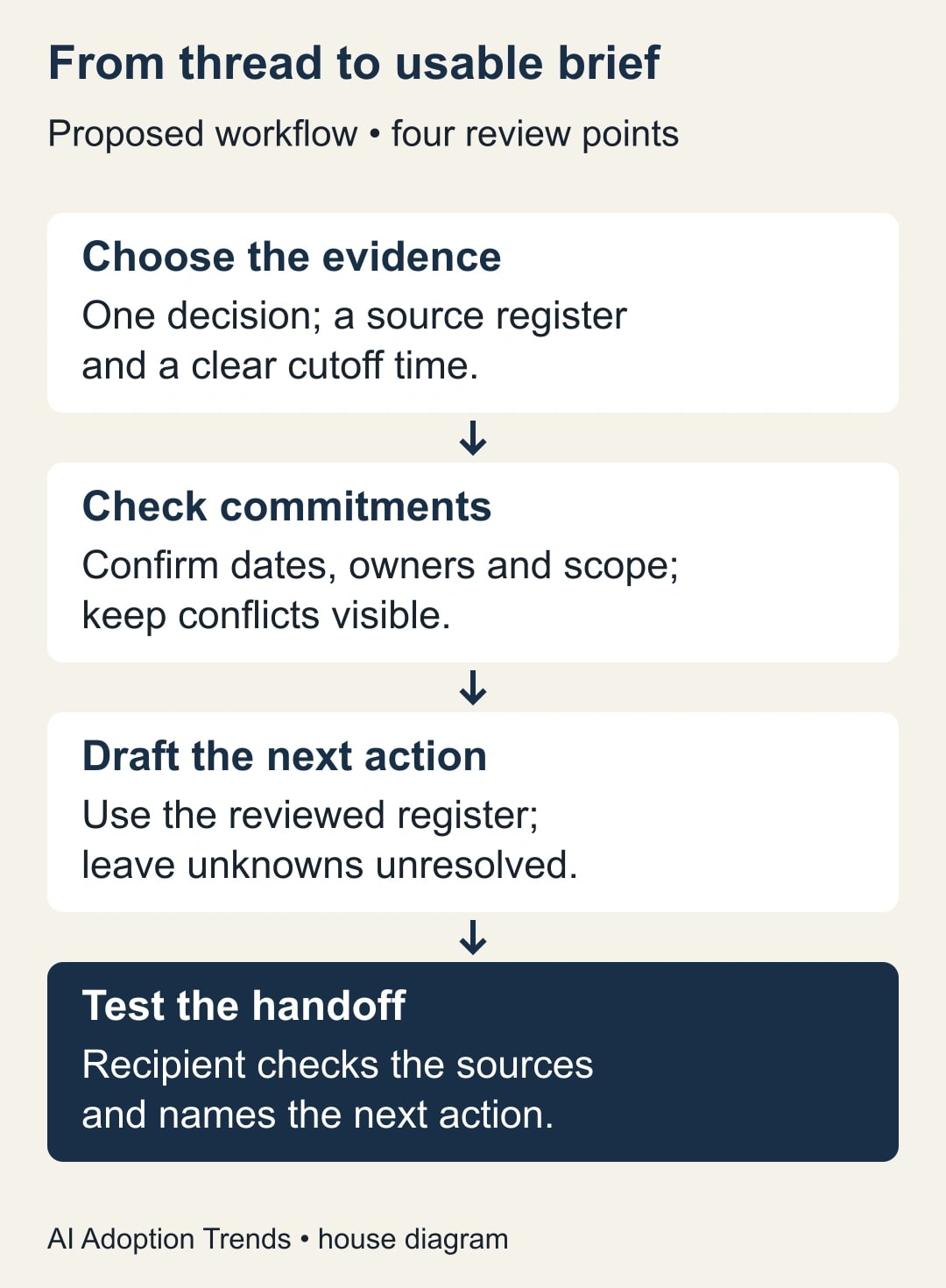
Extract the commitments before writing the brief
Use a first prompt that asks for a small decision register rather than a narrative. Adapt this wording: “From the selected sources, list each requested deliverable, proposed date, confirmed commitment, unresolved disagreement, and dependency. For every entry, give the source identifier, speaker, date, and a short supporting passage. Label each entry Confirmed, Proposed, Conflicting, or Unknown. Do not infer acceptance from silence. Do not choose between conflicting sources. Return the register before drafting a brief.”
The supporting passage is for your internal review; retain only what you need and follow the source material's handling rules. Open the original message for every commitment involving money, delivery, access, or external communication. If Gemini attributes a request to the wrong participant, correct the register before moving on. Otherwise the error will acquire more convincing prose in the next step.
A practical review order is commitments first, dates second, owners third, and descriptive context last. Missing an adjective is less consequential than assigning the wrong person to a launch. Record corrections beside the draft register so the delivery reviewer can see what changed and why.
A constructed example: the Friday launch that was never approved
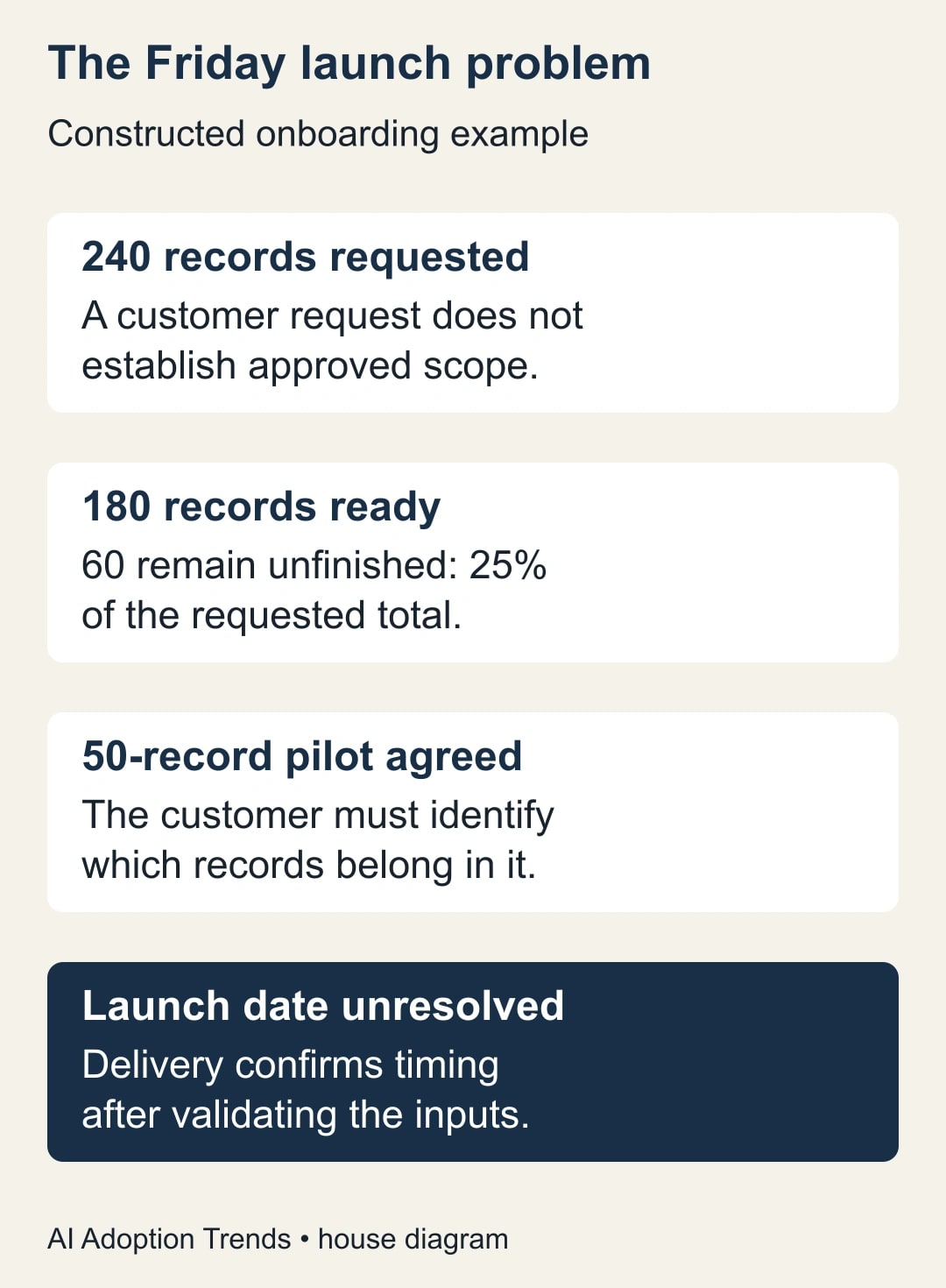
Consider a fictional onboarding project for a regional distributor. E1, the customer's Monday message, requests a Friday launch and mentions 240 product records. E2, the implementation lead's Tuesday reply, says a pilot can begin after a validated file arrives. E3, the customer's Wednesday reply, says 180 records are ready and the remaining 60 need correction. D1 describes the agreed pilot as 50 records. No message approves expanding that pilot or commits the delivery team to Friday.
A weak brief might read: “Launch 240 records Friday; customer supplies the final file.” Every element sounds plausible, but the sentence combines a request, an incomplete input, and an unapproved scope change. The register should instead preserve four separate facts: 240 records requested; 180 reportedly ready; 50 records in the agreed pilot; launch date unresolved pending a validated file and delivery confirmation.
The arithmetic helps reveal the operational question. There are 60 unfinished records, or 25% of the requested 240. That does not establish which 50 belong in the pilot. The account lead must ask the customer to identify the pilot set, and the delivery owner must decide whether that set meets the acceptance criteria. An assistant cannot solve that choice by selecting the first 50 rows.
The useful brief says: “Prepare validation for the approved 50-record pilot. Do not represent the 240-record launch or Friday date as committed. Account lead: obtain the customer's proposed pilot set by Thursday noon. Delivery owner: review completeness and confirm the earliest feasible pilot date after receipt.” This turns an ambiguous thread into an executable next step while keeping the unresolved decision visible.
Draft the document around the next worker's decisions
Once the register is checked, ask Gemini to create the brief from that corrected register and the selected sources. In accounts where Gmail can create the Doc directly, use that route and open the resulting document. If it is unavailable, put the reviewed text into an approved document yourself. Do not spend the trial troubleshooting a cross-app button when the actual test is whether the brief improves the handoff.
Use this adaptable instruction: “Create an internal project brief from the reviewed register. Put the next permitted action first. Include confirmed scope, exclusions, dependencies, owners, unresolved questions, and a source register. Keep proposed dates visibly proposed. Use Unknown where information is missing. Do not add recipients, send messages, or imply approval. Keep a separate section for decisions the delivery owner must make.”
The following worksheet is enough for many handoffs. Copy it into your existing brief format rather than creating a parallel system:
- Decision needed: what the next worker must decide or begin.
- Evidence cutoff: date, time, and source identifiers included.
- Confirmed scope: outputs and exclusions with source links.
- Proposed changes: requests that still need an authorized decision.
- Dependencies: input, owner, due date, and acceptance condition.
- Open questions: question, decision owner, and consequence of delay.
- Next action: named person, permitted task, and checkpoint.
- Review record: reviewer, review date, corrections, and approved sharing audience.
Keep the brief short enough to use while doing the job. Put background detail behind descriptive links. A four-page summary of a five-page conversation has moved the reading burden without resolving it. Length is justified only when it makes a consequential decision easier to find or check.
Review as a recipient before sharing
Have the delivery owner read the brief without the original conversation first. Ask them to identify the approved output, the earliest allowed action, the blocked action, and the person who can unblock it. Then have them open the cited sources to verify those answers. This tests both usability and factual accuracy; a correct document can still fail if its next action is buried.
Check the document's actual sharing settings before distributing it. A source may be accessible to the account lead but unavailable to the recipient, and copying private source content into a widely shared brief can create a new exposure. For each consequential source, either provide authorized access or include an approved explanation that the recipient can use. Do not broaden the source's audience merely to make a link work.
Use an explicit handoff message: “This brief reflects the sources listed through Thursday noon. The pilot scope is confirmed; the launch date remains open. Please confirm whether the validation task is ready to start.” That message invites a precise correction and avoids implying that every item in the document is approved.
Handle later replies without rewriting history
Assign the conversation owner responsibility for updates until the receiving team accepts the handoff. When a new message changes a material fact, add the source to the register and identify the affected field. Ask for a proposed amendment, not a fresh summary of everything. The reviewer should see the old statement, new evidence, proposed replacement, and any downstream action that must stop.
If a reply contradicts an earlier approval, keep both sources visible until the authorized owner resolves the conflict. Do not simply prefer the newest timestamp: a later participant may lack authority to change the scope. If an incorrect brief has already been shared, send a correction to its actual recipients and mark the obsolete version clearly. Quietly editing the document does not tell someone who already started work that their instructions changed.
Decide whether the workflow earns its place
Trial five comparable handoffs. Record total preparation and review minutes, material corrections before sharing, clarification requests after sharing, and any work restarted because of a bad brief. Compare with five recent manual handoffs of similar complexity. This is a small operational trial, so explain differences in the work rather than presenting the result as a general benchmark.
Suppose, in a constructed calculation, manual preparation and review average 35 minutes per brief, while the assisted process averages 27. Five briefs release 40 minutes: five times the eight-minute difference. That is available staff capacity, not cash savings. One preventable hour of rework would erase the time advantage in this small sample. Track the consequences alongside the drafting speed.
Pause the trial if a proposal becomes an unsupported commitment, a material source is missed, or review takes longer without improving the recipient's understanding. Keep the useful source register even if you stop using Gemini. For the next handoff, choose one ambiguous thread and write the decision needed before generating anything. If you also need a persistent note across tools and sessions, use our guide to maintaining a Markdown handoff file.
Weekly Newsletter
AI Adoption Weekly
New research, field guides, training studies, and tool decisions for operators.
No spam. Unsubscribe anytime.
Related Comparisons
Calculator
AI seat cost calculator
List price × headcount. You enter the hours and the operating assumptions.