
Build a Checked Project Brief With a Gemini Notebook
Build a Gemini notebook brief from approved sources, check missing launch conditions, and keep the final decision with the project owner.
Published October 21, 2026

Use a Gemini notebook for a project brief when you can name the sources that should support the answer and assign a person to check the result. Start with a small, approved evidence pack and a specific decision. Do not begin by uploading every file associated with the project and asking for a confident recommendation.
Google's October 19, 2026 update extends notebooks in Gemini to Workspace users in the European Economic Area. Its announcement, checked October 21, describes project-focused conversations using uploaded sources. That wider availability makes this a useful moment for a modest operational pilot, especially for teams preparing recurring internal briefs.
This guide is for a project or operations manager assembling an internal decision brief from a limited set of documents. It is not a method for delegating legal conclusions, employee decisions, or customer commitments to a model. If the evidence is incomplete or the decision requires specialist judgment, the notebook should help expose the missing work rather than conceal it in polished prose.
The deliverable is a one-page brief with supported facts, unresolved questions, options, an owner, and a next action. You need an approved work account, permission to use the source material, a reviewer who knows the project, and access to the originals. Check your organization's service availability and limits before planning a rollout. This pilot does not require buying an upgrade before testing the basic job.
Choose a brief with a decision at the end
“Summarize our project” invites a broad narrative with no obvious acceptance test. A better job is: “Prepare the evidence for deciding whether the support team can start the revised onboarding process next Monday.” Now the reader knows what the brief must establish: readiness, remaining blockers, responsible people, and the consequence of waiting.
Write the decision and its deadline before selecting sources. Identify who has authority to make it and which facts would change the outcome. If the same document will serve a different audience, such as a customer rather than an internal manager, define a separate output and review route. Internal uncertainty should not accidentally become an external promise.
Pick a recurring task with enough friction to measure but limited consequences during the trial. A weekly internal project-readiness brief is a reasonable candidate. A decision to release funds, accept contractual terms, or send instructions to customers should remain in the existing approval process. The notebook can organize evidence without becoming the decision-maker.
Name a stop condition in advance. For example: “Do not recommend starting if any required training owner, approval, or recovery contact is missing from the approved sources.” That is a proposed operating rule. It is not a technical guarantee that the model will obey; the reviewer must apply it to the final brief.
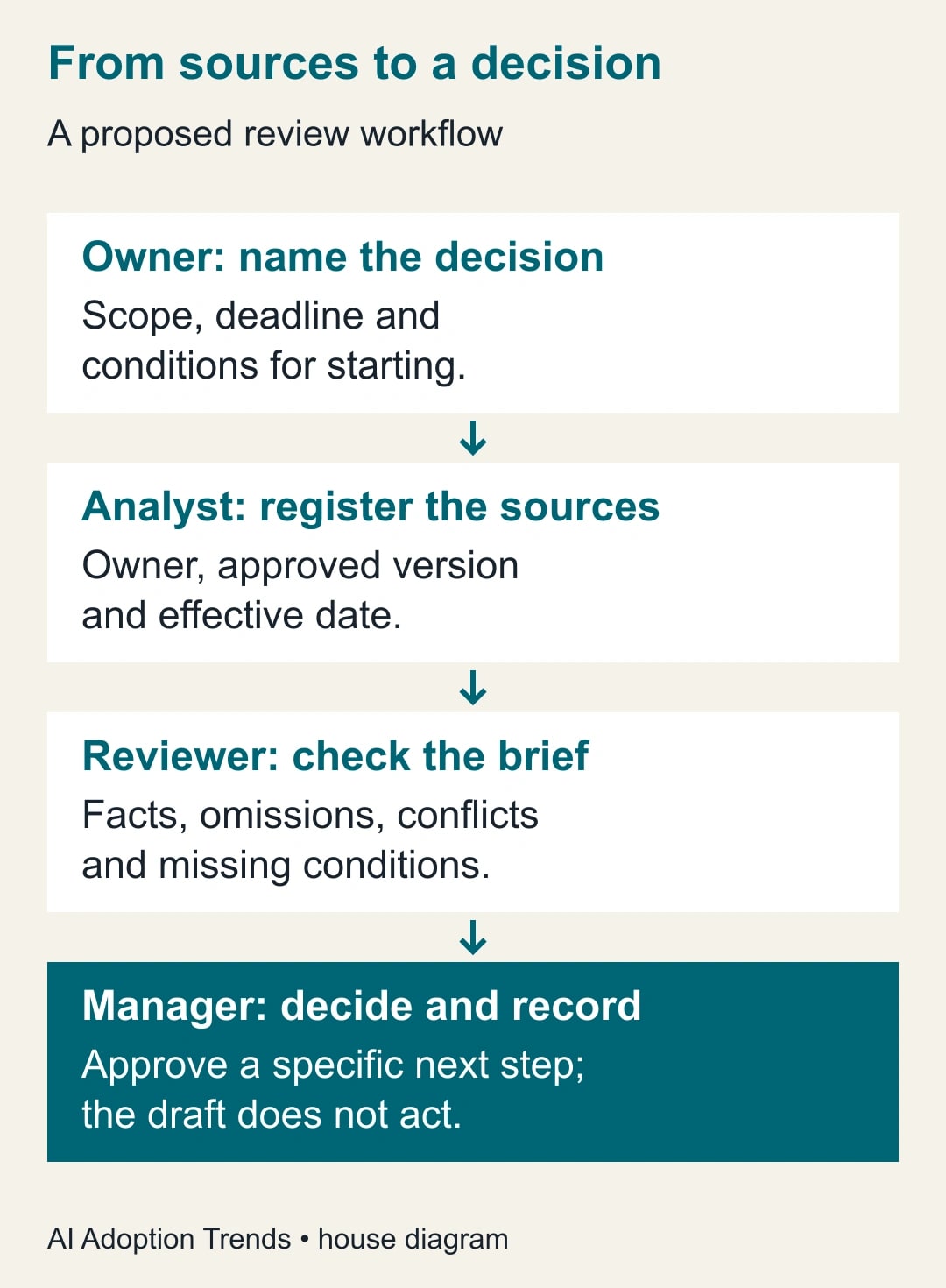
Build a source register before creating the notebook
Select a small set of documents that jointly answer the decision. For an onboarding readiness review, that might be the approved process, training attendance, an open-issues log, a test record, and a dated change note. List each source's owner, version, effective date, scope, and the question it can answer.
Exclude redundant drafts unless the disagreement between versions is part of the task. When two documents conflict, preserve the conflict and ask the owner which governs. The newest modified timestamp is not automatically the newest approved policy. A spelling correction can make an old document look more recent than the actual decision record.
Keep a clear boundary between source material and the model's previous answers. A generated summary is not a new independent source confirming the original documents. If you add prior analysis to the notebook, label it as analysis, identify its inputs, and review any claims it introduces. Otherwise, an early mistake can be repeated until it appears well established.
Google's launch page describes starting from New notebook in Gemini's side panel and adding up to ten sources for that announced workflow. It also says work-account access depends on both Gemini and Gemini Notebook service settings. Check current in-product limits for your account; the five-source pilot below deliberately does not need a large collection or a new purchasing decision.
Keep the two answer environments distinct
Google's notebook integration help makes a consequential distinction: Gemini Notebook answers use notebook sources, while Gemini can also use web search and other tools. A notebook visible in both products therefore does not mean every answer has the same evidence boundary. Record which application produced the draft.
For a brief that must rely only on approved internal evidence, explicitly ask for that scope and inspect every consequential claim. If the answer introduces an outside fact, keep it in a separate “needs verification” section or remove it from the decision brief until checked. A prompt is an instruction to the model, not an access control or proof that no outside information was used.
Use the originals to settle contradictions. An answer that accurately cites a document can still rely on the wrong version or misread a condition. The reviewer should verify both the quoted fact and why that source is appropriate for the current decision. Do not treat a citation marker as a substitute for opening the supporting passage.
The integration help also describes differences in sharing and retention across the products. For this pilot, keep the notebook within the approved work context and distribute the reviewed brief through the team's existing route. Do not promise that all notebook chats can be shared, or that changing one activity setting removes data everywhere. Ask the administrator about account-specific handling before adding restricted material.
Give the model a brief it can fail honestly
Use an instruction like this: “Prepare an internal readiness brief for the decision below. Use only the five named sources. For every material fact, identify the source and relevant passage. Separate established facts, disagreements, missing evidence, and your interpretation. Do not invent an owner, approval, deadline, or test result. If a required condition is unsupported, say unknown.”
Then specify the output: “Begin with ready, not ready, or insufficient evidence, followed by the reasons. Include a short list of blockers, each with an owner only where one is documented. Give two reasonable options, the consequence of each, and the next information needed. Keep recommendations distinct from statements in the sources.”
Those instructions make omissions easier to spot. They do not establish that the answer is correct. Save the prompt with the source register, so a future reviewer can understand what was requested and repeat the work with a new evidence pack. Avoid changing the source set halfway through review without recording that change.
Ask one focused follow-up at a time. If a training count is unclear, ask which rows and exclusions produced it. If a blocker is missing, ask whether the relevant source was included and read correctly. Repeatedly asking “are you sure?” tends to produce confidence rather than an audit trail. Request evidence that can be checked.
Work through a five-source readiness decision
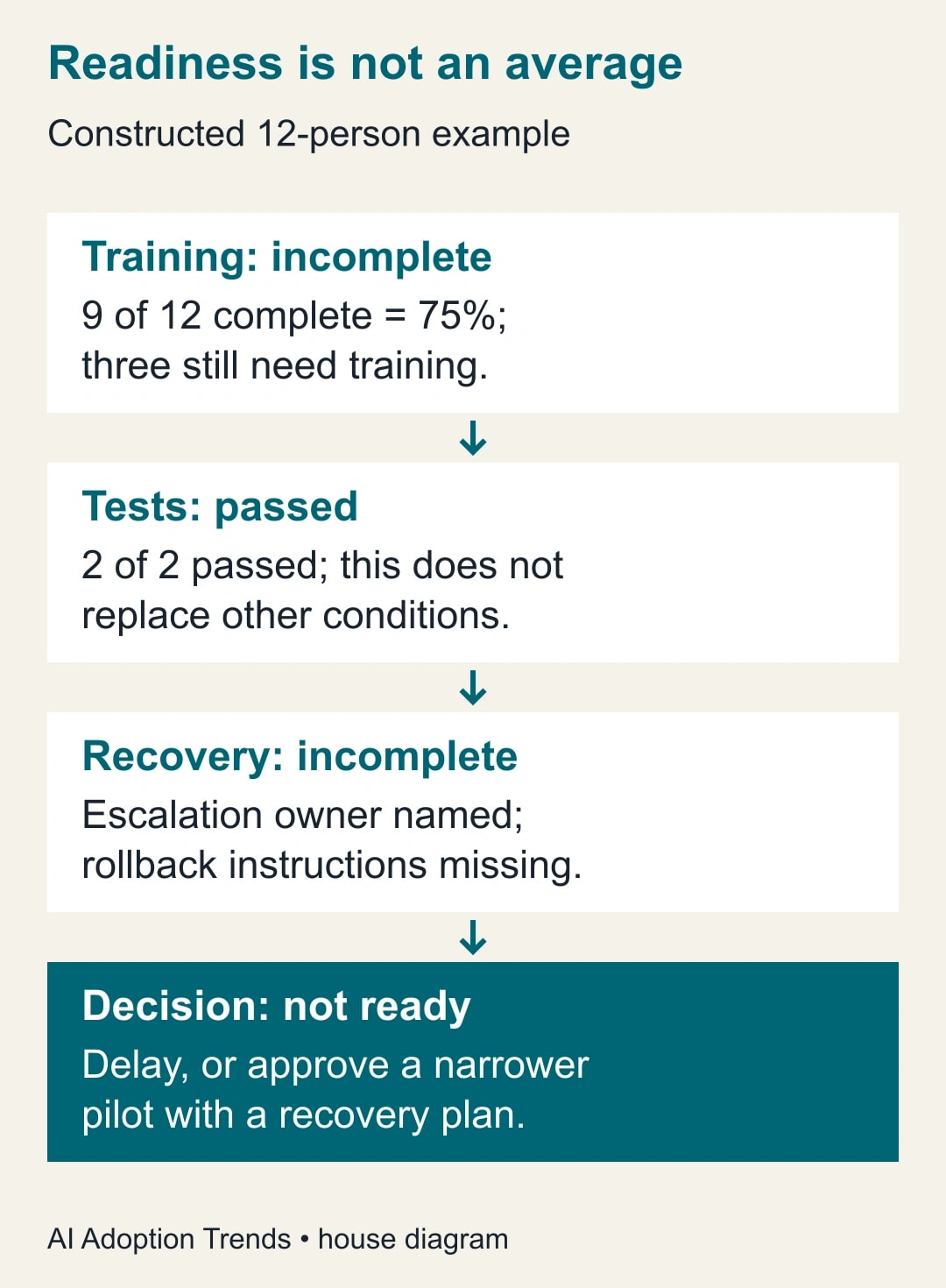
This constructed example concerns a 12-person support team preparing a revised onboarding process. The approved process lists four launch conditions: training complete, two test cases passed, escalation owner assigned, and rollback instructions available. A training sheet shows nine people complete. The test record shows both cases passed. The issues log names an escalation owner. The change note contains no rollback instructions.
The supported conclusion is not ready under those four conditions. Training completion is nine of 12 people, or 75%, leaving three incomplete. Two of two test cases passed, but passing the tests does not compensate for incomplete training or missing rollback instructions. The manager can change the launch plan, but the model cannot quietly redefine the conditions.
A flawed draft might say “Most staff are trained and tests passed, so the team is ready for launch.” The reviewer should reject that inference even if every individual fact is correctly quoted. Another flawed answer might assign the rollback task to the escalation owner without evidence. The correct entry is “rollback owner not documented,” followed by a request for the manager to assign one.
Two reasonable options emerge. Delay the full launch until the three remaining people finish training and rollback instructions are approved. Or define a smaller pilot with only trained staff, if the manager approves its scope and supplies a recovery process. The second option is an editorial proposal, not permission already present in the source pack.
The finished brief should identify the unresolved conditions and request a decision from the actual owner. It should not send calendar invitations, change the process status, or notify customers merely because the draft recommends a pilot. Those actions remain separate work with their own approval and evidence.
Review the exact final brief
Review every claim that could change the decision. Check the source passage, source version, scope, arithmetic, and interpretation. In the example, the reviewer checks the 12-person roster rather than assuming the training sheet lists everyone. A missing roster entry could make a mathematically correct percentage operationally misleading.
Look for omitted negatives. A source may say a test passed only with an administrator present, or that one team's training is complete while another team remains out of scope. A concise summary can accidentally remove those conditions. Restore any qualification that changes whether the recommendation is usable; omit caveats that do not affect the decision.
Check whether the brief distinguishes an actual approval from a proposal. “The team discussed starting Monday” is not the same as “the owner approved a Monday start.” Ask the reviewer to mark each consequential statement as supported, corrected, or unresolved. Keep the final approved brief with the source register and date so later readers know what it covered.
Substantive edits require another check of the affected reasoning. If the manager changes the pilot from nine trained staff to the whole team, an earlier readiness assessment no longer applies. The final version is the object being approved, not the first draft that happened to receive a favorable review.
Reuse this one-page brief structure
- Decision: what the owner must decide, by when, and which team or project is in scope.
- Evidence cutoff: source versions, effective dates, and the application used to produce the draft.
- Established facts: only the material facts that have been checked against the originals.
- Blockers: unmet conditions, missing evidence, and documented owners; use unknown where necessary.
- Options: reasonable choices, their consequences, and the assumptions each requires.
- Recommendation: the reviewer's judgment, visibly separate from provider output and source facts.
- Next action: named decision owner, required information, and the next review time.
This structure can be copied into an ordinary document. It does not depend on a particular notebook feature. That portability matters: if access changes or the model is unavailable, the team can still prepare the brief from the same source register and approval rules.
Measure whether the notebook reduces the whole job
Track source preparation, drafting, review, and correction time separately. Suppose a constructed manual workflow takes 25 minutes to gather sources, 30 to draft, and 15 to review: 70 minutes total. A notebook-assisted version takes 25, 10, and 25 respectively: 60 minutes. The illustrated benefit is ten minutes, because review became longer even while drafting became faster.
Record unsupported claims and missed blockers alongside time. A faster brief that overlooks the rollback gap is a failed output. Use a small initial trial across several comparable briefs, then assess whether the same source discipline and review effort remain practical. Do not extrapolate a single good example to every project or employee.
Stop or narrow the pilot if reviewers repeatedly reconstruct the entire analysis, if source versions are unreliable, or if the tool blurs proposals and approvals. Improve the source register before adding more documents. Broader availability makes the feature easier to try; it does not resolve a team's underlying evidence problems.
Start with one decision, five sources, and one skeptical reviewer. Use the AI workflow pilot guide to set a wider trial, and the business-case worksheet if the pilot needs funding. Count verified improvements in the complete job, while keeping released staff capacity separate from any actual change in spending.
Weekly Newsletter
AI Adoption Weekly
New research, field guides, training studies, and tool decisions for operators.
No spam. Unsubscribe anytime.
Related Comparisons
Calculator
AI seat cost calculator
List price × headcount. You enter the hours and the operating assumptions.