
Export Fireflies Transcripts for a Usable Client Handoff
Choose a Fireflies export format, preserve speakers and timestamps, and build a checked handoff without treating an AI summary as the full record.
Published October 16, 2026

For a usable Fireflies handoff, export the transcript in the format the receiving team needs, preserve speaker labels and timestamps, and deliver it with a short record of scope and unresolved decisions. A downloaded summary is useful orientation. It is not a substitute for the underlying conversation when someone needs to check who agreed to what.
The right first question is therefore “What will the recipient do with this file?” A project lead reviewing commitments needs different material from an editor preparing subtitles or an analyst processing conversation fields. Sending every available format usually creates more copies to govern without making the handoff clearer.
This guide is for project managers and account teams moving authorized meeting evidence into an approved delivery process. Skip it as a bulk migration recipe or a legal-records procedure. Those jobs require their own retention, access and validation requirements. The workflow here is a proposed operating method with a constructed example, not a claim that we tested Fireflies exports on customer data.
Confirm the export exists before promising it
Fireflies' download guide, checked October 16, 2026, says downloads require Pro or higher. Open Meetings, find the meeting, open it and use Download. Transcripts support PDF, DOCX, SRT, CSV, JSON and Markdown; summaries support DOCX, PDF, JSON and Markdown. Transcript options include timestamps and speaker labels. Audio uses MP3; video uses MP4 when video was captured. Missing or disabled options can reflect processing, access, plan eligibility or absent content.
Check those conditions with one approved meeting before planning a handoff. Record the account used, whether processing is complete, what content exists and which downloads are available. If a transcript is absent, a different file extension will not create it. If you lack access, ask the meeting owner through the normal route rather than trying another employee's account.
For the commercial decision, use the Fireflies plan and access guide and verify current account pricing before committing. This article does not require a particular seat count or promise a fixed subscription cost. Budget the incremental entitlement, review time, approved storage and any transformation work. Avoid upgrading an entire team to solve one untested export requirement.
Select a format by the receiving task
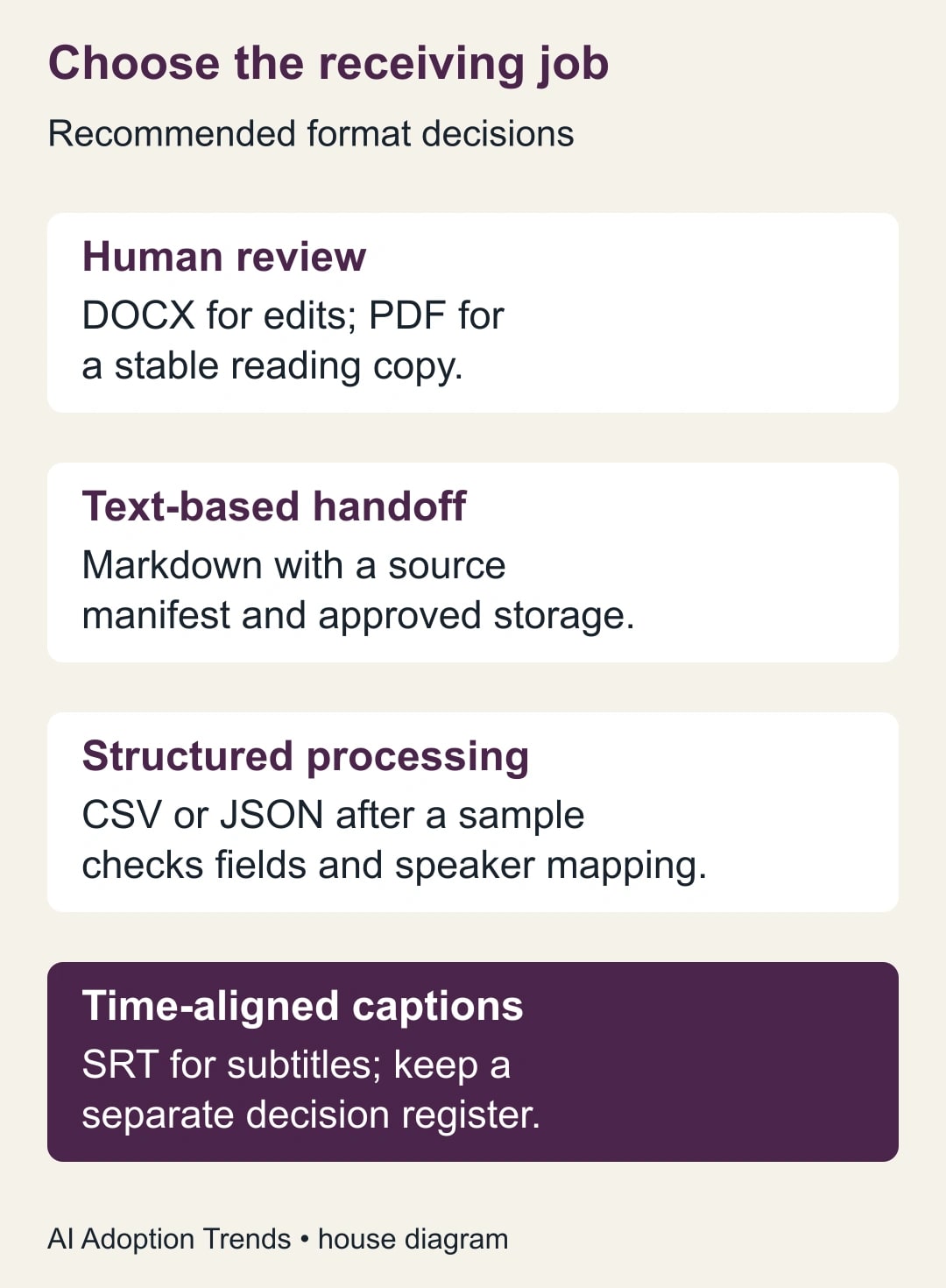
Choose DOCX when a person must edit and annotate the record in a document workflow. Choose PDF when the immediate need is a stable reading copy. Neither choice makes the content authoritative; both still require a source reference and a version. A PDF can preserve an error just as neatly as a correct statement.
Markdown is a practical option for a plain-text handoff that will be read by people or used as input to an approved AI tool. Keep headings, source links and the scope note clear. Do not strip speaker identity simply to make the text shorter if identity changes the meaning of a commitment. A readable file should still let the recipient distinguish the customer from the supplier.
Use CSV or JSON only when a downstream process needs structured data. First inspect a sample to learn which fields are actually present and how speakers, timestamps and line breaks are represented. Do not write an importer around guessed field names. Ask the receiving analyst to confirm how the sample maps to the intended table before preparing the full set.
Use SRT for a time-aligned subtitle job. Do not assume that caption segments make a good decision register. They divide speech for playback, while business actions may span multiple segments and speakers. Maintain the verified action list separately, with references back to the conversation where needed.
Define the minimum useful package
A small handoff usually needs three things: the approved transcript export, a brief decision-and-action register, and a manifest identifying the source and scope. The manifest is simply a list of what you are delivering and why. It can be a short worksheet rather than a new application.
Include the meeting title, date, source link or identifier, export date, chosen format, transcript version and intended recipients. Note any excluded portion and the reason for exclusion. If only a selected meeting segment is authorized for the recipient, make that scope obvious. A partial record should not look like the complete conversation.
Keep the original export separate from an edited working copy. Give the edited version a clear label and identify who made the changes. This matters when correcting names or removing information that does not belong in the receiving workflow. The recipient should be able to tell a faithful export from a deliberately adapted handoff without guessing from file dates.
Avoid turning the package into an archive of everything available. Audio or video can help resolve ambiguity, but broader media may not be necessary for every recipient. Use the organization's approved storage and permissions. The meeting owner's permission to capture a call should not be treated as a universal decision to distribute it to any new audience.
Check fidelity before extracting actions
Open the exported file in the software the recipient will actually use. Check the beginning, a middle section and the ending. Verify that text is present, speakers are distinguishable, timestamps are usable and important punctuation or symbols survived. For a structured export, inspect records containing commas, quotes and multiple lines rather than checking only a simple greeting.
Then check every consequential commitment against the authorized source. Focus on dates, amounts, quantities, owner names and negations. “We can release the order” and “we cannot release the order” differ by one short word. A transcript that looks fluent can still reverse a decision. If the source cannot resolve an ambiguity, ask the participants instead of silently choosing an interpretation.
Record corrections in the working copy and decision register. Preserve the original wording or a source pointer so the reviewer can understand why the correction was made. Do not rewrite the transcript to make the meeting sound more decisive than it was. An unresolved delivery date is a real outcome, not an editing defect.
The checkpoint is a recipient-readable sample with a documented review. Before exporting twenty meetings, give one completed package to the receiving team. Ask them to locate a decision, identify its owner and find the supporting passage. Their ability to do that is better evidence than the fact that the download button worked.
Build the action register without promoting guesses
For each action, capture the deliverable, accountable person, due date, dependency and evidence reference. Keep a separate category for proposals and questions. “Consider a smaller pilot” belongs there until someone accepts the work. A model can help draft the register, but the meeting owner decides which statements establish commitments.
If you use an approved AI assistant, provide only the material that tool is permitted to receive. A useful adaptable instruction is: “Extract candidate actions from this reviewed transcript. For each, show the speaker and timestamp, the exact commitment, the proposed owner and date, and any unresolved condition. Separate requests and possibilities from agreed actions. Do not infer missing owners or deadlines. Return uncertainties for human review.”
Review the result against the transcript rather than asking the same assistant whether it is correct. The output is a set of candidates, not an approved task list. If an action refers to an external document, open the current approved version before finalizing the handoff. The meeting may have discussed a draft that changed afterward.
When work is already in a project tracker, link to the existing task instead of creating another one. The transcript is supporting evidence; it should not become a competing assignment system. Confirm that the receiving owner accepts the action and knows where future updates belong.
A worked example: twelve meetings do not mean twelve deliverables
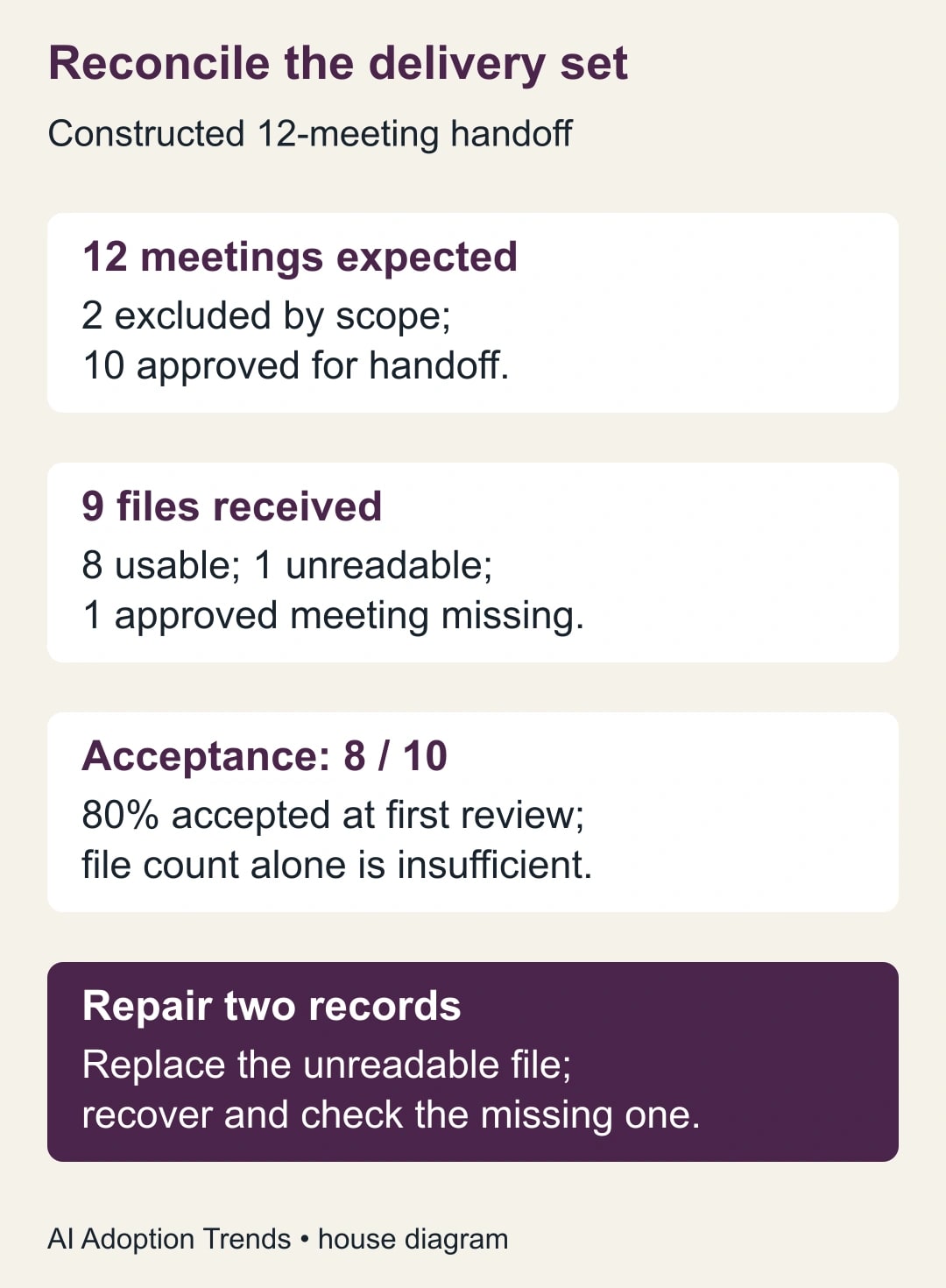
Consider a constructed client transition. The project lead lists 12 meetings from the last month. Two are outside the agreed handoff scope, leaving ten approved meetings. The first delivery contains nine files. One cannot be opened by the recipient, and one approved meeting is missing entirely. These are invented workflow numbers, not a Fireflies customer result.
The file count is nine, but the accepted record count is eight. Initial acceptance is eight divided by ten, or 80%. Reporting “nine of ten delivered” would conceal the unusable file. Reporting “eight of twelve” would mix excluded meetings with required records. Keep the scope decision and the quality result in different columns.
The lead repairs the unreadable export using a format the recipient can open, then locates and checks the missing meeting. Each repaired record passes the same content checks as the first eight. The manifest now accounts for all 12 meetings: ten accepted, two excluded with reasons. It does not claim that every action in those meetings is complete.
Suppose a summary also lists a June 18 launch, while the transcript says the date depends on client data arriving June 10. The handoff register retains the dependency and asks the delivery owner to confirm the schedule. The team should not “correct” the transcript to match the cleaner summary. The value of exporting the evidence is being able to catch that difference.
Copy this handoff acceptance checklist
Complete the list with the sender and recipient. Keep it beside the manifest so a later reviewer can distinguish a completed transfer from a folder that merely contains files.
- Scope: every expected meeting is listed, including exclusions and missing records.
- Identity: each file has the correct meeting date, source reference, export date and version.
- Usability: the recipient can open the file in their normal software without a special workaround.
- Fidelity: speakers, timestamps and consequential passages were checked against the authorized source.
- Actions: commitments are separate from suggestions, with confirmed owners and unresolved conditions visible.
- Access: storage and recipient permissions match the approved audience; extra copies are accounted for.
- Acceptance: the receiving owner confirms what is usable, what needs repair and when the next review happens.
This checklist should produce a decision, not a ritual signature. If the recipient cannot find a source passage, the package is not ready for a source-dependent decision. If the meeting contains no agreed action, record that explicitly rather than inventing one to fill the template.
Recover from export and handoff failures
When an export option is missing, return to the account and content checks before changing plans. Record the exact condition and ask the workspace owner to verify eligibility. Do not promise a video export from an audio-only meeting. If the business only needs a checked decision register, a missing video may not block the handoff at all.
When a file opens incorrectly, retain the original and test a different supported format on one sample. Have the recipient verify the repaired version before repeating the conversion. For CSV or JSON, ask the analyst to compare row counts and key fields after import; a successful import can still truncate text or misinterpret dates.
When the wrong material reaches a recipient, stop further distribution and follow the organization's incident process. Correct the destination permissions and tell the relevant owner what was shared. Do not assume replacing a link withdraws files already downloaded. The recovery task includes the copies and people affected, not just the source folder.
When a participant disputes the record, mark the relevant action unresolved. Keep both the source reference and the correction request visible until the accountable owner resolves it. The purpose of the transcript is to support judgment, not to overrule someone with a confident automated rendering of their words.
Measure the handoff, then decide whether to automate more
Track accepted records divided by approved records, consequential corrections, time to recipient acceptance and total handling minutes. Include export, checking, repair and storage administration. A faster first download is a weak result if the receiving team spends longer reconstructing context afterward.
Begin with one meeting type and a small approved sample. Stop expansion when the team cannot reconcile expected records, when access is uncertain, or when important commitments remain unreliable after review. If the process works, standardize the manifest and format choice before considering bulk processing. Stable inputs make later automation easier to judge.
Treat released time as capacity unless a real spending decision converts it into cash savings. Your next action is to deliver one checked sample and ask the recipient to find a specific decision and its evidence. For a plain-text package, the Markdown handoff guide provides a useful next step for preserving context across people and AI sessions.
Weekly Newsletter
AI Adoption Weekly
New research, field guides, training studies, and tool decisions for operators.
No spam. Unsubscribe anytime.
Related Comparisons
Calculator
AI seat cost calculator
List price × headcount. You enter the hours and the operating assumptions.