
Seven Hours Saved, More Work Stuck: AI Moved Science’s Bottleneck
Scientists report saving almost seven hours a week with AI, while validation and physical experimentation accumulate downstream. The executive lesson is to budget the bottleneck, not celebrate the shortcut.
Published September 21, 2026

A research leader opens Monday’s dashboard and sees a victory: scientists say AI has returned almost a day each week. By Thursday, the lab queue is worse. More hypotheses are waiting for experiments, more generated analyses need checking, and the same small group of reviewers is signing off on all of it. The team became faster. The system did not.
What happened
Google published new AI & Economy ATLAS findings on September 15, including work with Google DeepMind and MIT FutureTech. The research organized 2,600 specialized AI models and surveyed more than 600 scientists in the United States and United Kingdom. Nearly half of respondents said they use some form of AI every day, and scientists reported saving just under seven hours a week.
But the same research found significant time spent validating AI outputs, a larger backlog of hypotheses, and new constraints in physical experimentation and clinical validation. This is not a contradiction. It is the normal economics of a pipeline when one stage gets dramatically cheaper and the adjacent stages do not.
What is real
AI can expand the number of plausible paths a team can explore. That is meaningful capability, not just faster typing. The findings also distinguish broad language-model use from specialized models used for domain prediction, generation, and simulation. Operators should notice that the gain is distributed across different kinds of work, while the verification burden concentrates around fewer accountable people and scarce real-world tests.
Call this the throughput tax: when the cost of producing candidates falls, the cost of choosing, validating, and acting on them becomes the governing constraint. Marketing gets more campaign variants than legal can approve. Engineering creates more code than security can review. Finance produces more scenarios than business owners can challenge. The local productivity number can be true while the enterprise outcome stays flat.
The skeptical read
The seven-hour figure is self-reported, not a time-and-motion measure, and the study population is scientists rather than a representative sample of all workers. Google also benefits when leaders believe AI is productive. The reported bottlenecks are therefore more decision-useful than the headline time saving: they describe where a buyer can look for corroborating operational evidence in their own environment.
OpenAI’s account of its own research acceleration supplies a useful parallel and a warning. It says code-generation volume is easy to count but hard to interpret because the connection to research progress is uncertain. That is exactly the measurement trap: output is visible first, while validated outcomes arrive later.
What other teams should measure
- Arrival rate: how many drafts, hypotheses, cases, or recommendations enter the next stage each week?
- Service rate: how many can reviewers, labs, approvers, or customer teams responsibly clear?
- Validation yield: what share survives checking and produces an actionable result?
- Queue age: how long does the oldest high-value item wait before review?
- Cost per accepted outcome: include generation, review, rework, tools, and downstream execution.
The Monday-morning playbook
Pick one AI-assisted workflow and draw its stages on a single page. For each stage, write the weekly arrival rate, service capacity, owner, and maximum acceptable queue. If AI could double the first number, decide now what happens to the second. Add review capacity, raise the acceptance threshold, sample low-risk work, or deliberately cap generation. “We will review it” is not a capacity plan.
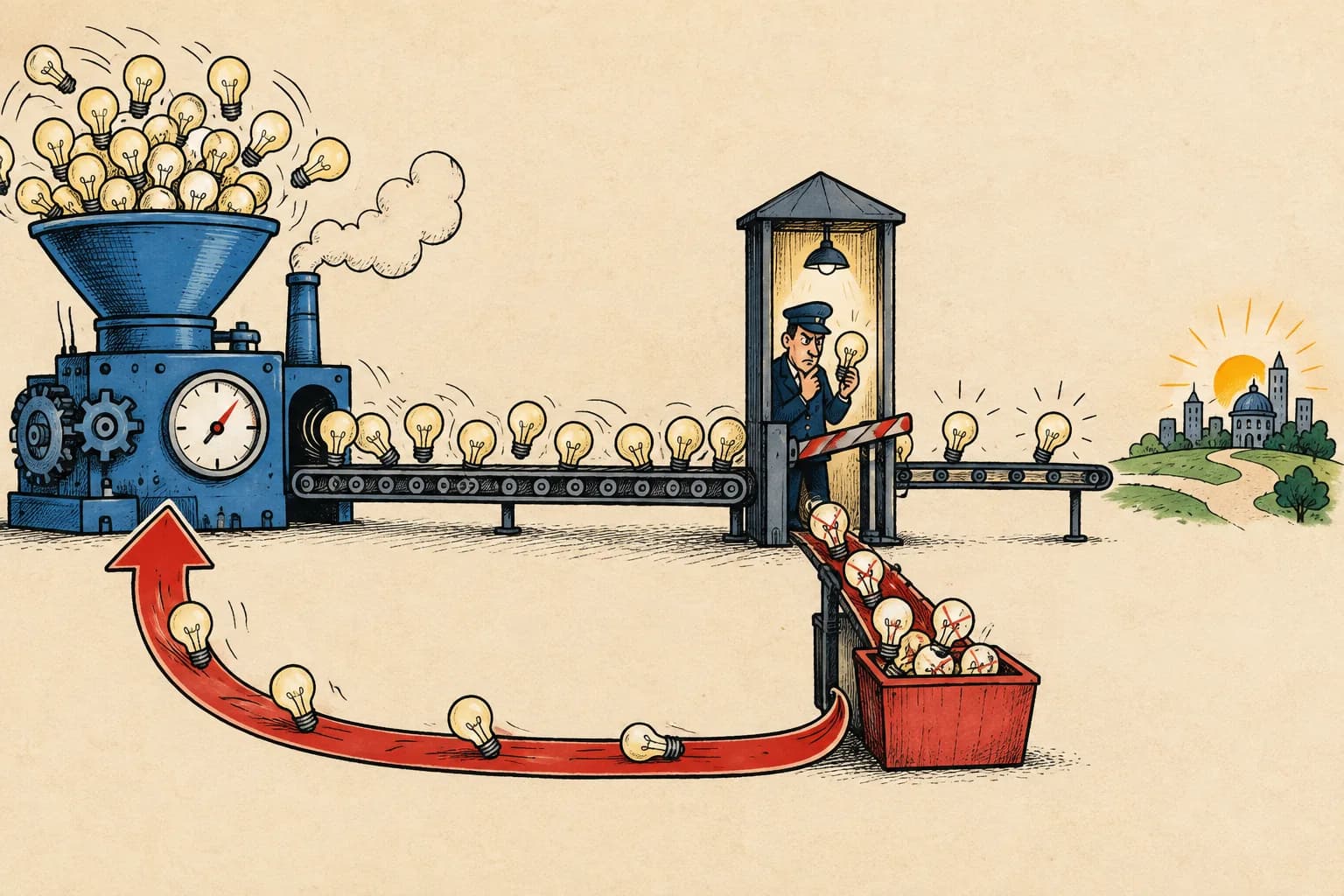
Then change the success metric. Do not report hours saved without the accepted-output rate and the age of downstream work. A real productivity gain increases useful throughput or quality at a tolerable cost. Everything else is a faster way to fill someone else’s inbox.
Primary sources
- Google: New insights from the AI & Economy ATLAS — September 15 findings, sample description, time savings, and downstream constraints.
- OpenAI: Research acceleration—the view inside OpenAI — A second primary-source account of why visible activity is not the same as research progress.
The automation layer a founder can see
Branching scenarios. You still own the graph.
We may earn a commission · editorial verdicts remain independent
Weekly Newsletter
AI Adoption Weekly
New research, field guides, training studies, and tool decisions for operators.
No spam. Unsubscribe anytime.
Related Comparisons
Calculator
AI seat cost calculator
List price × headcount. You enter the hours and the operating assumptions.