
Gemini Notebook Flashcards: Test Staff Decisions, Not Recall Speed
Build a reviewed Gemini Notebook flashcard deck, check source images, and test staff decisions separately from recall speed.
Published November 26, 2026

Use Gemini Notebook flashcards to help staff practice a defined set of decisions, then check those decisions in a separate work sample. A fast answer to a familiar card is useful practice evidence. It is not proof that someone can handle a customer exception, identify the current procedure or recognize when to ask for help.
For a training lead, the practical starting point is one approved procedure, a small reviewed deck and a named subject expert. Avoid loading the whole company knowledge base and treating whatever the system produces as a syllabus. The narrower start makes omissions visible and gives you a fair way to decide whether the exercise deserves more staff time.
What the November update adds
Google announced three flashcard enhancements on November 24, 2026: images drawn from uploaded sources, an optional session stopwatch and study reminders in the mobile app. Google lists the enhancements as available now for Workspace customers, Workspace Individual subscribers and personal accounts. These are provider statements about features and availability, not measured evidence that employees learn faster. Read the November flashcard announcement.
The operating opportunity is specific. A trainer can pair a visual from an approved guide with a question, let people practice in short sessions and encourage them to return. The corresponding risk is also specific: an attractive image can hide a missing qualifier, and a stopwatch can reward confident recall of an answer that no longer matches the procedure. This guide was checked November 26.
This approach fits product knowledge, service intake, internal terminology and routine process reminders. Skip it as the sole assessment for safety-critical work, regulated qualifications or tasks that require supervised physical performance. A deck can support those programs, but the accountable training owner must retain the assessment method the job actually requires.
Choose the decision before the source
Write the learning objective as an action. “Choose the correct escalation route when a delivery date is uncertain” is assessable. “Understand customer service” is too broad. List the circumstances in which a staff member should answer, look up the procedure or hand the case to someone with authority.
For a constructed example, imagine a distributor training six new service coordinators. They need to distinguish confirmed delivery dates, estimated dates and orders waiting for supplier confirmation. They must not promise a refund or change an order based only on a customer's assertion. None of this describes a reported customer deployment; it is a planning example for the method.
The trainer selects the current delivery-status procedure and an approved diagram of the escalation route. A supervisor supplies five realistic situations with known answers. The expected output is not twenty cards chosen at random. It is a set covering status recognition, evidence, escalation and customer wording, with a reason for each card to exist.
Choose an owner for each source. Record its version, effective date and the person who can resolve ambiguity. If two policies conflict, settle the conflict before generation. An AI tool cannot decide which department has authority simply because one document is longer or easier to summarize. Remove superseded material from the exercise and retain the old version separately if the team needs an audit trail.
Prepare a source pack staff are allowed to see
Check the audience's access and the organization's rules for using the service. Use approved training examples rather than live customer records when those records are unnecessary. A diagram can contain names, account numbers or private notes even when the surrounding paragraph looks harmless. Inspect images as carefully as text before adding them to the notebook.
Give the pack a simple inventory: procedure name, owner, version, included sections, excluded sections and the reason for exclusion. If a picture illustrates a discontinued product, do not leave it in the pack as decoration. The new image capability makes visual accuracy part of the content review, not an optional finishing step.
Prerequisites are an approved account, access to the intended notebook, a suitable source pack and time from a subject expert. Confirm the account's current usage limits and any organizational restrictions before assigning a cohort. Do not assume that broad feature availability means unlimited generation or that a personal account is the right place for business documents.
Budget the exercise in staff time as well as any incremental service cost. If the business already has appropriate access, there may be no new subscription to buy for this pilot, but preparation and review still consume capacity. Price any additional plan separately using the actual account offer; this guide does not assume a universal per-user price.
Generate a small deck with a useful brief
Google's help page says edit access is required to generate or delete flashcards and quizzes. In the Studio panel, choose Flashcards, or use the customization control before generating. The available preferences include difficulty and a prompt describing the desired audience or focus. Check Google's flashcard instructions.
Use the prompt below as a drafting brief. It requests a structure; it does not guarantee that the tool will obey every constraint. The trainer still reviews the result against the source pack and learning objective. Keep any review worksheet outside the deck so the person answering does not accidentally see the answer key.
Sample brief: Create practice cards for new service coordinators using only the selected delivery-status procedure and escalation diagram. Cover confirmed dates, estimates, missing supplier confirmation and situations requiring a supervisor. Ask one decision per card. Preserve conditions and exceptions. Do not invent policy, refund authority or delivery promises. If the sources do not establish an answer, flag that gap for the trainer. Use source images only when they help distinguish the decision. These are practice materials, not certification questions.
Begin with a small output and inspect it before requesting more. If the deck overproduces definitions and underproduces exceptions, revise the brief or the source selection. Repeated generation without a clear coverage plan can create more review work while leaving the same important gap untouched.
Audit coverage before learners see the cards
Create a review register with one line per card. Record the decision tested, the supporting source location, whether the answer retains necessary conditions, whether the image is current, and whether the card should be kept, revised or removed. Where the tool offers a source explanation, use it as a lead back to the document, not as a substitute for reading it.
In our constructed example, the trainer reviews twenty generated cards. Twelve are acceptable, four need a missing qualifier restored, three duplicate another question and one introduces an unsupported promise. The first-pass acceptance rate is 12 divided by 20, or 60%. That is an invented audit result for illustration, not a claim about Gemini's typical quality.
After revising the four incomplete cards and removing the four unsuitable ones, the deck has sixteen cards. A coverage check then finds that “supplier has not confirmed” is still underrepresented. The trainer adds two reviewed practice cards through an appropriate supported workflow or maintains them in a separate exercise. The final training package contains eighteen questions, but the count alone does not establish that it is complete.
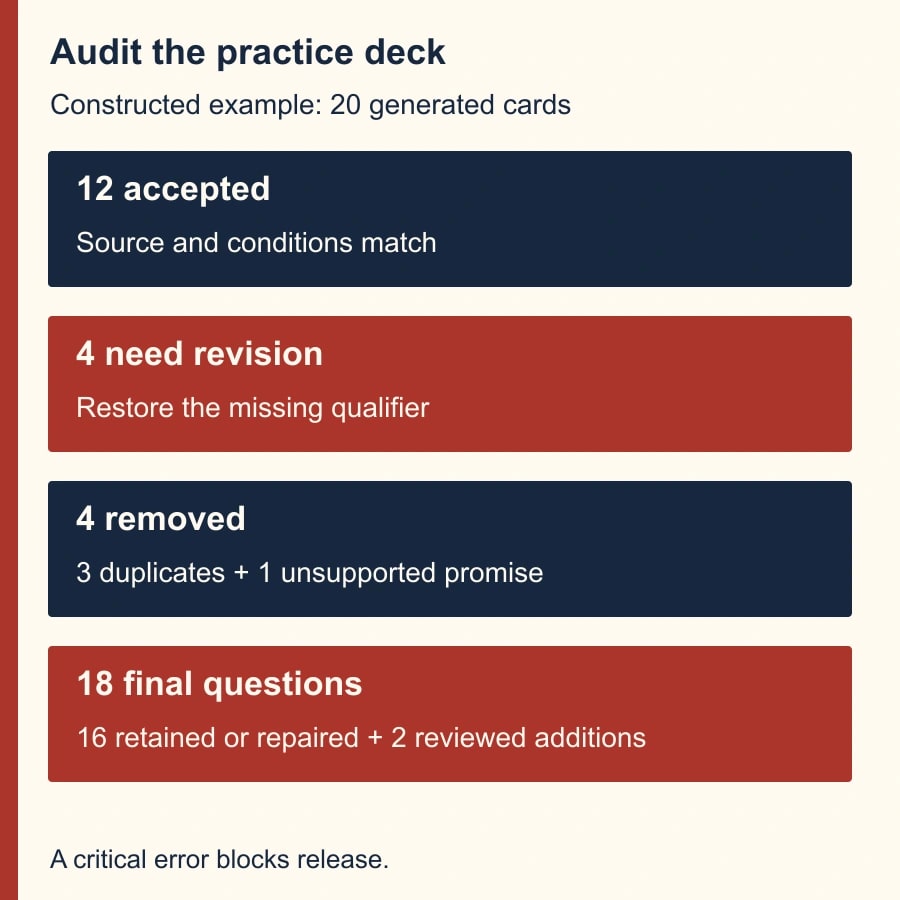
Set a stronger rule for consequential errors than for wording preferences. An unsupported promise, wrong escalation route or outdated safety instruction blocks release. Awkward phrasing can be repaired. A critical factual defect cannot be traded away because most of the remaining cards look good. Ask a second knowledgeable colleague to challenge the answer key when the subject warrants it; do not describe that as a product test unless you actually conduct and document one.
Use images to distinguish, not decorate
A helpful visual makes the learner inspect something that matters: the correct status marker, the relevant part of a form or the branch of an approved process diagram. A decorative product image does not necessarily teach a decision. Check that cropping has not removed a date, warning or exception that changes the answer.
Have the reviewer answer the question using the image as it actually appears on the smallest device the cohort will use. If a necessary label cannot be read, replace the learning activity or provide an accessible source view. Do not assume that a desktop review proves the mobile exercise is usable. Include staff who need larger text or an alternative to image-dependent questions.
Avoid giving away the answer unintentionally. A card asking which route to choose is a weak assessment if the picture highlights the correct route before the learner responds. That may still be a useful teaching card, but label its role as explanation rather than a test of unaided recall. Mixing those roles makes progress figures harder to interpret.
Separate practice progress from readiness
Google documents self-marking for flashcards, remembered progress and the ability to revisit missed concepts. Those features help learners organize practice. They are not the same as a supervisor observing an unfamiliar work case. Review the documented study controls.
Use the stopwatch only when response speed matters to the real task and the answer is already correct. For a new coordinator, taking thirty extra seconds to verify a delivery commitment may be desirable. A speed target imposed too early can teach guessing. Make it acceptable to say “I need to check the current record” when that is the correct action.
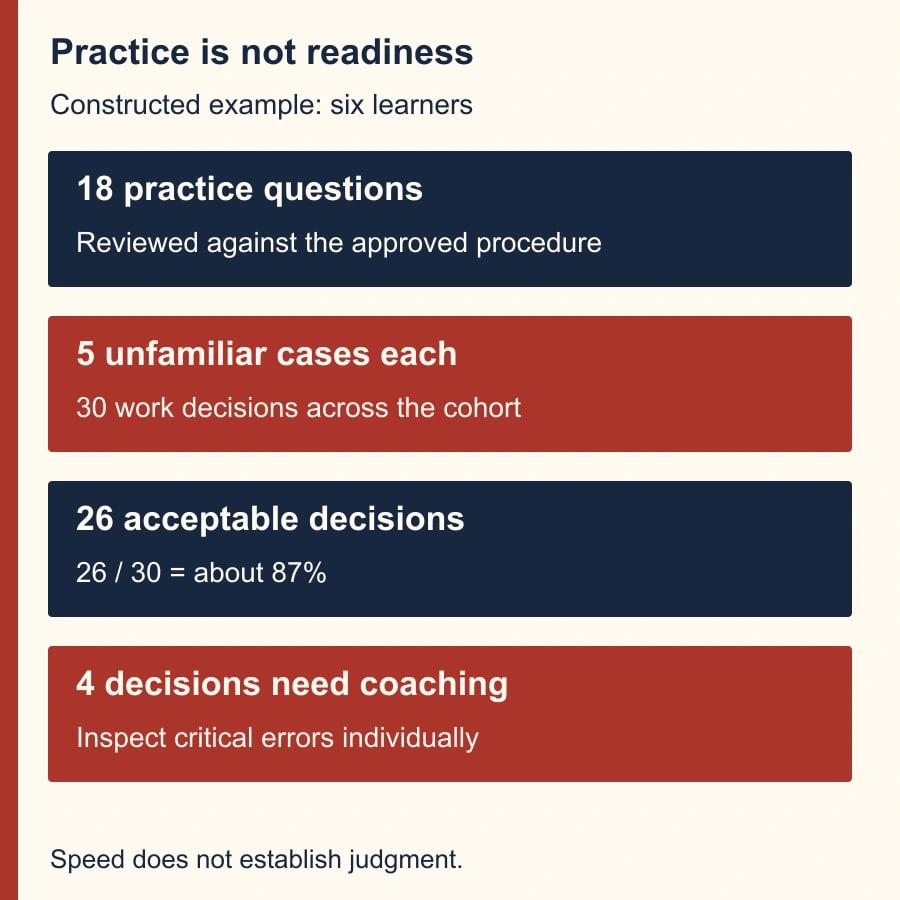
Build a separate five-case work sample with different wording and details from the cards. In the constructed distributor example, include a confirmed date, an estimate, contradictory messages, an unavailable source and a request outside the coordinator's authority. Grade the chosen action and explanation, not just a memorized phrase. Keep the correct outcomes with the supervisor.
Suppose six learners complete five cases each: thirty decisions. Twenty-six are acceptable and four need coaching. The calculated acceptance rate is about 87%, but inspect the four failures individually. One unauthorized commitment may matter more than several hesitant explanations. Do not award a readiness label from the overall percentage without a job-specific rule for critical mistakes.
Run a small pilot and price the upkeep
Schedule a short practice period, then the independent work sample. Record preparation time, expert review time, learner time and coaching time. Use reminders only at a cadence the team agrees to; notifications are a means to practice, not a measure of learning. Give the trainer a way to hear about confusing cards without requiring staff to work around the official process.
For a constructed planning budget, allow ninety minutes to prepare sources, sixty minutes to review the initial deck and thirty minutes to set up the assessment. That is three staff hours before learner practice. Six learners spending fifteen minutes each add ninety minutes, or 1.5 hours. Total allocated capacity is 4.5 hours, excluding later coaching and any paid service costs. Those hours are not cash savings.
After the pilot, decide whether the work sample improved enough to justify the upkeep. A before-and-after exercise can inform a local decision, but without comparable conditions it does not isolate the tool's effect. Record changes in source quality, instructor help and learner familiarity. Report what the team actually observed rather than attributing every gain to AI.
Keep the deck current or retire it
Tie review to changes in the underlying procedure. When a policy, product or escalation owner changes, identify the affected cards and suspend the outdated material. Regenerate or revise, repeat the factual review, and tell learners which version is current. A deck that was accurate at launch can become the most convenient source of the wrong answer.
Stop the pilot if the source owner cannot resolve contradictions, if critical errors survive review, or if maintaining the deck costs more time than the training value warrants. Start this week by selecting one procedure and drafting five work-sample cases before generating any cards. Our team AI training plan helps place that exercise in a broader program; the Notebook source-change guide explains why source maintenance needs its own owner.
Weekly Newsletter
AI Adoption Weekly
New research, field guides, training studies, and tool decisions for operators.
No spam. Unsubscribe anytime.
Related Comparisons
Calculator
AI seat cost calculator
List price × headcount. You enter the hours and the operating assumptions.