
Compare Supplier Proposals With Gemini in Drive Without Mixing Scope
Build a source-checked supplier comparison with Gemini in Drive. Normalize scope, separate assumptions, and calculate comparable costs before choosing.
Published October 19, 2026

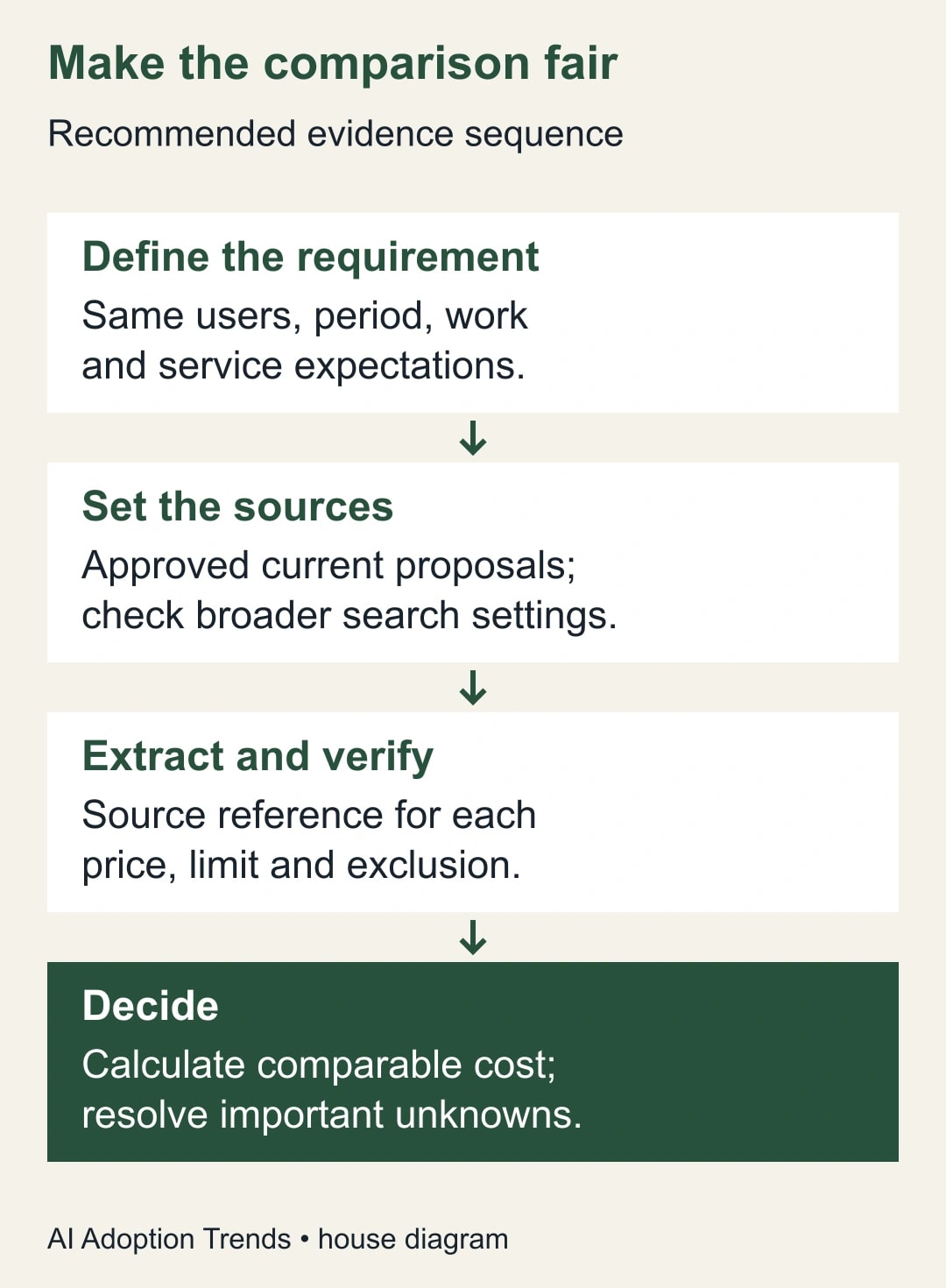
Use Gemini in Google Drive to extract and organize supplier proposal terms, then make the offers comparable yourself. Start with a written requirement, select the current approved source files, check broader search settings, and verify every price, limit and exclusion against its source. Calculate the comparable cost in a worksheet before asking anyone to choose a supplier.
This approach fits an operations or procurement lead comparing a small set of business-service proposals. It is useful when the documents contain different structures and language but describe work you can normalize. Skip an AI-led comparison when the source documents are incomplete, the proposed work is still undefined or the decision requires a specialist assessment the team cannot provide.
Google's Drive research and analysis guidance describes comparing files, selecting sources and checking citations. Access requires an eligible Google Workspace or Google AI plan. Product details here were checked October 18, 2026. The worksheet, prompts and examples are our proposed buying method, not a hands-on product benchmark or a claim that Gemini selects better suppliers.
Define the comparison before reading the sales pitch
Write a short requirement independent of the suppliers' offers. Name the service, expected volume, number of users, locations, time period, required support and implementation work. Include the business outcome, such as producing a reconciled monthly report or maintaining a supported internal workflow. A supplier's feature list should not silently become your requirement.
Choose the comparison period. First-year cost is often useful when setup and migration matter; a recurring annual comparison answers a different question. If you need both, keep both. A low first-year introductory price can coexist with a higher continuing cost, while a high setup fee can distort a comparison of steady-state service.
Agree which differences are essential. A support response time, data-export capability or implementation deadline may be a condition of purchase rather than a weighted preference. Put those conditions in a separate pass/fail section so a low price cannot compensate for a requirement the business cannot waive.
Have the decision owner approve this basis before reviewing AI output. Otherwise, a persuasive summary can steer the team toward the easiest comparison rather than the right one. Keep the requirement short enough that reviewers will actually use it, but specific enough that an omission is detectable.
Build a current, bounded source set
Collect the latest proposal from each supplier and any written clarifications that change it. Record the document title, version, date, validity period and supplier contact. Keep superseded proposals in a clearly separate archive. A newer filename is not proof that a document supersedes every earlier term; identify exactly which clarification changes which part of the offer.
Use an approved Workspace account and documents the team is permitted to process. Begin in Drive with the relevant files or folder, open Ask Gemini and inspect the listed sources. Google documents source controls in the research interface. Select the current materials deliberately rather than starting from an unrestricted search across years of correspondence.
Check the broader search settings as well as the pinned files. Google says new conversations can search Drive, Gmail, Chat and Calendar by default, while web search starts off. For a proposal comparison, limit the locations to the agreed evidence set. A prompt saying “use these files” is not a substitute for checking the available source settings.
Google's Workspace source guidance warns that prior conversational sources can remain relevant and that citations can be wrong or incomplete. Start a fresh conversation if you need to exclude previously used material, and verify the actual references. This is particularly important when an older proposal offers a feature the latest version removed.
Do not share a research project with everyone simply to make source access convenient. The reviewer needs authorized access to the relevant evidence. If access is missing, have the document owner resolve it or produce an approved summary. Changing who can read a supplier's confidential material is a separate decision from comparing it.
Extract evidence before asking for a recommendation
Ask for a structured extraction with one row per requirement and one column per supplier. Require the source file and section for each answer. Include a distinct value for “not stated” rather than inviting the model to infer common industry practice. A missing support commitment is not equivalent to standard support.
An adaptable prompt is: “Compare only the approved proposals and clarifications listed here against this requirement. For each supplier, extract included scope, exclusions, volume limits, recurring charges, one-time charges, required extras, support commitments and implementation dependencies. Cite the file and relevant section for each claim. Mark absent terms as not stated. Keep assumptions separate from supplier commitments. Do not rank the suppliers yet.”
Review the output against the original files. Open the cited passage for consequential terms: price, minimum term, included volume, implementation responsibility and exit or export arrangements. Check nearby qualifications and footnotes. A citation to the right document is not enough if the sentence describes only a limited package or a conditional discount.
Maintain a claim log as you check. Record the extracted claim, source location, your verification result and any question for the supplier. If a claim is unsupported, remove it from the comparison until it is resolved. Do not turn a confident sentence into an accepted fact just because it makes the table more complete.
For long proposals, split extraction into smaller topics. Ask separately about cost, service scope and implementation responsibilities, then reconcile the outputs into one worksheet. Google notes that source volume can exceed processing capacity. Treat a concise response as a possible partial reading until the reviewer has checked coverage against the requirement list.
Make the costs describe the same work
Separate recurring subscription or service charges from setup, migration, support, usage charges and optional work. State the assumed volume beside each calculation. A price for ten users cannot be compared directly with a price for unlimited users if your team needs thirty. The right calculation depends on the requirement you approved at the start.
Keep currency, tax treatment and period consistent. Record whether taxes are included or excluded rather than assuming they cancel out. If a currency conversion is needed, document the rate, date and policy the business uses. Do not ask Gemini to supply an unsourced exchange rate and then present the result to the nearest cent.
Distinguish quoted prices from your calculations. “Supplier A quotes $800 per month” is a source claim. “Twelve months at that rate equals $9,600” is your arithmetic. “The service will reduce staff effort” is an outcome hypothesis unless supported by appropriate evidence. These statements belong in different parts of the comparison.
Keep non-price exclusions visible even when you cannot price them yet. Missing implementation work may be a blocker, not a zero-dollar item. Write “cost unresolved” and ask for clarification. Assigning zero to an unknown makes the apparently cheapest offer depend on a hidden assumption.
Work a two-supplier example
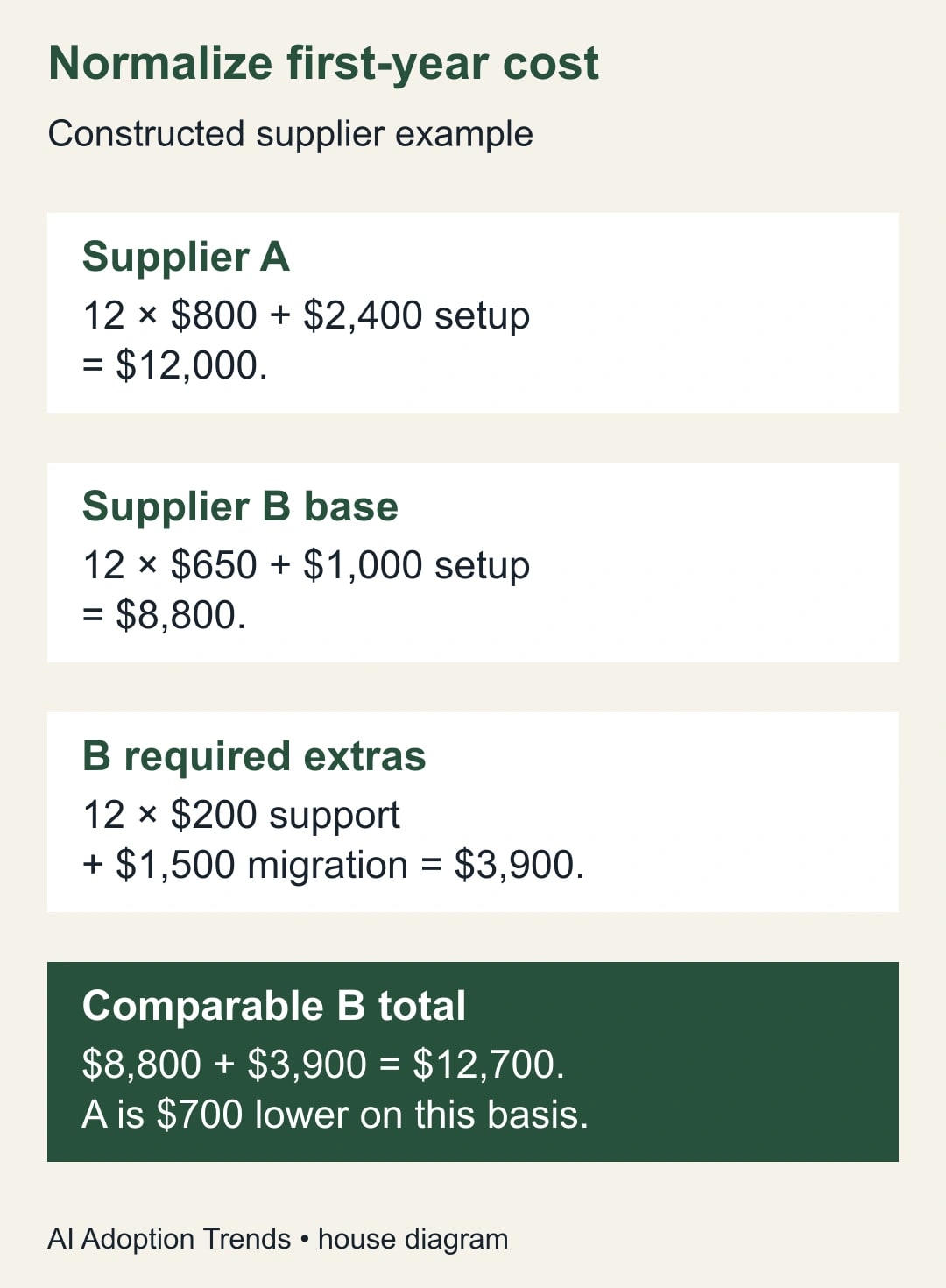
Consider a constructed comparison for the same reporting service over twelve months. Both proposals use the same currency and exclude tax for this example. Supplier A quotes $800 per month plus $2,400 setup, with the required support and migration included. Its first-year comparable cost is 12 × $800 + $2,400 = $12,000.
Supplier B quotes $650 per month plus $1,000 setup. On those headline figures, its first-year base cost is 12 × $650 + $1,000 = $8,800. A quick AI summary might call it $3,200 cheaper. But that conclusion ignores the requirement: the business also needs the support and migration that A includes.
Suppose B's written clarification prices required support at $200 per month and migration at $1,500. These add 12 × $200 + $1,500 = $3,900. B's comparable first-year cost becomes $8,800 + $3,900 = $12,700. A is $700 lower on this stated basis. The arithmetic is reproducible; no customer outcome is being claimed.
Now ask whether the work is actually equivalent. If B's migration excludes historical attachments while A includes them, the $12,700 still does not describe the same deliverable. The buyer must resolve that scope difference or explicitly decide that the attachments are unnecessary. “Same number of line items” is not the same as comparable service.
Also inspect the ongoing year. If setup and migration are one-time and the quoted monthly prices stay unchanged, A's recurring annual cost is $9,600 and B's is $10,200 including required support. That is a separate conditional calculation, not a promise about renewal prices. Renewal terms need their own source check before those figures enter a longer-term budget.
Give the supplier a precise clarification request
Turn gaps into questions that can change the decision. “Please clarify implementation” is too broad. Ask which data is migrated, who prepares the export, how exceptions are handled, what acceptance evidence is provided and which work attracts an extra charge. Reference the exact proposal section so the answer can be attached to the right claim.
Ask the same material questions of both suppliers when their offers need comparison. Keep the responses with the source set and update the worksheet deliberately. If a clarification replaces a price or term, mark the old value superseded. Do not leave contradictory versions active and hope the next AI response chooses the intended one.
Use this prompt after the first verification pass: “From the unresolved fields in this checked comparison, draft clarification questions for each supplier. State the business requirement and the missing or conflicting proposal term. Do not imply we have selected a supplier, accept a price, or add a new requirement. Group questions by scope, cost and implementation.” A person should review the questions before sending them.
The response may reveal that the original requirement was unrealistic. Bring that finding back to the decision owner. Changing the requirement is legitimate, but record it and rerun both offers against the new basis. Otherwise, one supplier can appear stronger merely because its proposal quietly changed the rules.
Reuse this decision worksheet
- Requirement: outcome, volume, users, period, essential capabilities and any non-negotiable conditions.
- Source register: supplier, file version, date, validity and clarifications that supersede earlier terms.
- Evidence rows: one requirement, each supplier's commitment, source location and verification result.
- Cost model: recurring charges, one-time work, required extras, assumptions, currency and tax treatment.
- Open questions: missing terms, decision impact, responsible person and response deadline.
- Decision: why the selected offer fits, unresolved conditions, approver and next authorized action.
Add a separate risk review when the supplier will connect to business data. The AI vendor security questions guide provides a useful next step. A proposal comparison should identify that work, not pretend a few extracted sentences complete it.
Stop when the evidence cannot support a choice
Hold the recommendation if a material cost is missing, the service scopes differ in an unresolved way, a proposal has expired or the citations fail to support the claims. If the model repeatedly combines old and new terms, narrow the sources and rebuild the extraction. If that remains unreliable, use the worksheet manually. The process should still work without the assistant.
For a first trial, choose two low-risk proposals and have a second person verify the decisive rows. Measure source-checking time, unsupported claims, missing requirements and whether the final comparison survives that second review. Do not measure success by the speed of the first generated table alone.
Include staff review and clarification time in the cost of the method. Any time released is capacity until a real budget change makes it cash savings. Start by writing the common requirement and checking one price-bearing sentence from each proposal. When the offers are genuinely comparable, use the AI business-case guide to connect the selected cost and expected benefits to a measurable pilot.
Weekly Newsletter
AI Adoption Weekly
New research, field guides, training studies, and tool decisions for operators.
No spam. Unsubscribe anytime.
Related Comparisons
Calculator
AI seat cost calculator
List price × headcount. You enter the hours and the operating assumptions.