
Move Gemini Gems to Skills Without Losing the Workflow
A practical migration plan for team Gems: preserve the job, test reusable instructions, check both destinations, and keep a working fallback.
Published October 13, 2026· Updated Oct 14, 2026
If your team uses a Gemini Gem to prepare client updates, review proposals, or apply its writing rules, start by preserving the job it performs. Then rebuild and test that job as a skill. Copying a long instruction into a new box is the easy part. Proving that it still handles missing information, conflicting instructions, and shared access is the work that makes the transition useful.
Google's September 30 transition notice says skills begin rolling out in the Gemini app on October 13, 2026, with completion expected by mid-November. This is a rollout start, not a promise that every account has the feature today. Skills are reusable instructions you can apply within a conversation, including more than one set of instructions at a time. The practical opportunity is to separate the task from the rules that several tasks share.
This guide is for the operations or marketing lead responsible for a small collection of team Gems. It covers a proposed migration method, with a constructed client-update example. It is not a report of a completed customer deployment. If your organization has no saved Gemini workflows, you do not need a migration project. If your Gem influences payments, hiring, legal commitments, or other consequential decisions, its business owner needs to review the replacement before anyone relies on it.
Update, October 14: Google's October 13 rollout update delays Workspace skills until further notice. Gemini app skills are still rolling out, but sharing and Google Drive integration are due in the coming weeks. Keep the working Gem or manual process while preparing the brief; wait for the required capabilities before attempting the team handoff.
Put the actual deadlines on the calendar
Google says Gems move to the Gemini app's Settings panel on November 17, while remaining usable. For business and enterprise users, removal and automatic migration of remaining Gems to draft skills will occur no sooner than March 1, 2027. Flows in Workspace Studio that use an Ask a Gem step will then stop working. Treat those as separate events: a menu change, a later retirement, and a dependency that needs replacement. October 13 is not a shutdown date.
The same notice says skills in the Gemini app do not currently synchronize with Workspace apps. A team that needs both must create and test both copies. Record the destination beside each workflow rather than marking a generic migration box complete. This is especially important when one employee prepares material in the Gemini app and another finishes it in Docs or Gmail.
Before changing anything, ask your administrator which experience is available in your account, which organizational controls apply, and whether the intended users have access. Google's Workspace skills announcement describes building skills in Docs, testing them in Workspace Studio, and using them in supported Workspace surfaces. Its availability notes and the administrator's skills controls should be checked against your edition and rollout. Do not buy an upgrade simply because a button is missing.
Inventory the job, including the parts nobody wrote down
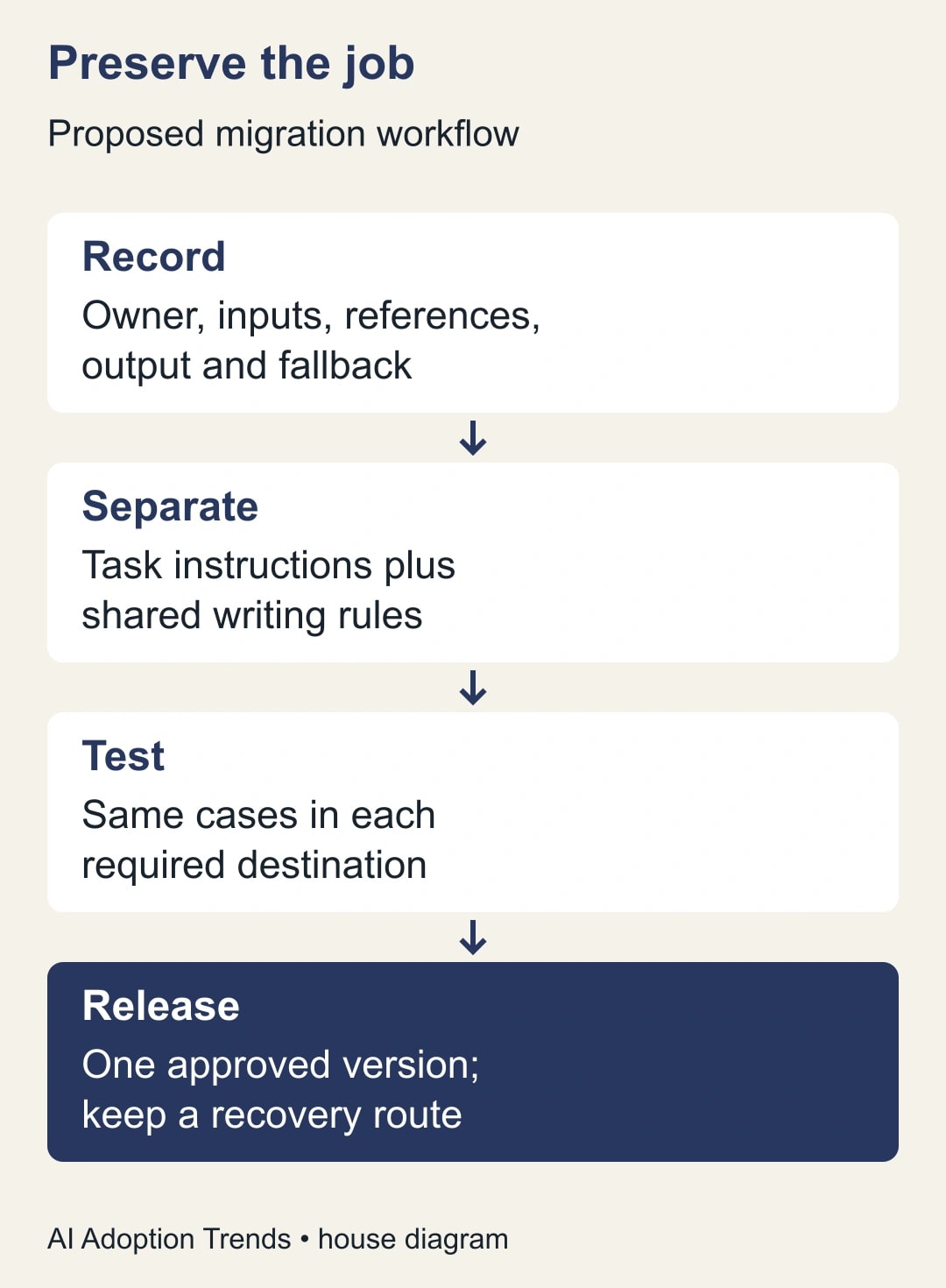
Choose one frequently used Gem with a clear owner. Save its current instructions in your approved document store, along with a date and version. Record the files it depends on, where those files live, who can open them, and an example of an acceptable result. If a colleague normally fixes the Gem's output from memory, write down that correction too. Otherwise you will preserve the prompt while losing the real process.
A useful inventory row contains: workflow name; business owner; current users; Gemini app or Workspace destination; instruction version; reference documents; input; output; reviewer; connected flow; and fallback. The fallback should describe how a person completes the task while the replacement is being repaired. “Ask IT” is an escalation route, not a working fallback.
Sort the inventory by consequence and frequency. A weekly internal summary is a better first migration than a supplier approval involving an external system. Give unused Gems a retirement decision instead of carrying them forward automatically. Confirm with their owners before removing access or deleting anything; apparent inactivity can reflect a quarterly process that has not run recently.
Separate the procedure from the shared writing rules
Imagine a 12-person consultancy whose account managers prepare weekly client updates. Its old Gem contains three kinds of instructions: select the important changes, format the update, and use the firm's tone. Split those only where the separation helps a person maintain them. One skill can prepare the update; another can apply the shared writing rules. Keep the rule against inventing dates inside the task skill, because it matters even when the style skill is absent.
The task skill needs a defined input. In this example, that is an approved project log containing milestone, owner, due date, status, evidence, and client decision needed. It should not search an employee's entire work history to guess which project matters. The output is a review draft with completed work, next steps, open decisions, and unresolved facts. Sending the message remains a separate human action.
The shared style skill can specify plain language, short paragraphs, and a consistent salutation. It should not contain client names, current deadlines, or promises. Those belong in the current source record. When a reusable instruction embeds changing facts, it becomes an undocumented second database. Separating stable rules from current evidence makes the next update easier to check.
Write a skill brief that someone else can maintain
Use this adaptable brief as a starting point. The labels are ordinary instructions, not a required Google file format. Place them in the creation experience available to your account, then use its available test or preview controls. Sharing must wait until that capability reaches your account.
- Job: Prepare a weekly client-update draft from the named project log and approved meeting notes. Audience: the client's project sponsor. Owner: the account lead.
- Required inputs: project name, reporting period, approved source links, milestone owners, dates, and any client decisions. If the period or project is missing, ask before drafting.
- Evidence rule: Every claimed completion, date, and commitment must trace to a named source entry. Mark an absent fact as “Needs confirmation” and list the person who should answer it. Do not infer agreement from silence.
- Output: a short opening, completed work, next steps with owners and dates, client decisions needed, and a separate reviewer-only list of uncertain or conflicting facts.
- Boundaries: Do not send messages, promise dates, change source records, or disclose internal comments. A person reviews the draft and chooses the final recipients.
- Conflict rule: Accuracy and confidentiality take priority over tone and brevity. If a writing instruction would remove an important qualification, keep the qualification and flag the conflict.
This brief gives the reviewer observable behavior. “Be accurate and professional” does not. A useful instruction says what to do when accuracy is impossible because an input is absent. It also names the action that must wait. That is how a colleague can distinguish a successful refusal to guess from an incomplete draft.
Run a small test pack before migrating the next Gem
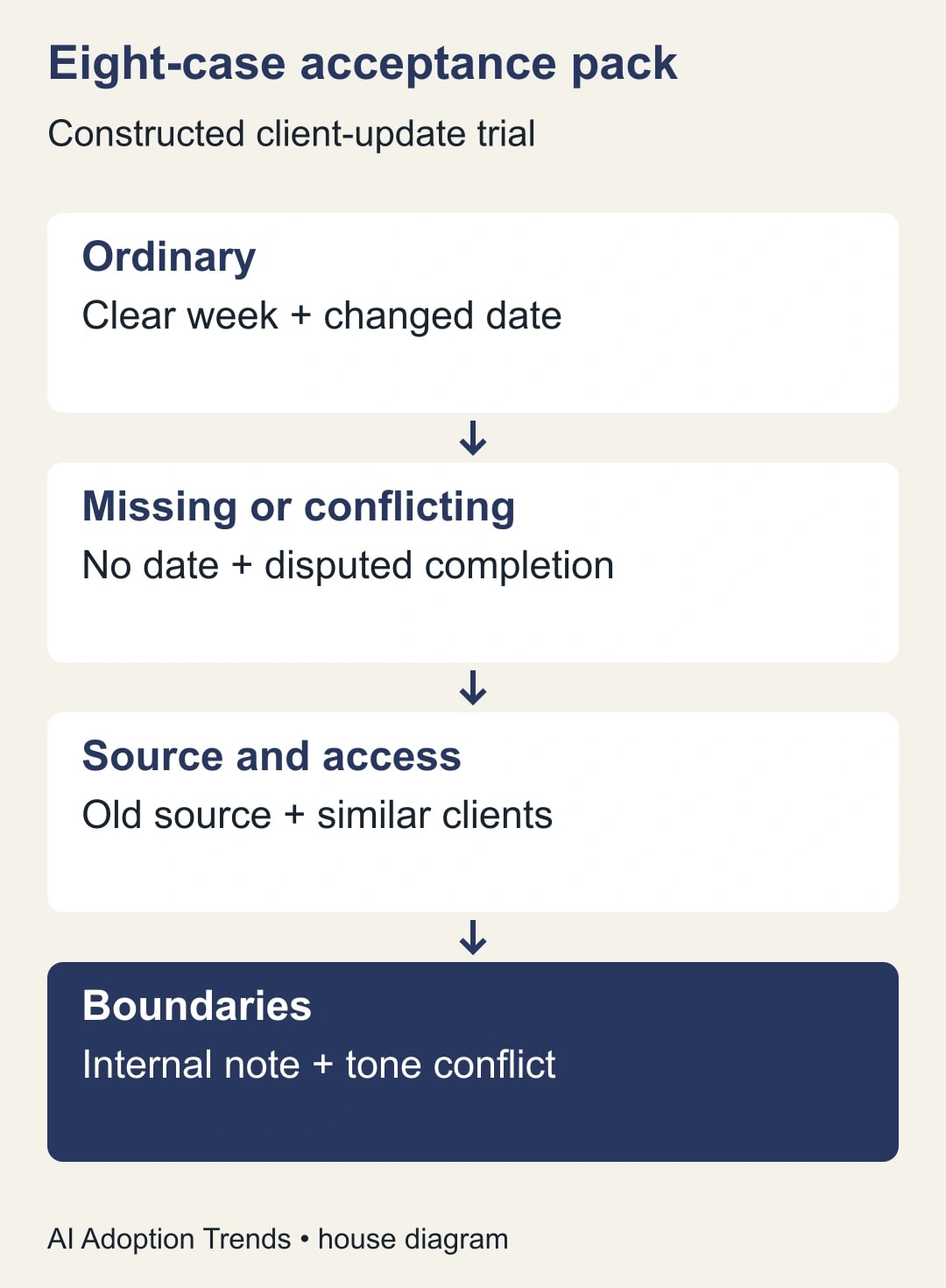
Create eight test cases using invented or approved non-sensitive project records. Include a straightforward week, a missing date, a disputed completion, a changed deadline, two clients with similar names, an internal-only note, an outdated source, and a conflict between the task and tone instructions. Write the expected behavior before running either version. Test cases with no agreed answer cannot establish that the new skill is better.
Run the old Gem and the new skill on the same inputs, where the old experience remains available. Save both outputs and ask a reviewer to assess them without being told which version produced each. The reviewer checks facts, required sections, unresolved questions, and prohibited disclosures. A preference for smoother prose should not outweigh a missed internal-only note.
Here is a constructed acceptance result: the replacement completes six of eight cases correctly. It invents a date in one and includes an internal margin comment in another. Six divided by eight is 75%, but the percentage is not the decision. Both failures breach the proposed boundaries. Hold the release, repair the instructions or source separation, and rerun the entire test pack. Do not retest only the two failures; a repair can break a previously correct case.
In a revised hypothetical run, all eight cases meet the checklist. That is permission for a supervised trial, not proof that the skill will never fail. Start with one account manager and review every draft. Keep unusual cases in the test pack so each genuine correction improves the next release. This is an editorial recommendation for managing the transition, not a Google guarantee or an industry benchmark.
Test access separately from writing quality
Once sharing and the required reference-file support are available, have a second intended user open the skill and its references from their own account. Until then, test only the supported individual workflow and keep the team handoff pending. Do not grant broader document access merely to make the test pass. If a source is unavailable to that person, decide whether they should receive access or whether the workflow needs a different approved input. A skill that works only for its creator is not ready for a team handoff.
For teams using both destinations, wait for the delayed Workspace rollout before testing that copy. Record two outcomes: tested in the Gemini app and tested in the relevant Workspace surface. Use the same version label and acceptance cases, but do not assume equal outputs or automatic synchronization. Keep the master brief in one controlled document and record where its approved version was copied. When the brief changes, both destinations return to review.
Inspect flows that invoke the old Gem as a separate workstream. List the trigger, input files, owner, current output, and downstream action. Test a replacement on copies or a non-sending path before switching it. A successful chat test does not prove that a scheduled flow passes the right input or handles an unavailable source. Where the replacement is not yet available, preserve the manual fallback and a named deadline for revisiting the dependency.
Budget the review, then measure accepted drafts
Avoid turning this into an unpriced cleanup effort. Estimate owner time to document the job, administrator time to check access, reviewer time for the test pack, and user time to learn the replacement. Confirm any edition, usage, or connected-service costs in your account; this guide does not assume that every described experience is included in every subscription.
Suppose the consultancy creates 20 updates per month. In a constructed baseline, each takes 18 minutes to draft and review. After the supervised trial, each takes 12 minutes including corrections. That releases 120 minutes per month: 20 multiplied by six. If migration and training consumed four hours, the simple time payback is two months, provided quality remains acceptable. It is released capacity, not cash savings unless a real spending decision changes.
Track time to an accepted draft, unsupported factual claims, missed client decisions, and reviewer corrections. Record all attempted drafts, including abandoned ones. If the new skill saves drafting time but adds the same amount of source-checking work, there is no net time benefit. It may still improve consistency, but name that benefit rather than manufacturing a productivity claim.
Release one version and keep a recovery route
The account lead should approve the tested brief, reference set, destinations, and reviewer instructions together. Tell users where the new version lives, what it is intended to do, and how to report a wrong result. Keep the previous approved instructions until the replacement has completed several normal cycles. Retire the old entry only after checking that users and connected processes have moved.
Stop the trial immediately for an external disclosure, a fabricated commitment, or an action outside the agreed scope. For less serious defects, restore the previous instructions or use the manual process while the owner repairs the skill. Record the failing input and expected behavior, avoiding unnecessary personal information. A rollback should restore a known working job, not simply a familiar interface.
Your next step is to select one active Gem and complete its inventory row. Pair this migration with the site's training plan for one business team and AI use policy employees can follow. The first useful result is a colleague producing an accepted draft from a documented skill, with the same boundaries and sources that made the old workflow dependable.
Weekly Newsletter
AI Adoption Weekly
New research, field guides, training studies, and tool decisions for operators.
No spam. Unsubscribe anytime.
Related Comparisons
Calculator
AI seat cost calculator
List price × headcount. You enter the hours and the operating assumptions.