
AI Lead Routing Performance: Compare the System, Not the Demo
Lead-routing products look similar in a demo. The differences appear under dirty data, owner changes, capacity limits, and exceptions. Use this seven-metric replay test before choosing one.
Published September 21, 2026
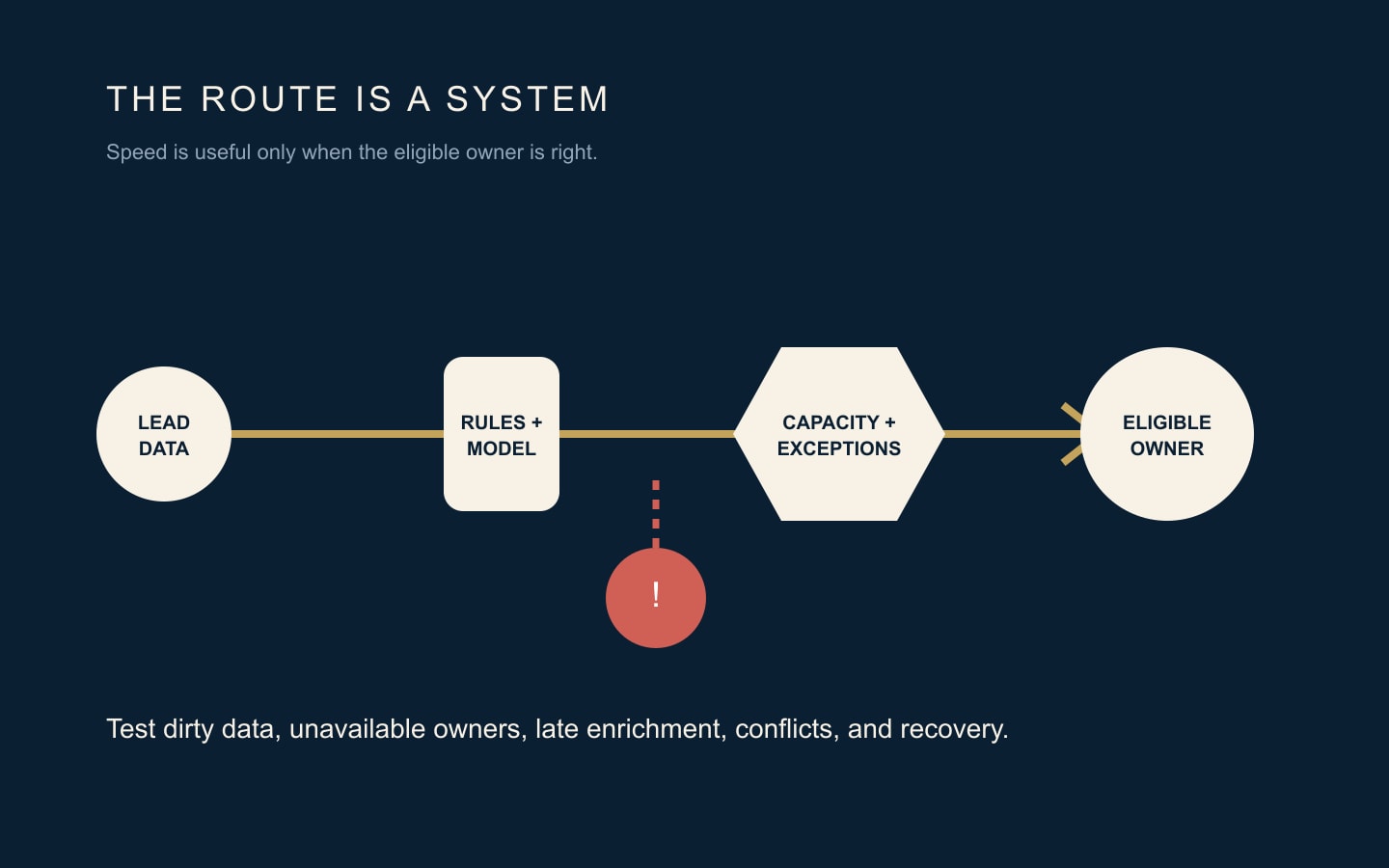
A high-value lead submits a form at 4:52 p.m. The routing dashboard says the record was assigned in seconds. On Tuesday, revenue operations discovers it went to a rep on leave, bounced through two queues, and received no human response for sixteen hours. The software won its speed metric. The business lost the lead.
What buyers are actually comparing
An AI lead routing performance comparison should not begin with a feature grid. Most products can describe territory rules, round robin, enrichment, scoring, and CRM updates. The useful comparison is how the whole system behaves when records are incomplete, rules conflict, owners are unavailable, integrations lag, or the model is uncertain.
There is no credible universal benchmark for “best” lead-routing accuracy. Vendors observe different customers, fields, definitions, and outcomes. A 30% improvement claim from one environment cannot be compared with a five-minute response claim from another. The only defensible benchmark is a replay of your historical leads against a pre-agreed answer key.
The four routing modes
Rule hierarchy sends records according to ordered conditions such as geography, segment, product, or account ownership. Round robin spreads eligible records across a group. Load-balanced routing considers current ownership or capacity. Model-assisted routing scores fit or intent and uses that prediction in the route. Mature systems often combine all four, which makes precedence and exception behavior more important than the label on the product.
Official CRM documentation shows why implementation details matter. HubSpot notes that editing a rotation can reset assignment counts and that records are rotated one object at a time, which can introduce retries or delays. Its workflow guidance also describes an ownership-sync configuration that can delay lead rotation by roughly ten minutes. Salesforce warns that a misplaced comma in assignment-rule criteria can match any value and bypass later rules. None of these details means the products are poor. They show that routing quality is a configured-system property, not a button.
The seven measures that expose a weak router
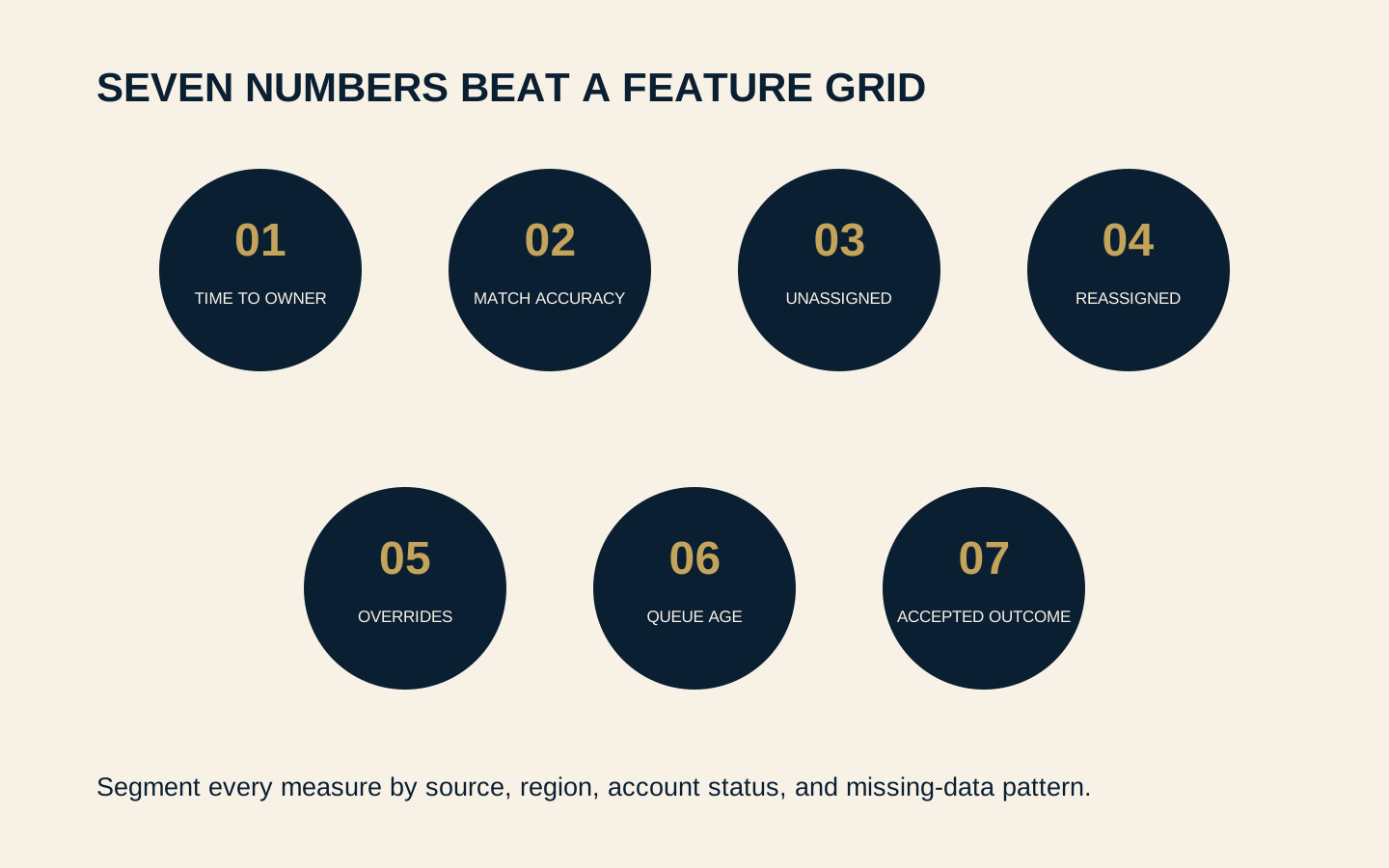
- Time to first eligible owner: elapsed time until someone who can act owns the lead—not database update time.
- Match accuracy: share assigned to the correct territory, segment, account, language, product, and skill combination.
- Unassigned rate: share left without an owner after the promised service window.
- Reassignment rate: share moved because the first route was wrong, unavailable, rejected, or stale.
- Override rate: share manually changed by operators, plus the reason for each override.
- Queue age: median and 90th-percentile time for unresolved exceptions.
- Accepted-outcome rate: share that reaches the agreed next stage without a preventable routing correction.
Run a historical replay, then try to break it
Take at least 500 recent leads across ordinary and edge cases. Have operations and sales define the correct route before seeing product output. Freeze the input fields and run the same set through each candidate. Score all seven measures, cost per accepted route, configuration time, and investigation time when something fails. Keep the answer key outside the vendor team.
Then inject failures on purpose. Remove industry or country. Use a free-email domain. Create a duplicate contact under an existing account. Mark the preferred owner out of office. Exceed a capacity limit. Change an account owner while the record is in flight. Supply two rules that both match. Route a lead whose language and territory point to different teams. A useful system fails visibly, preserves an audit trail, and offers a bounded exception path.
Where routing systems faceplant
They faceplant at the seams. Enrichment arrives after the assignment. Account matching uses a domain that belongs to a subsidiary or holding company. A model score is treated as certainty. A round-robin pool includes inactive users. The CRM accepts the update, but the engagement platform reads stale ownership. Operators fix the same exception repeatedly because override reasons are not captured and fed back into the rules.
The most dangerous dashboard reports only routing speed and distribution. Fast, even assignment can still be wrong. Pair speed with accuracy, reassignment, and accepted outcomes. Segment every metric by source, region, company size, existing-customer status, and missing-data pattern; averages hide the exact populations where automation breaks.
A procurement scorecard that travels beyond the demo
- Decision logic: Can an operator explain why this record went to this owner and which rule or score won?
- Change control: Can rules be tested against historical data, approved, versioned, and rolled back?
- Availability: How are leave, capacity, time zones, and temporary team changes represented?
- Data timing: What happens when enrichment, account ownership, consent, or duplicate resolution arrives late?
- Recovery: Can the team find, reprocess, and measure every failed or stale assignment?
- Economics: What is the total cost per accepted route, including enrichment, implementation, and operations time?
The Monday-morning playbook
Export the last 90 days of leads with original fields, timestamps, ownership history, manual changes, and final accepted stage. Ask sales and operations to label 50 edge cases together; disagreement is evidence that the policy is unclear. Turn that work into the answer key, replay set, and stop rules. Pilot one region or segment for four weeks with a daily exception review.
Scale only when the new route improves time to first eligible owner without a worse wrong-owner rate, reassignment rate, or queue age. The winning product is not the one that routes fastest in a clean demo. It is the one your operators can understand, stress, repair, and keep correct when the organization changes.
Primary sources
- HubSpot: assign and rotate record owners — Official behavior for rotation, assignment methods, and operational limits.
- HubSpot: workflows FAQ — Official documentation of timing and workflow behavior, including ownership sync.
- Salesforce: lead assignment rules — Official rule hierarchy and assignment guidance.
- Salesforce: troubleshoot assignment-rule criteria — Official example of punctuation causing broad matches and later rules to be skipped.
The automation layer a founder can see
Branching scenarios. You still own the graph.
We may earn a commission · editorial verdicts remain independent
Weekly Newsletter
AI Adoption Weekly
New research, field guides, training studies, and tool decisions for operators.
No spam. Unsubscribe anytime.
Related Comparisons
Working resource
Open the routing scorecard
Use the article’s framework on your own operating data. Print it, share it, and bring the completed version to the decision.