
After Jensen Huang: Does NVIDIA’s Leadership Crisis Change Your AI Plans?
Jensen Huang has resigned as NVIDIA chief executive. A five-part examination of what is confirmed, what remains unresolved, and which AI decisions businesses should actually revisit.
Published November 13, 2026

If your company uses AI, Jensen Huang’s exit is a reason to ask better questions of your suppliers. It is not, by itself, a reason to stop an employee pilot, cancel a cloud contract, or buy a warehouse of chips. NVIDIA said on November 12 that its founder had resigned as president, chief executive, and director. Chief financial officer Colette Kress is serving as interim chief executive while the board searches for a permanent successor. The change matters because Huang designed much of the strategy behind the computing systems that power the AI boom. The business consequences, however, depend on how close your company is to the hardware.
This is a five-part examination of the company he built, the unresolved investigation around his departure, and the decisions that now face buyers. The central finding is practical: NVIDIA is important to the supply of AI computing, but most companies buy finished AI services rather than NVIDIA equipment. The farther you are from building models or data centers, the less a CEO change should alter Monday’s plan.
1. What happened, and what we still do not know
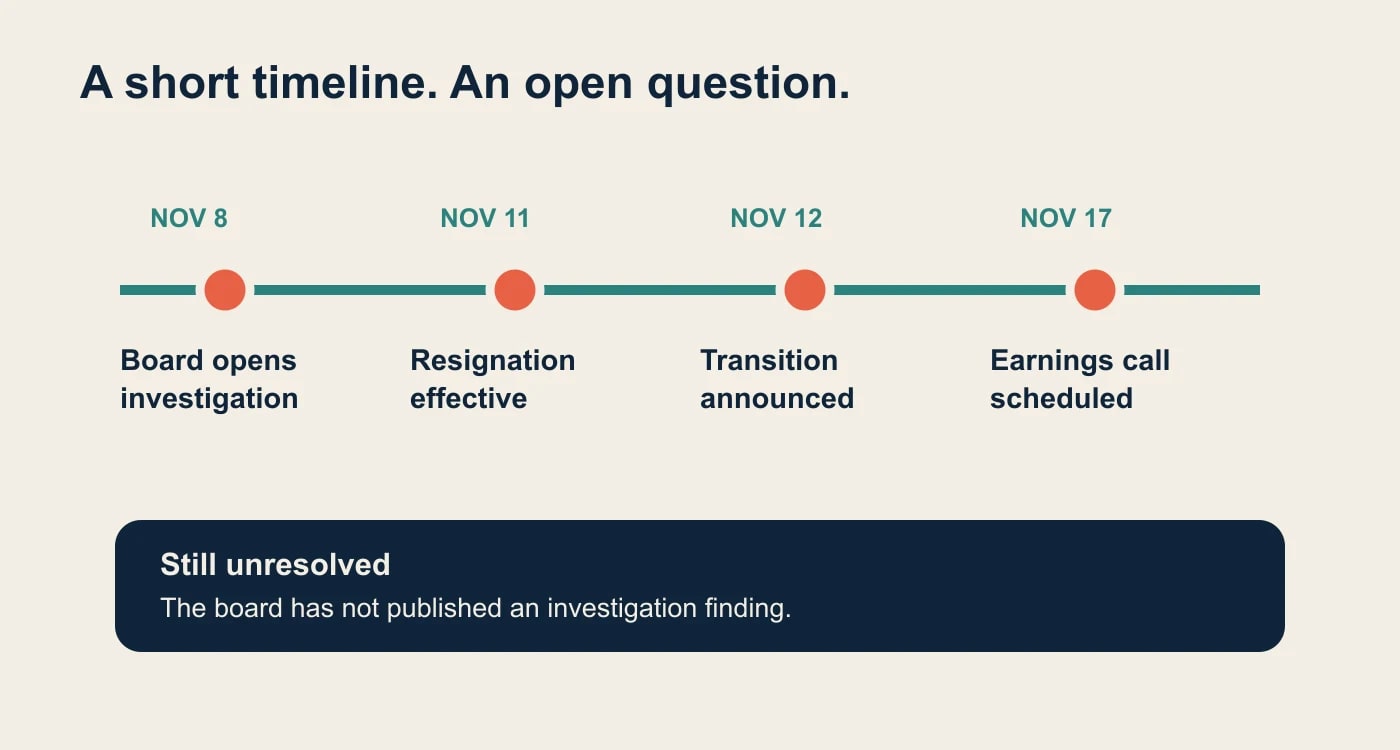
NVIDIA’s November 12 filing with the US Securities and Exchange Commission says the board accepted Huang’s resignation on November 11, effective immediately. It appointed Kress interim CEO and longtime director Harvey Jones board chair. The company’s announcement says it will consider internal and external candidates and expects operations, customer commitments, and the product roadmap to continue. That last point is the board’s expectation, not a verified forecast of future delivery.
Four days earlier, NVIDIA’s board opened an investigation after reporting that Huang may have been targeted by a foreign intelligence effort. The board said then that it had no reason to believe national security or NVIDIA secrets had been compromised. It also said the inquiry would examine the available information. Associated Press reported that Huang had acknowledged an intimate relationship with a business executive whom US intelligence reportedly suspected of gathering information for Beijing. That reporting is a serious reason for an inquiry; it is not proof that Huang disclosed secrets or that the other person committed espionage. The transition announcement does not give an investigation finding or explain the cause of the resignation. We will update this article if the board or authorities publish material results.
The distinction matters. A company deciding whether to renew an AI service needs to know whether supply, security assurances, support, or contracts changed. So far, the public CEO-transition notice announces a leadership handoff, not a service interruption. A procurement team should monitor the investigation and ask its supplier about continuity; it should not convert an allegation into a technical incident that NVIDIA has not disclosed.
The next fact to watch
NVIDIA says it will release fiscal third-quarter results on November 17. That call can test whether management reports changed customer demand, delayed shipments, altered guidance, or a successor timetable. Earnings will not by itself resolve the board inquiry. Treat those as separate questions.
2. The company is larger than the man—and unusually shaped by him
Huang co-founded NVIDIA in 1993 and stayed at its head for 33 years. Under him, the company moved from graphics chips toward a broader system of processors, networking, software, and developer tools. Its CUDA software lets developers use NVIDIA graphics processors for many computing tasks; years of code, training, and operations built around it can make switching costly. The point is not that a competitor cannot make a capable chip. It is that replacing one chip in a working AI system may require changing software, engineers’ habits, network equipment, support arrangements, and performance testing.
The financial scale is real. For the quarter ended July 26, 2026, NVIDIA reported $96.2 billion in revenue, including $89.0 billion from Data Center. Data Center therefore accounted for about 92% of that quarter’s reported revenue, by our calculation from the company’s figures. That is evidence of unusually strong infrastructure demand, not proof that the buyers of those systems are earning an adequate return. Huang’s statement that AI computing had become profitable was a vendor’s assessment of its market, not a result measured across every customer.
NVIDIA also has concentration risk on the demand side. In its fiscal 2026 annual report, one direct customer represented 22% of revenue and another 14%. These are companies buying directly from NVIDIA; the ultimate users may be different. In the following quarter, one direct customer represented 16% of total revenue. A small group of builders can move spending sharply. NVIDIA’s demand is enormous, but its sales are not a referendum in which every ordinary business voted to buy its own AI system.
Follow the financing as closely as the chip shipments. NVIDIA’s quarterly filing says it signed preliminary arrangements with large capital providers for platforms intended to finance AI infrastructure, while warning that those arrangements may never become definitive agreements. The August earnings release described a plan to mobilize more than $500 billion of third-party capital over time, subject to final agreements. That is a plan, not money already invested or proof of customer returns. For a prospective data-center operator, the question is whether contracted customers will pay enough, for long enough, to cover power, debt, and equipment. For a normal enterprise buyer, that financing architecture is background risk, not a reason to delay a useful workflow test.
The board has a credible continuity case: Kress has led finance since 2013, the company has an experienced operating team, and designs do not disappear when a founder leaves. The skeptical case is also credible: a founder can coordinate hard choices across hardware generations, key customers, software, government relations, and capital partners in a way a committee struggles to reproduce quickly. Neither side can claim victory from a press release. Watch execution over several quarters.
3. Where the bottleneck actually reaches your business
Think in layers. A model builder or large cloud provider depends directly on chips, high-speed connections, electric power, and long construction schedules. A company running its own model may depend on the same stack through a cloud contract. A retailer using an AI service to draft product copy is several contracts away. The retailer’s immediate risks are answer quality, data protection, cost, and whether staff use the result—not the identity of the chipmaker’s chief executive.
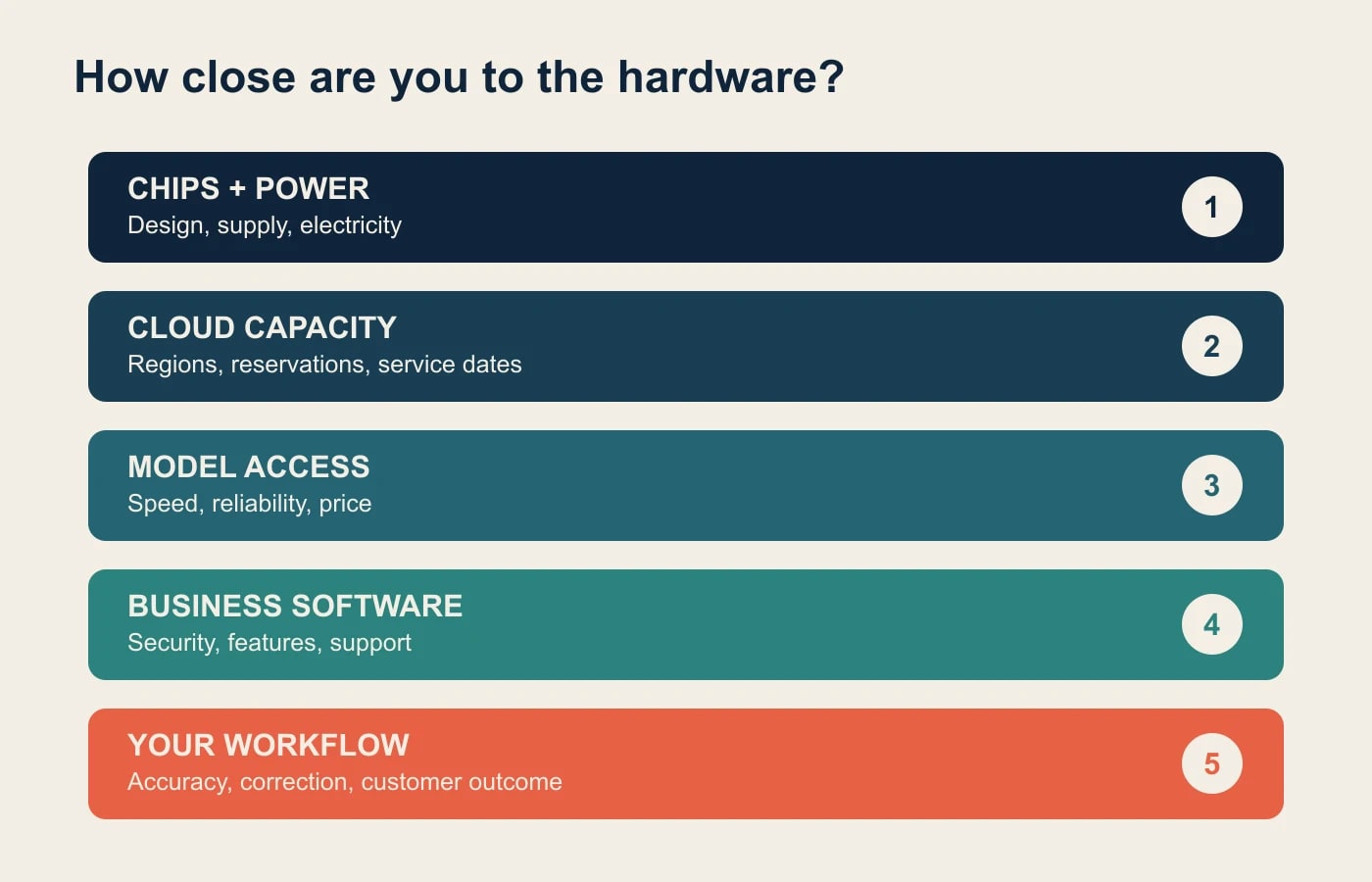
Consider three constructed decisions. A startup training its own large model has reserved GPU capacity for six months. Its finance and engineering leads should review delivery milestones, alternate capacity, and whether code can run elsewhere at an acceptable cost. A manufacturer building a private inspection system should test performance on its actual images and compare cloud, on-site, and simpler machine-vision options before committing to one hardware family. A law firm testing an approved document assistant should continue measuring missed citations and reviewer time. A chipmaker leadership change is not the firm’s chief failure mode.
There is another bottleneck beyond NVIDIA. The International Energy Agency’s 2026 outlook projects global data-center electricity use rising from 485 terawatt-hours in 2025 to about 950 in 2030 in its central case; a terawatt-hour is a large unit of energy, roughly one billion kilowatt-hours. This is a scenario, not electricity already consumed. Power connections, cooling, transformers, and local approval can delay a system even when chips are available. A business buying cloud AI should ask about service capacity and price stability; a community hosting a data center needs a separate conversation about grid costs and local effects.
NVIDIA’s October 27 announcement with Oracle described available Vera Rubin systems and larger future buildout plans. “Available” and “planned” are not interchangeable. If a vendor pitches capacity your team will rely on next quarter, ask which specific region, hardware, contract, and service date are committed. A multi-gigawatt vision does not answer whether your workload can start on Tuesday.
4. The challenge to NVIDIA is real, but a slide deck is not a migration plan
Customers have alternatives. Google announced two more Tensor Processing Unit configurations on November 9, expanding its own specialized AI-chip line. It says some customers can now deploy its chips in their own data centers. Amazon Web Services made Trainium3 systems generally available in late 2025. AMD and Anthropic announced a planned deployment of AMD accelerators beginning in the first half of 2027. The first two are available products in stated settings; the AMD agreement is a forward plan. None alone proves an easy replacement for every NVIDIA workload.
Competitive price claims are especially easy to misuse. Google’s performance comparisons in its announcement are against its own previous chip generation, on specified work. Amazon’s “lower cost” claim describes its own systems and configurations. A buyer should compare the same model, input size, response speed, acceptable error rate, data location, and monthly usage. Include engineering time to move the workload, monitoring, reserved-capacity terms, and the cost of keeping a second provider ready. A cheaper chip-hour can lead to a more expensive finished answer.
The practical bet is portability where it pays. Keep prompts, evaluation cases, approved data connections, and output checks separate from one provider’s features where possible. Test a second model or host on a small but representative slice before you need it in an emergency. For a typical business application, this is more valuable than designing a full multi-cloud architecture that nobody has time to operate. For a frontier model company, hardware and software portability may be a strategic investment; for a local service business, it may be a distraction.
5. A decision map for Monday—not a bet on the share price
The exposure of this episode is a familiar corporate one: an industry can depend heavily on a founder, a small set of customers, a long supply chain, and a public story about inevitable demand at the same time. That does not make the technology imaginary. It means buyers should measure the work they receive rather than inherit the vendor’s certainty. The confirmed leadership change is immediate; the investigation’s outcome, future demand, and execution under Kress are still open.
- If you buy finished AI software, keep the pilot running. Ask the application vendor for service commitments, data-use terms, an export path, and a recent incident history. Measure the completed business task and human correction effort. Stop if accuracy or privacy fails your agreed threshold.
- If you buy cloud model access or reserved computing, have procurement and engineering list every capacity promise by region and date. Compare a second supplier on the same workload. Record the migration effort and the cost of unused reservations. Escalate if your provider cannot confirm delivery or continuity in writing.
- If you build AI infrastructure, have the technology, finance, and facilities leads review chip supply, power connection dates, cooling, customer demand, and debt together. Run a downside case in which utilization rises more slowly than contracted capacity. Pause expansion if the project needs optimistic usage to cover fixed commitments.
- If you manage a company exposed indirectly through suppliers, map the top two critical AI dependencies and the person responsible for each. Ask what happens if a service price rises, a region is unavailable, or a model is retired. The answer may be a tested backup or a manual fallback, not a new data center.
The next public signals are concrete: the November 17 earnings call, any board finding, a permanent-CEO appointment, changes to product delivery dates, and whether competitors win real production workloads rather than announcing capacity alone. A company using AI for customer service, finance, marketing, or operations should keep asking a simpler question in parallel: did the workflow become more accurate, faster to finish, or easier for a customer? Our AI business-case guide shows how to measure that without calling every released hour a cash saving. That answer will matter to most executives long after this week’s headlines.
Source notes and scope
Checked November 13, 2026. The resignation and appointments come from NVIDIA’s SEC filing and transition release. The investigation and the board’s stated view come from its November 8 statement; no finding is asserted here. Revenue comes from NVIDIA’s August results. Competition and delivery claims are attributed to the relevant providers; the electricity projection is the IEA’s scenario. The three business cases are constructed examples, and the artwork is conceptual. The article analyzes operating decisions; it makes no prediction about NVIDIA’s stock.
Weekly Newsletter
AI Adoption Weekly
New research, field guides, training studies, and tool decisions for operators.
No spam. Unsubscribe anytime.
Related Comparisons
Calculator
AI seat cost calculator
List price × headcount. You enter the hours and the operating assumptions.