
AI for Bank Call Reports: Reconcile the Numbers Before the Narrative
A bank can use AI to assemble source-backed explanations and find mapping exceptions, while keeping regulatory calculations, validation and final submission under accountable review.
Published October 12, 2026
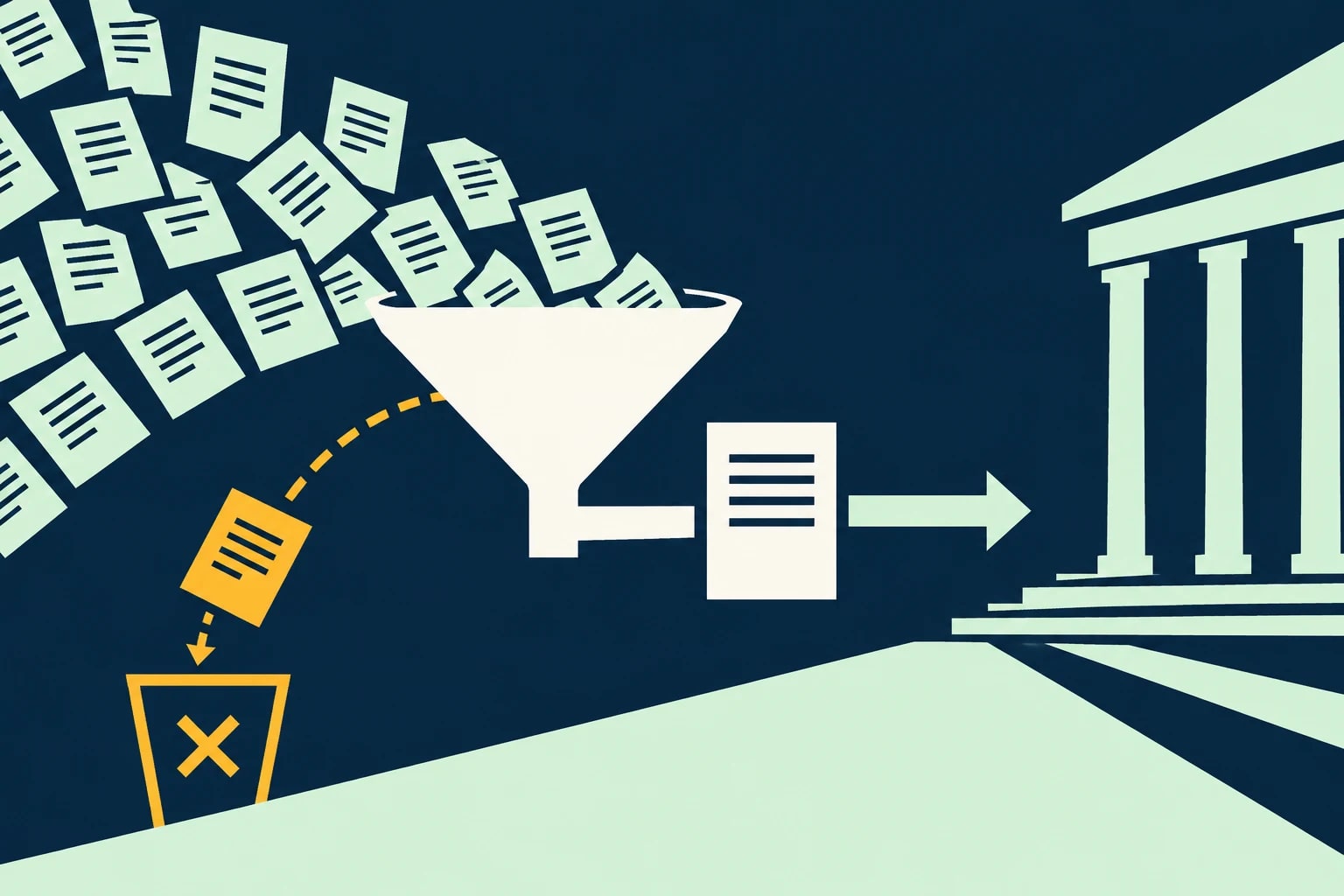
A bank's quarter ends. The general ledger and loan systems produce totals, but a changed product code sends a set of accounts to the wrong reporting line. An AI-written explanation of the total would make the packet look finished while the error remains. A better first job for AI is to flag the mapping change, point to the source records, and leave the reporting team time to resolve it. This is a constructed example of a preparation risk, not an account of an actual bank.
Know which report and instructions apply
The Federal Financial Institutions Examination Council (FFIEC) publishes the FFIEC 041 reporting form and instructions for banks with domestic offices only. The form includes a balance sheet, income statement, and supporting schedules. Other institutions may use different Call Report forms or additional requirements. The reporting owner should check the current form, supplemental instructions, and the institution's applicability for the actual quarter. An assistant should retrieve those approved materials, not assume last quarter's mapping still works.
The FFIEC's Central Data Repository guidance describes collection, validation, and management of bank reporting data. That validation is not a reason to send a weak report and hope the system catches it. The preparer should reconcile source totals, investigate changes, and preserve the calculation and approval path before submission.
The Federal Deposit Insurance Corporation explains that covered institutions file Call Reports as of each calendar quarter-end. The appropriate bank officer or director attests to the report under the applicable instructions; the AI tool is neither preparer of record nor signer. The bank's reporting officer should check the exact signature and correction procedure for its form. This is why an apparently harmless mapping suggestion can become a governance issue when it reaches the submitted report.
Give AI a preparation job, not filing authority
- Compare the current reporting template and instructions with the previous quarter; identify changed fields or definitions for the reviewer to confirm.
- Produce a source-to-line map—a list showing which bank record feeds each reporting-form line—for a chosen schedule. Include source system, extract date, calculation rule, amount, person responsible for the data, and reviewer. Flag blank mappings and unexpected changes.
- Draft questions for the lending, treasury, or accounting owner when a number moves enough to matter under the bank's agreed review threshold; cite the approved source and leave the cause open until confirmed.
- Keep final calculation, attestation, submission, correction, and any amended filing with the bank's authorized people and systems.
A one-line map might say: “Report line X; total from approved general-ledger accounts A and B; September 30 extract; adjustment J-17 excluded; prepared by finance analyst; reviewed by reporting officer.” The letters are placeholders, not actual FFIEC line definitions. The useful feature is that a second reviewer can open the extract and reproduce the amount without relying on the assistant's prose. If the calculation spans the core banking system and the general ledger, name both source owners and preserve the transformation between them.
For a community bank, start with one schedule whose source is stable and whose reviewer knows the exceptions. A large multi-entity bank may find more value in a controlled map of intercompany or product-code changes, but its permissions and approval chain will be more complex. A de novo institution should establish its reporting process and source ownership first. None of these cases is a reason to let a language model infer a regulatory classification from a product description alone.
The configuration should match that size. A community bank can freeze one ledger extract and report schedule for a reviewer to inspect; a large group should test entity IDs, mapping changes, and access rights across its source systems; a newly chartered institution needs a signed source-to-line map before it can meaningfully test automation. The April 17, 2026 interagency revision of model-risk guidance applies its stated principles to traditional statistical, quantitative, and non-generative AI models; the Federal Reserve's published guidance explicitly says generative and agentic AI are outside that guidance's scope. The bank's own governance still has to decide suitable controls for a language-model assistant. A traditional quantitative-model validation checklist by itself does not approve the proposed reporting workflow.
A replay test before a live quarter
The reporting officer selects a prior submitted quarter and creates an answer key of known source-to-line mappings and resolved adjustments. Run the assistant read-only on frozen extracts, then compare it with the approved filing. Include a new product code, a late adjustment, a wrong-period file, and a confidential customer field that should not appear in the output. For a proposed first gate, require every report-line total to reconcile to the approved source, every mapping change to have a reviewer, and zero restricted fields in the draft. Measure missing mappings, false alerts, time to a reviewed schedule, and minutes spent reconstructing each answer. The officer defines which lines are significant for this bank before the test; one false reassurance on such a line stops it. Record the failure, use the existing manual preparation route for the quarter, and bring in reporting, risk, privacy, and information-security specialists before reconnecting live data. Preserve the frozen inputs, tool version, exception draft, reviewer changes, and approval under the bank's record policy. The financial-institutions field report provides wider adoption context; this article's job is the narrow quarterly reporting workflow.
A smaller bank can begin with one complete schedule and all its supporting lines rather than a large random file sample. Count false alerts as a cost of review, but do not trade a missed consequential discrepancy for fewer alerts. If the assisted schedule is not fully traceable or takes more total reviewer time, keep the current preparation method and fix the source map first. This is a pilot decision rule, not a regulator's numeric standard.
Before expansion, the reporting officer signs a short decision with the approved schedule, source map, unresolved errors, reviewer minutes, license and integration costs, and next test date. A corrected run may re-enter the pilot only after the officer and risk owner reproduce the formerly failed case from frozen inputs. Extra review hours can erase apparent preparation savings; released hours do not become cash savings unless staffing, contractor spend, or another budget line changes. For a community bank, an existing spreadsheet with a reliable human review may remain cheaper and clearer than a new connected product.
Weekly Newsletter
AI Adoption Weekly
New research, field guides, training studies, and tool decisions for operators.
No spam. Unsubscribe anytime.
Related Comparisons
Calculator
AI seat cost calculator
List price × headcount. You enter the hours and the operating assumptions.