
The Hidden Work Behind AI Pilots: Why Good Experiments Still Stall
MIT Sloan’s field study found that AI pilots need sustained expert testing, review, and repair. Leaders who budget only for software miss the work that makes adoption possible.
Published September 25, 2026

An AI pilot can look inexpensive because the model subscription is on a visible invoice and the expert doing the hard work is not. Someone has to find difficult cases, test the output, settle disagreements, rewrite procedures, and help colleagues when a tool fails. A September MIT Sloan field study argues that this often-unrecognized work helps explain why seemingly similar AI experiments end very differently.
Two organizations, very different outcomes
The researchers studied an academic medical center and a corporate law firm over two years. Both introduced secure testing environments, training, and opportunities for employees to develop AI uses that could spread across the organization. MIT Sloan reports that the medical center had 141 organization-wide AI solutions in use, while the law firm had three. More than 80% of the law firm’s domain experts eventually stepped away from the innovation effort. Those are outcomes in these two organizations, not an industry-wide success rate or a controlled experiment.
MIT Sloan attributes the difference to support around experimentation. At the medical center, people had continuing education, shared evaluation rules, technical help for promising projects, risk review, and recognition for the work. The law firm offered initial training but less continuing support. The study does not prove that copying one workshop would produce 141 solutions elsewhere. It does identify a missing cost center in many adoption plans: the people who make an AI use safe and repeatable.
Make the extra work visible before it becomes a volunteer job
A pilot needs a simple work ledger, not another steering committee. For each candidate workflow, record the expert who supplies test cases, the person who reviews outputs, the technical owner who repairs connections, and the manager who can change the process. Give each a weekly time allowance. When an expert spends two hours finding exceptions, that time belongs in the pilot cost even if no new invoice appears.
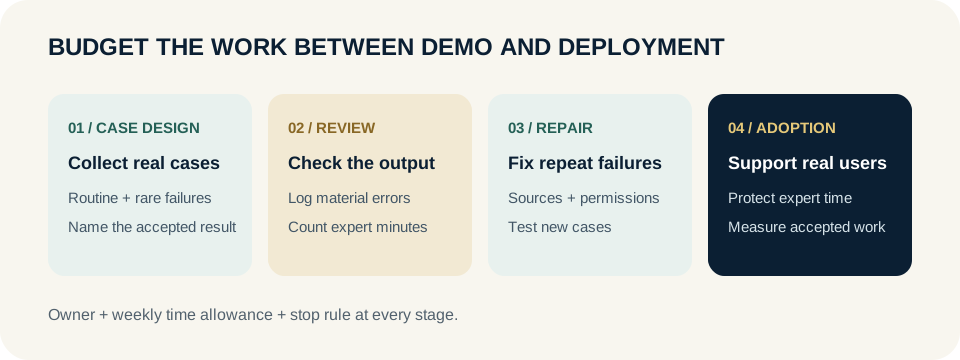
- Case design: collect routine cases, rare failures, and the judgment calls that make the work difficult.
- Review: compare the AI output with the accepted answer and log material errors, not just style edits.
- Repair: update source data, instructions, permissions, and the handoff when a failure repeats.
- Adoption: train colleagues, answer real questions, and check whether the new process survives normal workload.
This ledger changes the business case. If a model saves each user ten minutes but a senior specialist must spend forty minutes reviewing every ten outputs, the benefit is smaller than the demo suggests. If those forty minutes prevent costly mistakes and teach the system to handle future cases, they may still be worthwhile. The point is to price the labor and measure what it produces.
A monthly test leaders can actually run
Pick one workflow, one accountable manager, and one group of domain experts. Set aside named hours for testing and review for four weeks. Capture 30 to 50 real past cases, including failures, and write the acceptance rule before the team sees model output. Compare AI-assisted work with the existing process on accepted completions, error severity, end-to-end time, and expert hours spent. Meet weekly to fix the three most common failures, then run new cases rather than repeatedly grading the same easy set.
Ask the experts at week two whether the work is crowding out their actual job. A rising backlog of unreviewed outputs is an early warning. So is a pilot that depends on one enthusiastic person doing nights and weekends. The manager should either protect time, narrow the use, fund technical support, or stop. Calling that reluctance “resistance to change” would misdiagnose a capacity problem.
What the study cannot settle
The two organizations had different work, management cultures, and incentives. The 141-versus-three count does not tell us how valuable or durable each solution is, nor what it cost to build. Some firms should deliberately deploy fewer AI uses and scrutinize them more. A legal research error and a patient-facing discharge summary also have different risk profiles. The defensible lesson is narrower: sustained expert participation needs explicit support, and solution count alone is a poor return measure.
The next time a pilot owner asks for more licenses, ask what happened to expert participation during the last month. If accepted work improved while review hours stayed manageable, expand carefully. If the expert quietly left and the error log stopped being updated, the pilot has not scaled. It has lost its evidence.
Primary sources
- MIT Sloan: Why some organizations turn AI experiments into business value — September 9 summary of methods, organization comparison, and findings.
- Karunakaran, Kellogg, and Wiesenfeld: working paper — Original qualitative field study; preprint, not a controlled trial.
Put this to work
- AI workflow evaluation training — Plan the cases, reviewers, and release gate.
- AI ROI decision lab — Include the cost of review and implementation.
- How to build an AI business case — Show the evidence and full cost behind a pilot.
Weekly Newsletter
AI Adoption Weekly
New research, field guides, training studies, and tool decisions for operators.
No spam. Unsubscribe anytime.
Related Comparisons
Calculator
AI seat cost calculator
List price × headcount. You enter the hours and the operating assumptions.