
Prioritize Salesforce Deals with Claude: Next Actions and Win Probability
A practical method for ranking movable deal actions, checking Salesforce probability against history, and avoiding made-up win percentages.
Published September 28, 2026

A seller has time for three calls and twelve open opportunities. Claude can sort the work, but a confident “82% likely to close” is meaningless unless the percentage comes from comparable past deals and predicts outcomes well. The aim is to find the largest action the team can actually take today, then keep the forecast honest.
Use the prebuilt Salesforce in Claude beta or a Salesforce Hosted MCP `sobject-reads` connection for the live deal review; both support the read-only work below, although the prebuilt beta was still rolling out in September 2026. In Claude, select the approved Salesforce connector, run the evidence prompt, and open the linked opportunities to verify a sample. The Salesforce release note says the prebuilt beta cannot update records. A separately configured hosted mutations server can create or update when permitted, but this workflow leaves forecast fields to the manager.
Start with the Salesforce probability you already have
Salesforce commonly maps opportunity stage to a default probability and forecast category. Changing a stage can reset the Probability field; a user with edit access can override it. Those are configuration behaviors, not independent predictions about this particular buyer. Salesforce explains stage and forecast mapping and recommends adjusting probabilities from historical data in its forecasting guidance.
Build a historical baseline by cohort: same sales motion, product, market segment, and stage, using opportunities closed in a defined period. If 30 of 100 comparable opportunities at Proposal later became Closed Won, the observed win rate is 30%. It is a rough starting estimate, not the chance that the next deal must win. Check how recent the cohort is and whether enough examples remain after filtering. If you have five deals, show the five outcomes and stop pretending to have a precise percentage.
Describe the evidence gap before changing the number
For the fictional $100,000 Northstar opportunity, suppose Proposal-stage peers won 30 of 100 in the prior year. The buyer has asked about deployment and security but has not confirmed budget or a procurement review date. Claude should show the verified facts and missing gates, not jump from “positive call” to 70%. A manager can override a probability only under a documented rule; otherwise keep the stage baseline and add a risk note.
Deal evidence review
For each open proposal above $50,000, show Salesforce link,
segment, stage, amount, age in stage, close date, latest buyer
action, budget owner, decision process, unresolved blocker,
and dated next step. Cite every source. Compare each field with
our approved stage exit criteria. Do not estimate a new win
percentage or update Salesforce. List the missing evidence that
a seller can try to obtain this week.
Rank the action you can move, not the deal you like
Choose an action with a named owner, a plausible path to the buyer, and a near-term result. “Confirm procurement review date” is movable; “make the buyer enthusiastic” is not. “Resolve the open support issue” may outrank a pitch because it removes a known blocker. For every action, estimate the value of learning or changing the situation, the time it takes, and the risk of bothering the buyer. Claude can assemble the comparison, but the account owner decides.
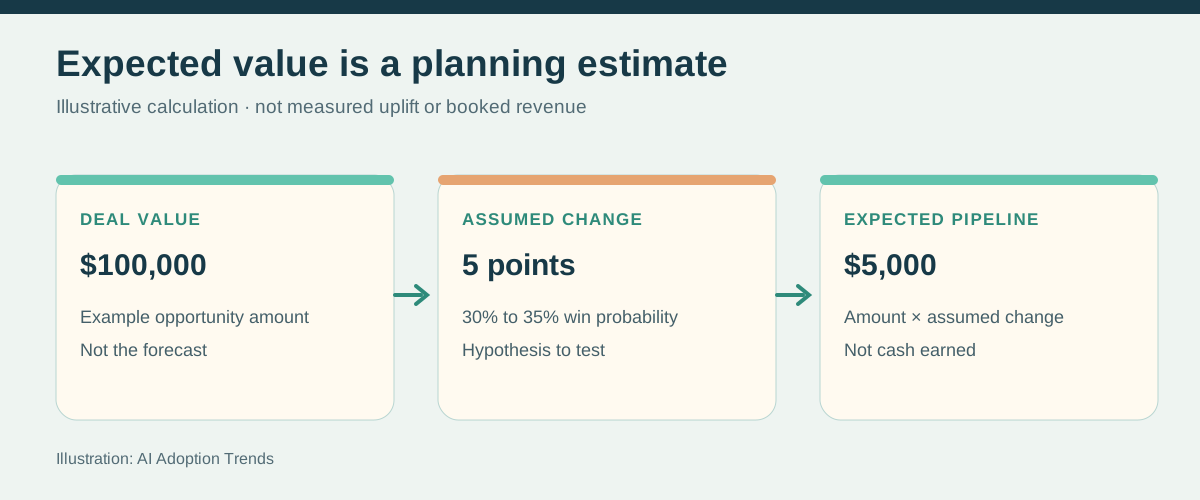
A planning calculation can help when its assumptions are visible: potential incremental expected value = opportunity amount × plausible change in win probability. For a $100,000 deal, a hypothetical rise from 30% to 35% is $5,000 of expected pipeline value. That is not $5,000 of revenue, savings, or a proven effect of the action. The five-point lift is an assumption until a comparable test supports it. Do not add several overlapping “lifts” for the same deal.
Next-action shortlist
For each deal, propose up to two actions we control this week.
Return: the exact gap, evidence link, action owner, buyer-facing
or internal, effort, earliest result, and what new evidence would
change the forecast. Put any probability lift in a separate
assumption column; never present it as measured. Rank actions
by plausible impact and ease of execution. No stage, amount,
probability, or close-date changes.
Test whether the percentages earn trust
Each month, compare forecast buckets with outcomes. Of the deals you labeled about 30% likely, roughly three in ten should win over the chosen horizon if the estimate is well calibrated. Check enough deals and avoid mixing new-business proposals with renewals. Track stage-to-close conversion, age in stage, slips, and win/loss reasons. A forecast can improve because a manager removes stale deals, not because the model predicts better; report both effects separately.
Prioritize one real operational action before tuning a scoring model: require a dated buyer next step in late stages and review overdue ones weekly. Salesforce itself recommends actionable tasks and regular forecast review. If the team cannot verify next steps, a new probability algorithm will polish missing data. Part 5 gives the privacy and pilot controls for expanding from briefs to approved actions.
For a weekly rhythm, schedule a read-only Cowork brief of missing evidence; Anthropic’s scheduled-task guide describes recurring runs. If the team wants an internal task every time a late-stage opportunity lacks a dated next step, have the administrator build and test that trigger in Salesforce Flow. The manager reviews any stage, probability, or close-date change before it is saved.
Weekly Newsletter
AI Adoption Weekly
New research, field guides, training studies, and tool decisions for operators.
No spam. Unsubscribe anytime.
Related Comparisons
Calculator
AI seat cost calculator
List price × headcount. You enter the hours and the operating assumptions.