
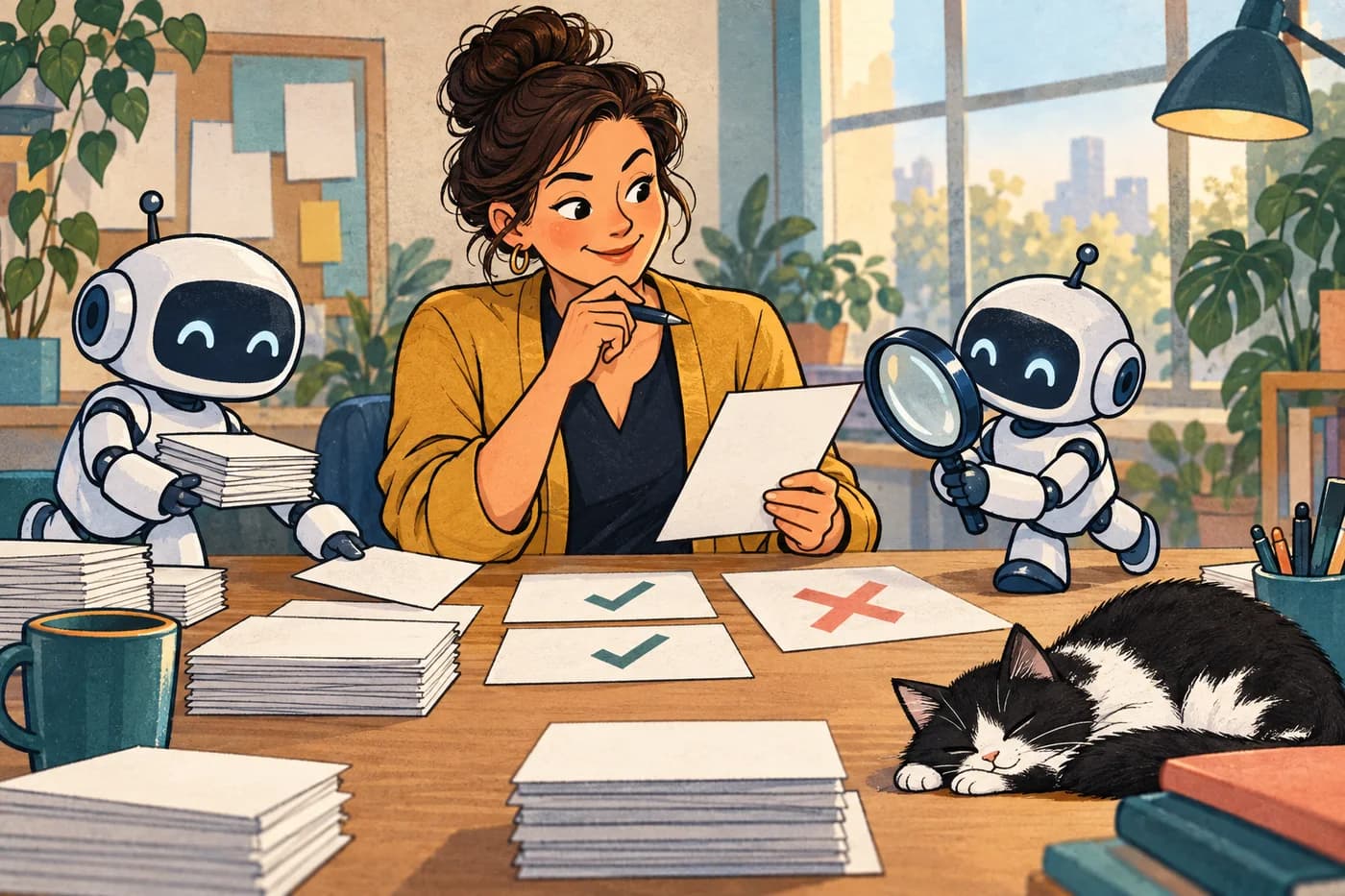
Your best tester knows the customer promise, the weird exception from last April, and which “minor” defect becomes a Monday-morning fire. Do not replace that knowledge with a bot. Give the tester a much larger reach.
The useful takeaway
Move repetitive preparation and first-pass sorting to AI. Keep test priorities, expected outcomes, source decisions, and release authority with the people who know the business.
A realistic example
Example: opening registration for six events
An events company has a two-person quality-assurance (QA) team. It is opening registration for six conferences with different ticket types, discounts, and attendee confirmations. The rules change often, but the team cannot rewrite every check by hand.
What goes wrong
Leadership asks AI to “do QA” and treats a green summary as approval. The assistant checks that pages load but misses a discount applied to the wrong ticket and a confirmation for the wrong session. Customers find the errors first.
A better check
The QA lead identifies the high-risk ticket rules and past defects. AI drafts candidate cases from the approved price list, prepares safe attendee records, and groups failures. People verify the money and confirmation paths and make the release call.
The flow
What gets checked, and when
Follow the numbered steps in order. Each answers a different question; one green check cannot stand in for the others.
- 01
Prioritize
QA names the ticket promises and expensive failures.
Catches: A large test set aimed at the wrong work.
- 02
Prepare
AI drafts cases and safe attendee records.
Catches: Forgotten ticket type, discount, or error condition.
- 03
Run and sort
Tools repeat checks; AI groups the failures.
Catches: Patterns buried in noisy reports.
- 04
Decide
QA confirms evidence and advises release or stop.
Catches: A false green result or risky exception.
Keep the expertise; change where the hours go
Quality work mixes four jobs: deciding what matters, preparing cases, running them, and interpreting failures. AI is useful in the middle two. It can turn approved ticket rules into candidate tests, suggest unusual cases from past defects, create clearly labeled sample records, and group similar failures. It is weaker at deciding whether a pricing exception is acceptable or which customer promise matters most.
No formal QA team? The work still exists. The event owner checks prices, operations checks attendee records, and customer service checks confirmation messages. Name one person to own the shared checklist and stop rule. A specialist can later turn the stable checks into automation; the first step is simply making ownership visible.
Quality lead
Before: Rewrites similar ticket checks and sorts duplicate failure reports.
With AI: Reviews draft cases and grouped failures instead of starting from a blank page.
Human focus: Ranks pricing risks and recommends release or stop.
Event owner
Before: Manually compares ticket pages with the approved price list.
With AI: Receives a short list of possible mismatches to investigate.
Human focus: Confirms the actual price, discount rules, and promise to attendees.
Operations coordinator
Before: Checks confirmation records one at a time.
With AI: Uses repeatable checks and sample attendee records.
Human focus: Resolves wrong sessions, duplicate records, and exceptions.
Team without QA staff
Before: Relies on whoever has time for a last-minute spot check.
With AI: Starts with a shared checklist and AI-drafted candidate cases.
Human focus: Names an owner and a stop rule before registration opens.
Start with work your team already repeats
Do not begin with an ambitious “AI tests everything” project. Ask the quality team where it spends time copying steps, recreating test attendees, comparing similar ticket pages, or sorting duplicate failures. Pick one task with clear inputs and an easy-to-check result. The assistant proposes a first draft; a tester corrects it and saves the approved version.
For the events company, build one shared journey: choose a ticket, apply a valid discount, pay with safe test details, and check the confirmation and saved attendee record. Repeat it for the ticket types that actually change the rules. Add a case where the discount is invalid. The value is not more green badges; it is less setup work and fewer missed money or session errors.
Measure the tenfold ambition honestly
“10× QA” is an ambition, not a result you can claim from installing an assistant. A team might run ten times as many checks and still miss the one broken payment path. Measure the useful work: critical journeys covered, preparation time per release, defects caught before customers see them, escaped defects, false alarms, and time spent investigating failures.
Run a small before-and-after trial on comparable releases. Record the old baseline first. If the team covers more important journeys with the same staffing and does not increase escaped defects or reviewer rework, the change is helping. If the test count rises while the team spends longer chasing invented problems, the assistant has made the dashboard prettier, not the product better. Released staff time is capacity for other work unless a real budget action turns it into cash savings.
Make the team harder to fool, not easier to bypass
Ask the assistant to show which source, requirement, or prior defect led to a proposed case. Keep a few planted failures in a safe test environment and confirm the checks catch them. Review a sample of passes, too. A test that never turns red may be a decorative light bulb.
Agree on a stop rule before launch day: the wrong ticket price, a duplicate charge, an incorrect session confirmation, or a missing attendee record blocks release until a person confirms the fix. The quality lead can then spend time on genuine exceptions instead of being asked to rubber-stamp an AI summary at 5:47 p.m.
Try this
Run a two-week quality-team trial
- 1Ask the team to choose one repeated preparation task and record how long it takes today.
- 2Use AI to draft the cases or summarize failures, with a tester correcting and approving the output.
- 3Compare important paths covered, team time, false alarms, and defects found after release against the baseline.
You are ready when: The team can say what work got easier, what new checks caught, and whether customer-visible misses stayed the same or fell.
Sources and further reading
The examples above are constructed teaching scenarios. These primary sources support the testing methods and evaluation principles.
- NIST AI risk-management core
Human responsibilities and repeatable evaluation practices.
- Playwright: best practices
Reliable checks of user-visible behavior and isolated test runs.
- W3C: evaluating web accessibility
An example of work where tool output still needs knowledgeable human review.