
The AI Adoption Paradox in Financial Services: Why Most Deployments Fail After Launch
JPMorgan runs 200 AI use cases. Most regional banks run pilots that go nowhere. The difference isn't technical—it's knowing which problems AI actually solves, and building systems that work when the AI fails.
Published October 18, 2025· Updated Sep 16, 2026

A mid-sized regional bank deployed an AI tool to summarize loan applications. For three months, loan officers ignored it. The tool worked perfectly—accuracy above 95%, faster than human summary—but it wasn't solving anyone's actual problem. The real bottleneck wasn't summary speed. It was the 48 hours of waiting for underwriting to queue up the next review. The bank had automated something that wasn't in the critical path.
Across the same regional banking cohort, a competitor deployed AI to predict which flagged transactions actually needed manual review for compliance. Same technical capability. Different outcome: loan decisions moved faster, compliance costs dropped 18%, and the tool became non-negotiable within six months. Both banks could point to working AI systems. Only one moved the needle.
This is where financial services stands in early 2026. The industry has 2,000+ AI pilots running. JPMorgan alone operates 200 internal use cases across trading, risk, operations, and customer service. Community banks are testing AI tellers. Fintechs have baked neural networks into core products. The technical capability is no longer the constraint. The constraint is knowing which problems AI actually solves.
The Real Bottleneck: Accuracy Isn't the Same as Value
Most financial services firms optimize for model performance, not for organizational friction. They measure accuracy. They ship the system. Then they're puzzled when adoption flatlines.
A securities firm built a market-moving AI system to detect anomalous trading patterns. The model was state-of-the-art. It flagged 3% of unusual trades. But traders ignored it. Not because it was wrong—because it didn't integrate into their workflow. Implementing the alert required jumping between three systems, copying data into a spreadsheet, and revalidating against their own mental model. The math was sound. The adoption math was broken.

Here's what actually determines whether an AI project scales or stalls: value = (accuracy × integration × trust × reduced friction). Miss any component and the project dies in the pilot phase. The regional bank's loan summarizer had accuracy. It had no integration, no trust in the output, and it didn't reduce friction on the critical path. The compliance-prediction competitor had all four.
The Diagnostic: Where Do People Wait?
Instead of asking "where could we use machine learning?" the teams deploying AI that actually ships ask different questions: Where do people wait for information they don't have? Where do people repeat the same decision with slight variations? Where do we lose deals because we move too slowly?
A mortgage lender was losing borrowers in the pre-qualification phase. Applicants would submit paperwork, wait 2–3 days for a loan officer to review it and provide a pre-qual estimate, then often shop competitors. The lender deployed an AI system that provided instant pre-qual estimates based on document review. Same accuracy as the human version. But now borrowers got an answer in minutes, not days. Loan originations jumped 34% in the first cohort.
The automation layer a founder can see
Branching scenarios. You still own the graph.
We may earn a commission · editorial verdicts remain independent
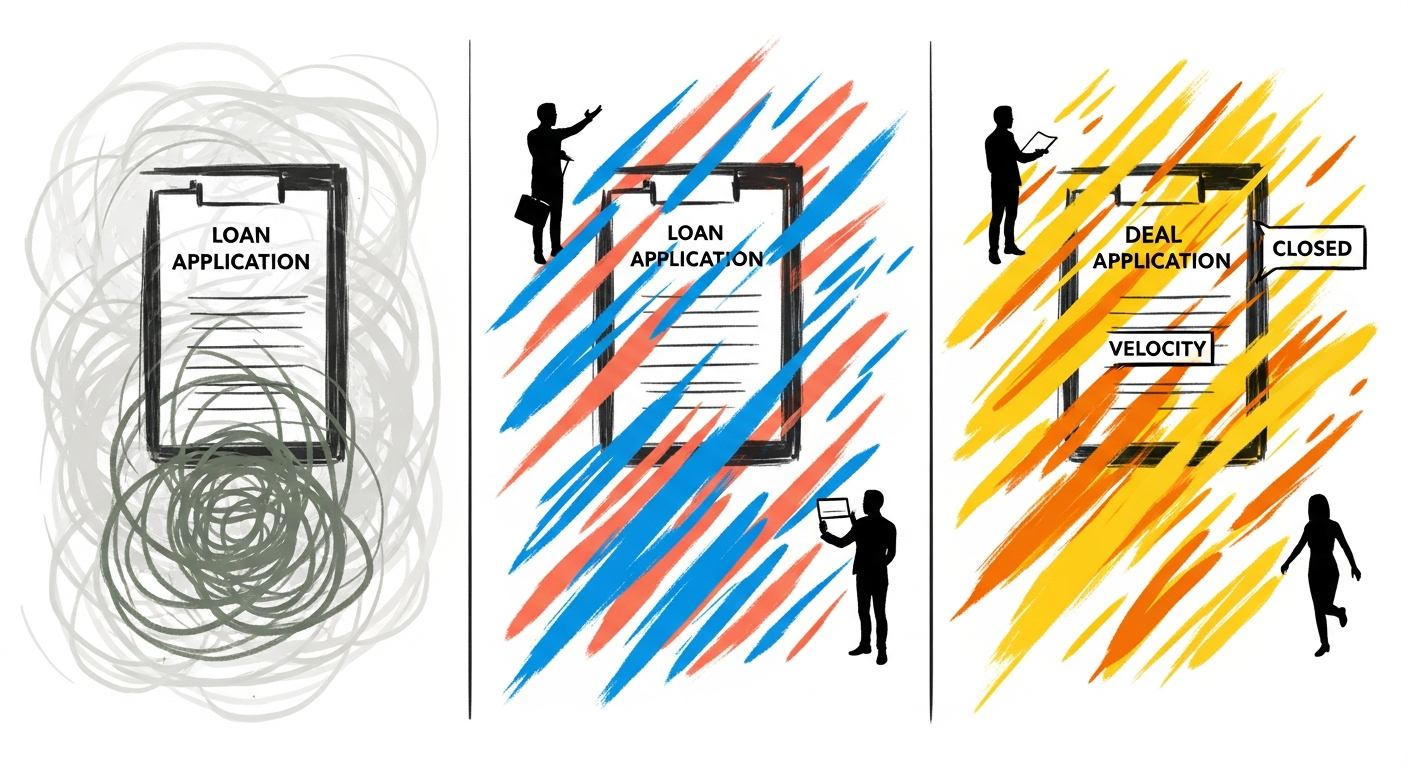
The difference between the successful mortgage play and the failed regional bank loan summarizer isn't technical sophistication. It's that one removed friction from the customer-facing critical path. The other sped up something that wasn't a bottleneck.
The Three Operational Rules That Separate Winners From Pilots
Rule 1: Embed, Don't Interrupt
Systems that work integrate into existing workflows without asking people to change behavior. A compliance team uses an AI that flags suspicious transactions. It doesn't require them to log into a separate dashboard—the flags appear in their existing review queue, ranked by risk. The analyst sees it where they already work.
A trading desk uses AI for real-time execution intelligence. Traders don't open a new tool. The AI surfaces execution suggestions directly in their Bloomberg terminal. Same workflow. Better information.
Teams that fail build AI as a separate product. "Here's a new AI dashboard. Please use it instead of what you already use." Adoption dies. Teams that win make the AI invisible—it shows up in the tools people are already in.
Rule 2: Measure Business Outcome, Not Model Accuracy
Early pilots measure model accuracy. Mature deployments measure what actually drives business value: cycle time, error rate, deal velocity, compliance violations, operational cost per transaction.
A large bank's AI credit risk system achieved 94% accuracy. Perfect. But it didn't reduce loan losses—it just moved them from 0.12% to 0.11% of portfolio. The business impact was minimal. The bank still funds it, but as a supporting tool, not a core initiative. Contrast that with another bank's AI system that reduced underwriting time from 6 days to 2 days. Lower accuracy (88%), massively higher business value. Loan volume grew 22%.
The second bank gets board resources for year two. The first doesn't. Accuracy is necessary but not sufficient. Business outcome is what determines whether a project survives the messy middle phase.
Rule 3: Build Graceful Degradation Into the Architecture
Deployments that survive regulatory scrutiny and operational stress are built to work if the AI fails. If the system goes down, the critical function doesn't.
A payments processor deployed AI fraud detection with three tiers. High-confidence decisions route straight through. Medium-confidence transactions route to human review. Low-confidence transactions get an extra validation layer. If the AI fails entirely, the human queue handles everything at slightly slower speed. The business keeps functioning.
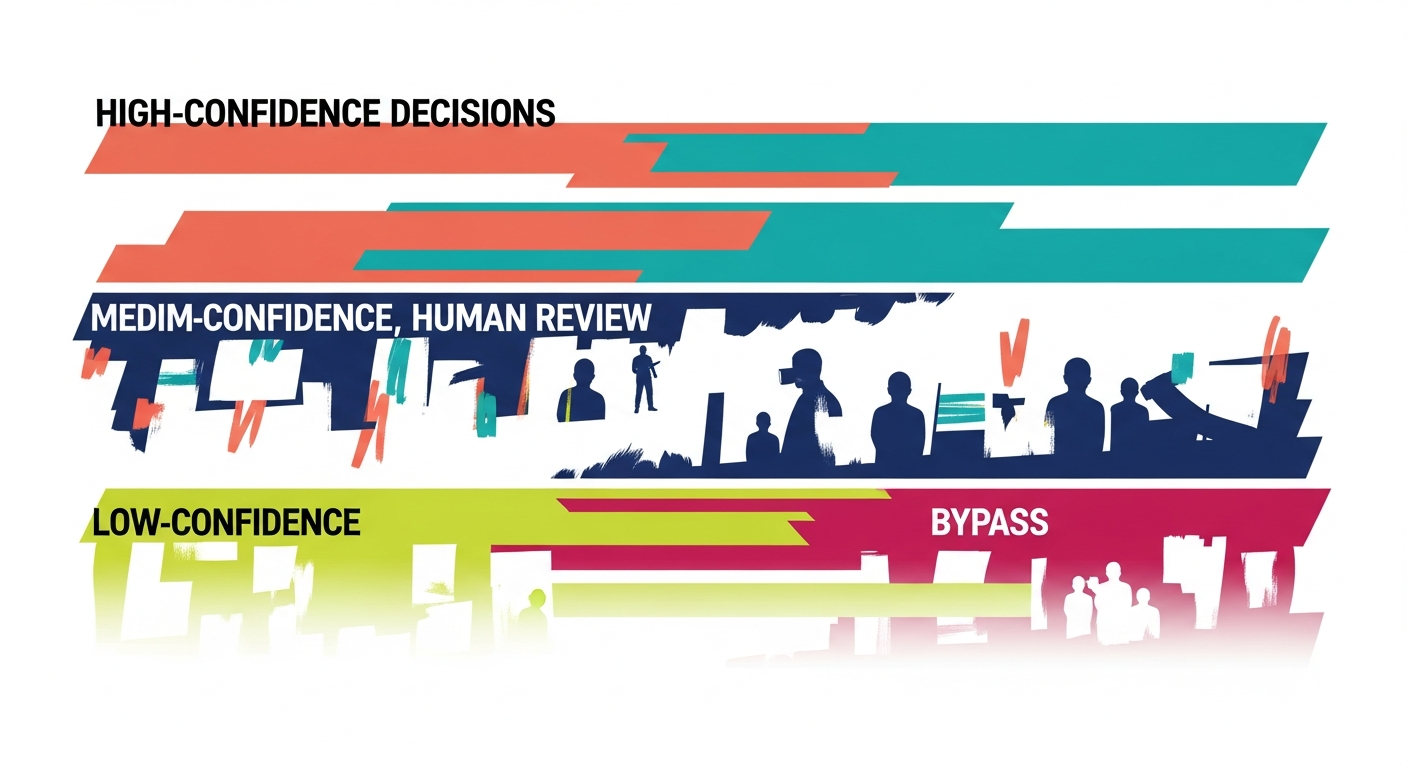
A trading firm's AI execution system works the same way. High-confidence signals execute automatically. Medium-confidence signals require trader approval. Low-confidence signals just surface as suggestions. If the model drifts or the market regime shifts, humans are still in the loop. The system degrades gracefully, not catastrophically.
Graceful degradation also means audit trails, explainability, and fallback procedures. This isn't bureaucratic friction. It's what separates "we deployed AI" from "we deployed AI and can still pass regulatory examination."
The Operator Playbook: Four Diagnostic Questions
If you're evaluating an AI initiative in financial services today, use these four questions to separate projects that will scale from projects that will plateau.
- Is the AI solving a problem on the critical path, or something adjacent? Walk through the actual workflow. If the AI accelerates something that isn't slowing down the business, kill it early.
- Does it require people to change their workflow, or does it integrate into what they already do? If the answer is "we'll train them on the new dashboard," plan for adoption below 40%.
- What's the business outcome you're measuring? Not accuracy. Not model performance. What happens to deal velocity, cycle time, error rate, or cost per transaction? If you can't articulate this before you build, you're building the wrong system.
- What happens if the AI fails tomorrow? Can the human process still work? If the answer is "we'd have to shut down," you're not ready to deploy. Build the fallback first.
The Real Constraint in 2026
Financial services firms have access to the same AI models. The infrastructure is commoditizing. The talent is still scarce, but flowing. What separates the firms building sustained competitive advantage from those burning budget on pilots is organizational clarity: they know exactly which friction points AI removes, they measure business outcome instead of model performance, and they build systems that work if the AI fails.
The regional bank that failed with loan summaries knew how to build machine learning. What they didn't know was that they were solving the wrong problem. That's not a technical mistake. It's an organizational one. And it's the one that's preventing most financial services AI initiatives from scaling. The technical part is done. The hard part—knowing what to build—is just beginning.
The automation layer a founder can see
Branching scenarios. You still own the graph.
We may earn a commission · editorial verdicts remain independent
Weekly Newsletter
AI Adoption Weekly
New research, field guides, training studies, and tool decisions for operators.
No spam. Unsubscribe anytime.
Related Comparisons
Calculator
AI seat cost calculator
List price × headcount. You enter the hours and the operating assumptions.